CM Siddaramaiah Marks 3 Years of Nava Karnataka Rural Push
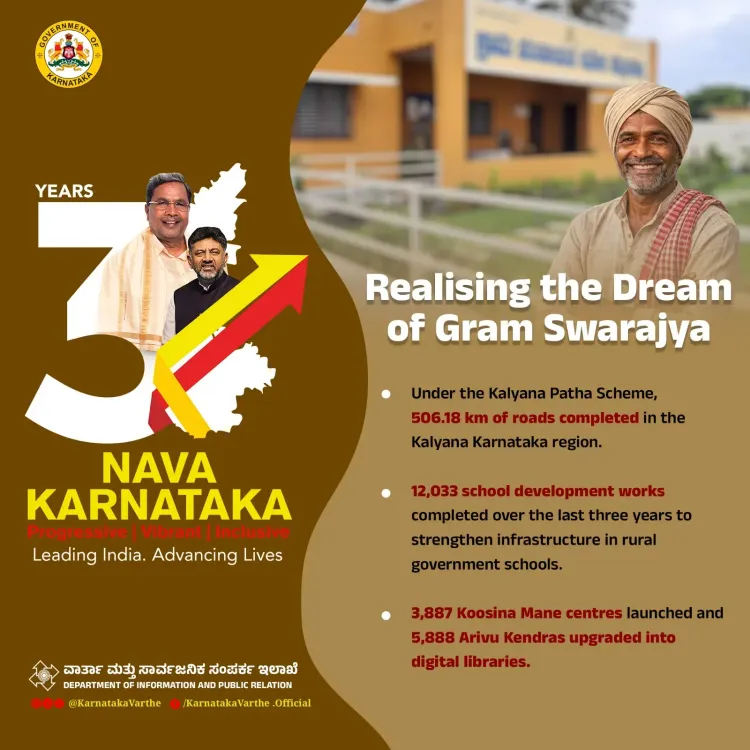
Synopsis
Karnataka Chief Minister Siddaramaiah marked three years of the Nava Karnataka programme on 22 May 2026, highlighting rural road connectivity in Kalyana Karnataka, government school upgrades, and the conversion of Koosina Mane centres and Arivu Kendras into digital libraries as steps toward Gram Swarajya.
Key Takeaways
Karnataka CM Siddaramaiah marked three years of the Nava Karnataka programme on 22 May 2026 .
Road connectivity investments have been directed at Kalyana Karnataka , a constitutionally designated backward region under Article 371(J) .
Koosina Mane community centres and Arivu Kendra hubs have been upgraded into digital libraries, combining infrastructure with knowledge access.
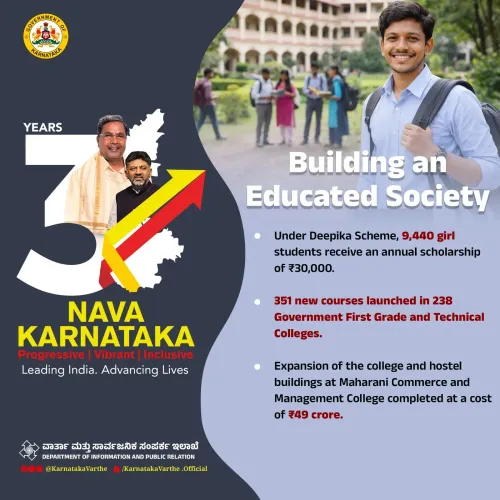
Large-scale development works have been carried out in rural government schools across the state.
The programme is framed as delivering on the Congress party's 2023 election guarantees under the #GuaranteeSarkara tag.
Impact data from upgraded centres and road completion figures are expected in the forthcoming state economic survey .
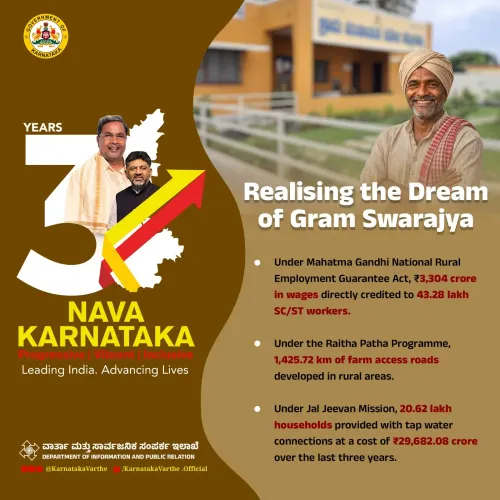
Karnataka Chief Minister Siddaramaiah on Friday, 22 May 2026 highlighted three years of rural development under the Nava Karnataka programme, citing road connectivity in Kalyana Karnataka, school infrastructure upgrades, and the expansion of Koosina Mane centres and Arivu Kendras into digital libraries as markers of progress toward the Gandhian ideal of Gram Swarajya.
Context
Posting under the hashtags #3YearsOfNavaKarnataka and #GuaranteeSarkara, the Chief Minister said the government's focus over the past three years has been on 'strengthening rural infrastructure and bringing the vision of Gram Swarajya closer to reality.' The post marks a political milestone for the Indian National Congress government that took office in Karnataka in May 2023 after winning the state assembly election on a five-guarantee platform.
The #GuaranteeSarkara tag directly invokes the Congress party's 2023 election manifesto, which included explicit commitments to rural education and digital access. Friday's post positions the Nava Karnataka programme as the delivery vehicle for those pledges.
Policy Backdrop
Kalyana Karnataka — the northeastern region of the state formerly known as Hyderabad-Karnataka — receives special constitutional focus under Article 371(J) on account of its historical socio-economic backwardness. Road connectivity investments in the region build on the central Pradhan Mantri Gram Sadak Yojana, launched in 2000, and subsequent state rural connectivity missions.
The upgradation of Koosina Mane community centres and Arivu Kendra learning hubs into digital libraries layers state initiative atop national programmes such as Digital India and Samagra Shiksha, which together aim to extend digital infrastructure and quality schooling to backward districts. Siddaramaiah described the effort as being 'not just about infrastructure — it is about empowering rural Karnataka with knowledge, connectivity, and dignity.'
Stakeholders and Impact
The primary beneficiaries identified in the post are rural communities and village school students across Karnataka, particularly in historically underserved regions. The Chief Minister cited 'large-scale development works in rural government schools' alongside road projects as twin pillars of the programme.
Thousands of Koosina Mane centres and Arivu Kendras have been upgraded, according to the post, though precise figures and aggregate expenditure totals remain to be confirmed through official state records. The Karnataka Rural Development and Panchayat Raj Department oversees implementation of the road and panchayat components.
What's Next
Analysts and civil society groups will look to the forthcoming Karnataka state economic survey for impact data — including literacy rates, school enrollment figures, and digital access metrics — from the upgraded centres. Progress reports on remaining road projects in Kalyana Karnataka are also expected from the Rural Development and Panchayat Raj Department.
The three-year marker positions the Congress government to begin building its re-election narrative ahead of the 2028 Karnataka assembly election, with rural infrastructure and welfare delivery likely to remain central to that argument.
Point of View
Linking welfare guarantees made in 2023 to visible ground-level outcomes. By invoking Gram Swarajya — a concept with deep cross-party legitimacy — the Congress government positions its infrastructure spending as ideologically rooted rather than transactional. The emphasis on Kalyana Karnataka is strategically significant: the region's backwardness has historically been a political liability for incumbent governments, and demonstrable progress there could neutralise a recurring opposition attack line. Whether the claim holds up will depend on the hard numbers that the state economic survey and departmental reports are expected to provide.
NationPress
20 Sept 2026
Frequently Asked Questions
What is the Nava Karnataka programme?
Nava Karnataka is the Karnataka state government's overarching rural development and welfare framework launched after the Congress party came to power in May 2023, encompassing road connectivity, school infrastructure, digital access, and the party's five election guarantees.
What are Arivu Kendras and Koosina Mane centres?
Arivu Kendras are community learning hubs and Koosina Mane centres are local community spaces in Karnataka; the current government has upgraded many of them into digital libraries to improve rural access to knowledge and connectivity.
Why does Kalyana Karnataka receive special development focus?
Kalyana Karnataka, the northeastern region formerly called Hyderabad-Karnataka, is designated for special development attention under Article 371(J) of the Indian Constitution due to its historical socio-economic backwardness relative to the rest of the state.
What is the Gram Swarajya vision Siddaramaiah referred to?
Gram Swarajya is the Gandhian ideal of village self-rule and decentralised governance; successive Indian governments have invoked it to frame rural development and panchayat policies as empowering local communities rather than imposing top-down administration.
What were the Congress party's 2023 Karnataka election guarantees?
The Congress party's 2023 Karnataka election manifesto included five welfare guarantees covering free electricity, cash transfers to women, free bus travel, unemployment allowances, and food security, with rural education and digital access also explicitly committed to under the broader platform.