CM Siddaramaiah marks 3 years in office, lists tech gains
Synopsis
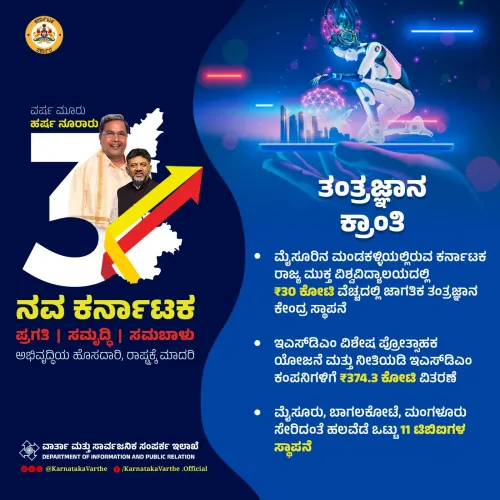
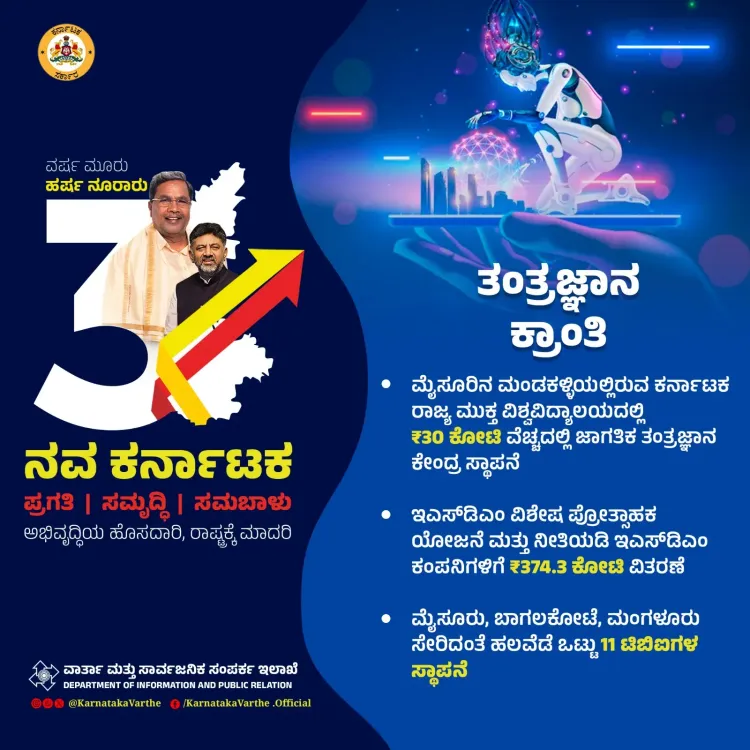
Karnataka Chief Minister Siddaramaiah marked three years of his Congress government on 23 May 2026, listing key technology achievements including a ₹30 crore global tech centre at Mysuru's open university, ₹374.3 crore in ESDM disbursements, and 11 new Technology Business Incubators across the state.
Key Takeaways
Three-year milestone: The Karnataka Congress government led by Siddaramaiah completed three years in office on 23 May 2026 . ₹30 crore tech centre: A Global Technology Centre is being established at the Karnataka State Open University, Mandakalli, Mysuru . ₹374.3 crore ESDM disbursement: Funds distributed to electronics manufacturing companies under the state's special ESDM incentive scheme and policy.
11 TBIs established: Technology Business Incubators set up across multiple locations including Mysuru, Bagalkote , and Mangaluru .
Decentralisation push: Infrastructure investments deliberately spread to tier-2 cities beyond Bengaluru .
Forward pledge: The Chief Minister committed to accelerating governance delivery in the remaining term.
Karnataka Chief Minister Siddaramaiah on Saturday, 23 May 2026, marked the completion of three years of his Congress government in office, crediting every Kannadiga for the administration's achievements and reaffirming commitment to building a 'strong, prosperous and self-respecting Karnataka.'
In a post on X in Kannada, the Chief Minister wrote: 'ರಾಜ್ಯದ ಜನರ ಆಶೀರ್ವಾದದೊಂದಿಗೆ ನಾವು ಅಧಿಕಾರಕ್ಕೆ ಬಂದು ಮೂರು ವರ್ಷಗಳು ಪೂರೈಸಿರುವ ಈ ಸಾರ್ಥಕ ಸಂದರ್ಭದಲ್ಲಿ' ['On this meaningful occasion of completing three years in power with the blessings of the people of the state']. He added that the government takes pride in having walked the talk on every pre-election promise, and pledged that the work of rebuilding Karnataka would accelerate further.
Context
The Congress party returned to power in Karnataka in May 2023, winning a decisive majority in the state assembly elections. Siddaramaiah, who had earlier served as Chief Minister from 2013 to 2018, was sworn in for a second term alongside Deputy Chief Minister D.K. Shivakumar. The government came to office on a platform of five guarantee schemes — Pancha Guarantees — covering free electricity, cash transfers for women, free bus travel, and food security.
The three-year anniversary, marked under the hashtag #3YearsOfNavaKarnataka, is being used by the ruling party to consolidate its governance narrative ahead of the next assembly election cycle. The post lists specific technology and infrastructure achievements as evidence of delivery on pre-poll commitments.
Policy Backdrop
Among the achievements cited, Siddaramaiah highlighted the establishment of a Global Technology Centre at the Karnataka State Open University, Mandakalli, Mysuru, at a cost of ₹30 crore. The Karnataka State Open University is a state-funded institution offering distance education programmes and the new centre is intended to integrate technology infrastructure into higher education outside Bengaluru.
The post also cited a disbursement of ₹374.3 crore to Electronics System Design and Manufacturing (ESDM) companies under the state's special incentive scheme and policy. Karnataka's Industrial Policy 2020-25 had already identified electronics and semiconductor manufacturing as priority sectors, and the ESDM incentive framework — offering capital subsidies and other benefits — is a continuation of that thrust. The state has sought to diversify its economy beyond software services into hardware design and deep-tech manufacturing.
Additionally, the government claimed the establishment of 11 Technology Business Incubators (TBIs) across multiple locations, including Mysuru, Bagalkote, and Mangaluru. TBIs, typically supported under the Department of Science and Technology framework, are set up at academic institutions to nurture early-stage technology startups and have been a tool successive Karnataka governments have used to decentralise innovation infrastructure beyond the state capital.
Stakeholders and Impact
The ESDM disbursements directly benefit electronics manufacturing companies that have applied under the state's incentive framework, with broader implications for employment in the hardware and components sector. The 11 TBIs spread across districts like Bagalkote and Mangaluru signal a deliberate effort to seed startup ecosystems in tier-2 cities rather than concentrating investment in Bengaluru.
University students and researchers at the Karnataka State Open University stand to benefit from the ₹30 crore Global Technology Centre, which is positioned to bridge the gap between distance-learning institutions and emerging technology sectors. For the Congress government, these announcements serve a dual political purpose: demonstrating fiscal delivery and building a record of governance competence for the next electoral cycle.
What's Next
The government's own framing — that its efforts will become 'faster and more effective' going forward — signals further announcements are likely. Watchers will track whether the state budget for 2026-27 expands allocations for the TBI network or revises ESDM incentive thresholds in the upcoming assembly session. The #NavaKarnataka campaign is expected to continue as the administration builds its mid-term narrative, with technology and welfare delivery as twin pillars of its public communication strategy.
Point of View
Leading with quantified technology investments to counter any narrative of a welfare-heavy, fiscally strained administration. By spotlighting ESDM disbursements and TBIs in districts beyond Bengaluru, Siddaramaiah is signalling a broader economic vision that complements the Congress party's social guarantee schemes. The timing also serves a political function: with no immediate election on the horizon, the government is using the milestone to reset its public image and build momentum for the second half of its term. The emphasis on 'faster and more effective' delivery ahead suggests the administration is aware it needs to sharpen execution to sustain its electoral coalition.
NationPress
7 Oct 2026
Frequently Asked Questions
How many years has Siddaramaiah's government completed in Karnataka?
The Siddaramaiah-led Congress government in Karnataka completed three years in office on 23 May 2026 , having come to power after the May 2023 assembly election victory.
What is the Global Technology Centre at Karnataka State Open University?
It is a technology infrastructure facility being established at the Karnataka State Open University in Mandakalli, Mysuru , at a cost of ₹30 crore , aimed at integrating advanced technology resources into distance higher education.
What is the ESDM scheme in Karnataka and how much has been disbursed?
The ESDM (Electronics System Design and Manufacturing) Special Incentive Scheme is a Karnataka state policy offering capital subsidies and benefits to electronics manufacturing companies. The government has disbursed ₹374.3 crore to ESDM companies under this framework.
How many Technology Business Incubators has Karnataka set up?
The Karnataka government has established 11 Technology Business Incubators (TBIs) across the state, including in Mysuru, Bagalkote , and Mangaluru , to support early-stage technology startups.
What is NavaKarnataka?
NavaKarnataka ('New Karnataka') is the governance and communication campaign of the Siddaramaiah-led Congress government, used to brand its development agenda and mark milestones such as the three-year anniversary of the administration.