CM Siddaramaiah Marks 3 Years, Lists Karnataka Gains
Synopsis
The Chief Minister's Office of Karnataka marked three years of the Congress government on 23 May 2026, crediting all achievements to the people and listing key deliverables including a ₹30 crore tech centre at KSOU Mysuru, ₹374.3 crore disbursed to ESDM firms, and 11 new Technology Business Incubators across the state.
Key Takeaways
The Karnataka Congress government completed three years in office on 23 May 2026 , marking the occasion with a list of policy achievements under the #NavaKarnataka banner.
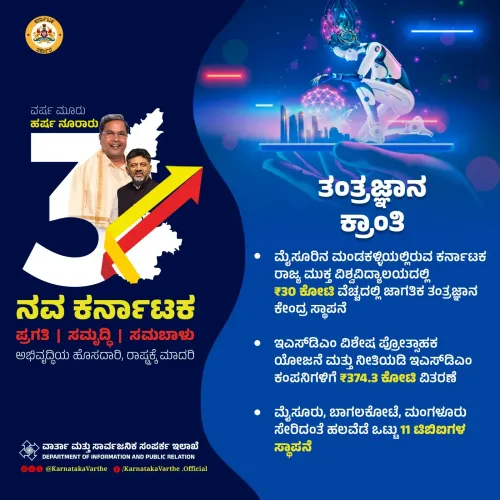
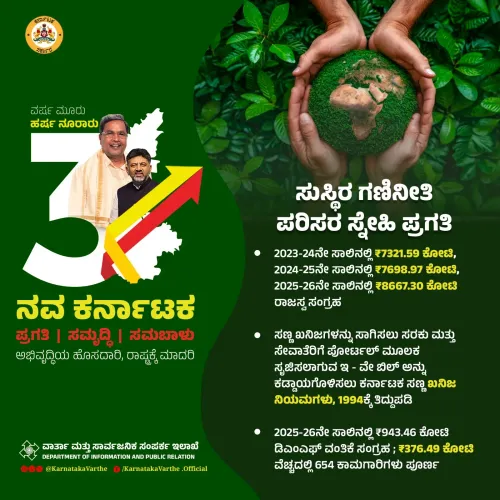
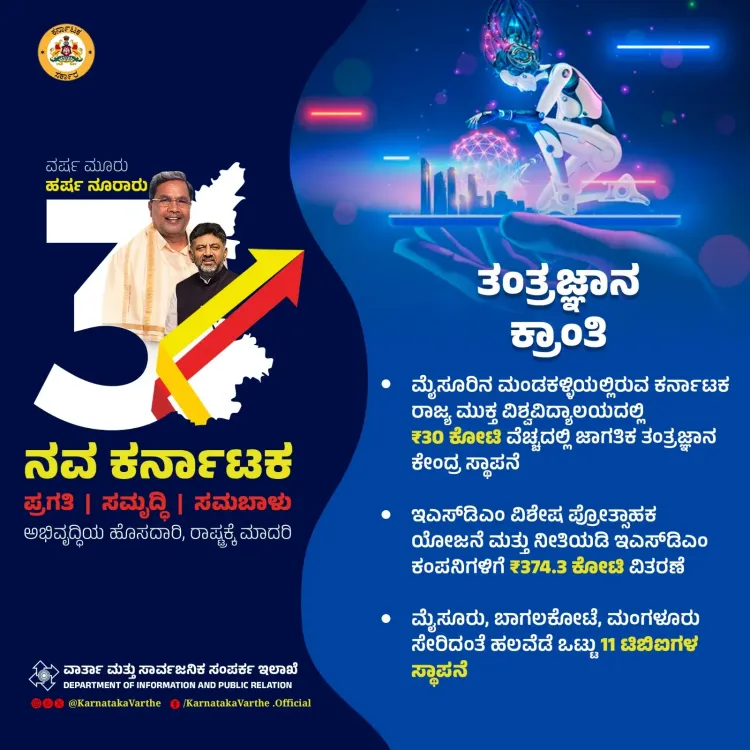
A Global Technology Centre is being established at the Karnataka State Open University, Mandakalli, Mysuru , at a cost of ₹30 crore . ₹374.3 crore has been distributed to ESDM (Electronics System Design and Manufacturing) companies under a special incentive scheme and policy.
11 Technology Business Incubators (TBIs) have been set up across the state, including in Mysuru , Bagalkot , and Mangaluru .
The government stated it had honoured all pre-election promises and pledged to accelerate its 'Nava Karnataka' rebuilding agenda in the remaining term.
The Chief Minister's Office of Karnataka on Saturday, 23 May 2026, marked the completion of three years of the Congress government in the state, crediting every achievement of the administration to the people of Karnataka and reaffirming its commitment to fulfilling pre-election promises.
Context
The post, shared under the hashtags #3YearsOfNavaKarnataka and #NavaKarnataka, stated: 'On this meaningful occasion of completing three years in power with the blessings of the people of the state, we dedicate the credit for all achievements of our government to every Kannadiga.' The message emphasised that the government had honoured every promise made before the election, describing this as a matter of pride.
The Congress party returned to power in Karnataka after winning the May 2023 assembly elections, ending the BJP's tenure. Siddaramaiah was sworn in as Chief Minister, with D K Shivakumar as Deputy Chief Minister, forming a government that came in on the back of five guarantee schemes — Gruha Lakshmi, Gruha Jyoti, Anna Bhagya, Yuva Nidhi, and Shakti — that became the centrepiece of the Congress campaign.
Policy Backdrop
Among the specific achievements highlighted in the post, the government cited the establishment of a Global Technology Centre at the Karnataka State Open University (KSOU) in Mandakalli, Mysuru, at a cost of ₹30 crore. The centre is intended to expand technology access and digital education infrastructure through one of the state's major open-learning institutions.
The post also noted the disbursement of ₹374.3 crore to Electronics System Design and Manufacturing (ESDM) companies under a dedicated special incentive scheme and policy. Karnataka has long positioned itself as a hub for electronics manufacturing, and the ESDM policy is part of broader efforts to attract investment in semiconductor and electronics value chains beyond the IT services sector.
Additionally, the government listed the establishment of 11 Technology Business Incubators (TBIs) across multiple locations, including Mysuru, Bagalkot, and Mangaluru. TBIs are state-supported institutions designed to nurture startups and technology enterprises, particularly outside the Bengaluru metropolitan corridor, addressing longstanding concerns about uneven regional development in the state's innovation economy.
Stakeholders and Impact
The measures listed touch several distinct constituencies. Students and faculty at KSOU stand to benefit from improved digital infrastructure, while electronics manufacturers and component firms gain through the ESDM incentive payouts. Entrepreneurs and early-stage startups in Tier-2 and Tier-3 cities of Karnataka are the primary intended beneficiaries of the expanded TBI network.
The government's framing — dedicating achievements to 'every Kannadiga' — signals a broad-based political messaging strategy aimed at consolidating the Congress's support base ahead of future electoral cycles, including local body elections and the next state assembly polls.
What's Next
The CMO's post indicated that the government's efforts in rebuilding a 'strong, prosperous, and self-respecting Karnataka' (sashakta, samruddha, swabhimani Karnataka) would 'accelerate and become more effective going forward.' This suggests further policy announcements and scheme expansions are likely in the months ahead as the government enters the second half of its term.
With the three-year milestone serving as a political benchmark, the administration is expected to intensify delivery on its guarantee schemes and infrastructure commitments to sustain voter confidence heading into the back half of its five-year mandate.
Point of View
Addressing a persistent criticism that Karnataka's growth story is geographically lopsided. Dedicating achievements to 'every Kannadiga' is a rhetorical bridge to the guarantee-scheme voter base while simultaneously courting an investor and startup audience. How the government translates these milestone claims into measurable ground-level outcomes will determine whether the 'Nava Karnataka' frame holds electoral weight by 2028.
NationPress
7 Oct 2026
Frequently Asked Questions
How many years has the Karnataka Congress government completed in 2026?
The Karnataka Congress government completed three years in office as of 23 May 2026 , having come to power after winning the May 2023 state assembly elections.
What is the Global Technology Centre being set up at KSOU Mysuru?
A Global Technology Centre is being established at the Karnataka State Open University (KSOU) in Mandakalli, Mysuru , at a cost of ₹30 crore , aimed at expanding digital and technology education infrastructure.
What is the ESDM incentive scheme in Karnataka?
Karnataka's ESDM (Electronics System Design and Manufacturing) Special Incentive Scheme and Policy provides financial support to electronics manufacturing companies; the government has disbursed ₹374.3 crore to ESDM firms under this policy over the past three years.
How many Technology Business Incubators has Karnataka set up?
The Karnataka government has established 11 Technology Business Incubators (TBIs) across the state, including in cities such as Mysuru , Bagalkot , and Mangaluru , to support startups beyond Bengaluru.
What is Nava Karnataka?
Nava Karnataka ('New Karnataka') is the Congress government's overarching governance and branding framework, representing its vision of building a 'strong, prosperous, and self-respecting' Karnataka through welfare schemes, infrastructure, and technology investment.