CM Siddaramaiah marks 3 years with green push in Karnataka
Synopsis
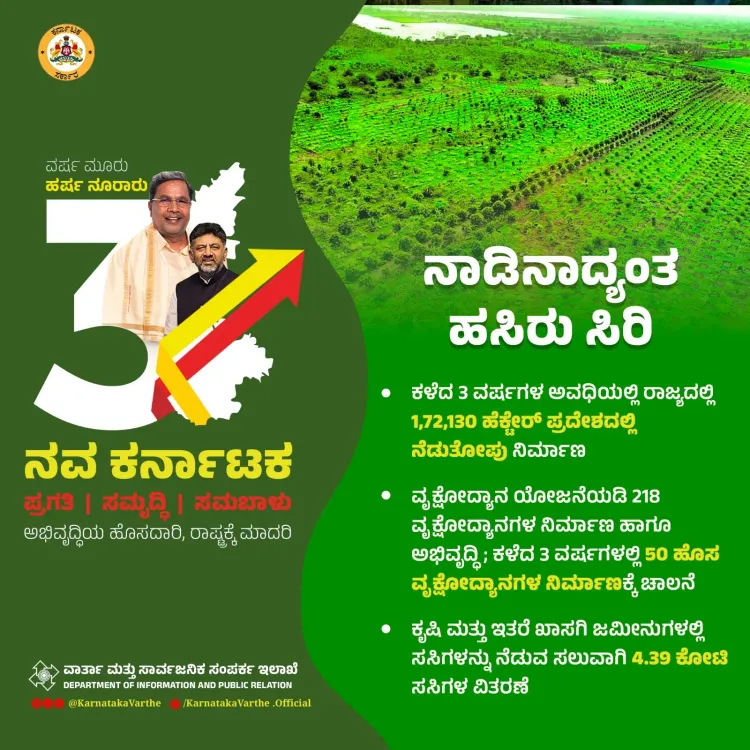
The Chief Minister's Office of Karnataka marked three years of the Siddaramaiah-led Congress government on 23 May 2026, highlighting 1,72,130 hectares of new plantations, 218 tree parks under Vrikshodyana Yojane, and distribution of 4.39 crore saplings to farmers and private landowners.
Key Takeaways
The Karnataka Congress government completed three years in office on 23 May 2026 , marking the milestone under the #NavaKarnataka banner.
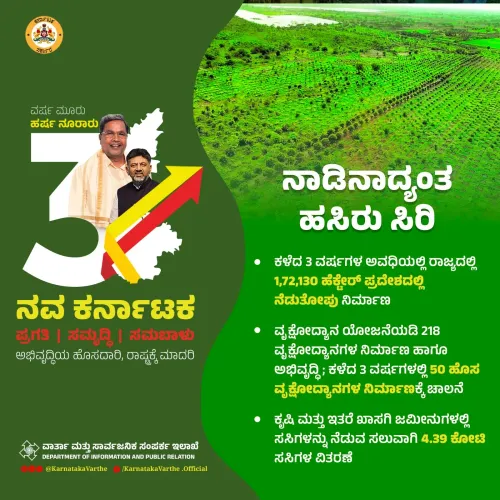
New plantations covering 1,72,130 hectares were created across the state over the three-year period.
Under the Vrikshodyana Yojane , 218 tree parks have been developed, including 50 new parks initiated in the last three years.
4.39 crore saplings were distributed for planting on agricultural and other private lands.
The government pledged that its reconstruction of a 'strong, prosperous and self-respecting Karnataka' would accelerate going forward.
Survival-rate data for distributed saplings and the next annual forest survey will be key accountability benchmarks to watch.
The Chief Minister's Office of Karnataka marked three years of the Congress-led state government on Saturday, 23 May 2026, crediting every Kannadiga for the administration's achievements and reaffirming its commitment to pre-election promises — including a significant push on afforestation and green infrastructure across the state.
The post, shared in Kannada, stated: 'ರಾಜ್ಯದ ಜನರ ಆಶೀರ್ವಾದದೊಂದಿಗೆ ನಾವು ಅಧಿಕಾರಕ್ಕೆ ಬಂದು ಮೂರು ವರ್ಷಗಳು ಪೂರೈಸಿರುವ ಈ ಸಾರ್ಥಕ ಸಂದರ್ಭದಲ್ಲಿ' ('On this meaningful occasion of completing three years in power with the blessings of the people of the state'). The office credited the credit for all government achievements to 'every Kannadiga' and pledged that ongoing efforts would become 'faster and more effective' going forward.
Context
The Karnataka Congress government, led by Chief Minister Siddaramaiah, took office in May 2023 following a decisive state assembly election victory. The three-year milestone is being marked under the hashtag #3YearsOfNavaKarnataka, anchoring it to the government's broader Nava Karnataka (New Karnataka) development vision. The office framed the anniversary not as a celebration of leadership but as a report card to citizens.
Policy Backdrop
Among the key environmental deliverables highlighted, the government cited plantation drives covering 1,72,130 hectares across the state over three years. Under the Vrikshodyana Yojane — a state scheme for creating and upgrading tree parks and gardens — 218 tree parks have been developed, with 50 new parks initiated in the last three years alone.
Additionally, the government distributed 4.39 crore saplings for planting on agricultural and other private lands. This agroforestry component builds on Karnataka's earlier green-cover programmes from the 2010s, including the Hasiru Karnataka and Krishi Bhagya schemes, which promoted tree cover on farmland and watershed areas.
State governments across India have scaled up compensatory afforestation programmes in recent years to meet national green-cover targets and align with climate commitments. Karnataka's post-2023 focus on measurable plantation targets — hectares covered, saplings distributed, parks built — fits this wider pattern of states seeking visible environmental deliverables.
Stakeholders and Impact
The sapling distribution programme directly benefits farmers and rural households, providing free planting material for agricultural and private land. Urban local bodies are the primary beneficiaries of the Vrikshodyana Yojane park development push, which expands green recreational space in towns and cities.
The Karnataka Forest Department is the nodal agency responsible for executing afforestation drives, overseeing sapling distribution logistics, and maintaining the new plantations. The scale of distribution — 4.39 crore saplings — places a significant operational and monitoring burden on the department to ensure survival rates justify the investment.
What's Next
The government's post signalled an acceleration of efforts, stating the work of rebuilding a 'strong, prosperous and self-respecting Karnataka' would proceed 'faster and more effectively' ahead. Analysts and civil society groups are likely to watch the next annual forest survey data closely to assess actual green-cover gains against the plantation figures cited.
A mid-term review of sapling survival rates — a standard accountability measure for large-scale plantation programmes — will be a key indicator of whether the 1,72,130-hectare plantation drive translates into durable forest and green cover for Karnataka.
Point of View
Parks built, saplings distributed — reflects a deliberate Congress strategy to anchor the Nava Karnataka narrative in tangible, citizen-visible deliverables rather than purely fiscal or welfare data. By attributing all credit to 'every Kannadiga,' the communication is calibrated to reinforce a participatory governance image ahead of the political cycle. However, the absence of survival-rate or third-party verification data for the plantation figures means the claims remain self-reported, leaving room for opposition scrutiny. The move mirrors a broader national trend of state governments using green-cover statistics as soft-power governance metrics.
NationPress
7 Oct 2026
Frequently Asked Questions
How many years has the Karnataka Congress government completed in 2026?
The Karnataka Congress government, led by Chief Minister Siddaramaiah, completed three years in office in May 2026, having come to power after the state assembly elections in May 2023.
What is the Vrikshodyana Yojane scheme in Karnataka?
Vrikshodyana Yojane is a Karnataka state government scheme for creating and upgrading tree parks and gardens to expand green spaces in urban and rural areas. As of May 2026, 218 tree parks have been developed under it, with 50 new parks initiated in the last three years.
How many saplings did the Karnataka government distribute in three years?
The Karnataka government distributed 4.39 crore saplings for planting on agricultural and other private lands over the three years between May 2023 and May 2026.
What is Nava Karnataka?
Nava Karnataka, meaning 'New Karnataka,' is the development vision of the Siddaramaiah-led Congress government, framing its governance agenda around building a strong, prosperous, and self-reliant state.
How much area has Karnataka covered with new plantations under the current government?
According to the Chief Minister's Office, new plantations covering 1,72,130 hectares were created across Karnataka during the three years from May 2023 to May 2026.