CM Siddaramaiah marks 3 years with sugarcane price hike
Synopsis
The Chief Minister's Office of Karnataka marked three years of the Siddaramaiah government on 23 May 2026, announcing an additional sugarcane price of up to ₹3,300 per tonne for 2025-26, ₹8.03 crore released for sugar-mill roads, and fixed crushing dates to boost production.
Key Takeaways
The Siddaramaiah-led Karnataka Congress government completed three years in office on 23 May 2026 , marking the occasion under the Nava Karnataka banner.
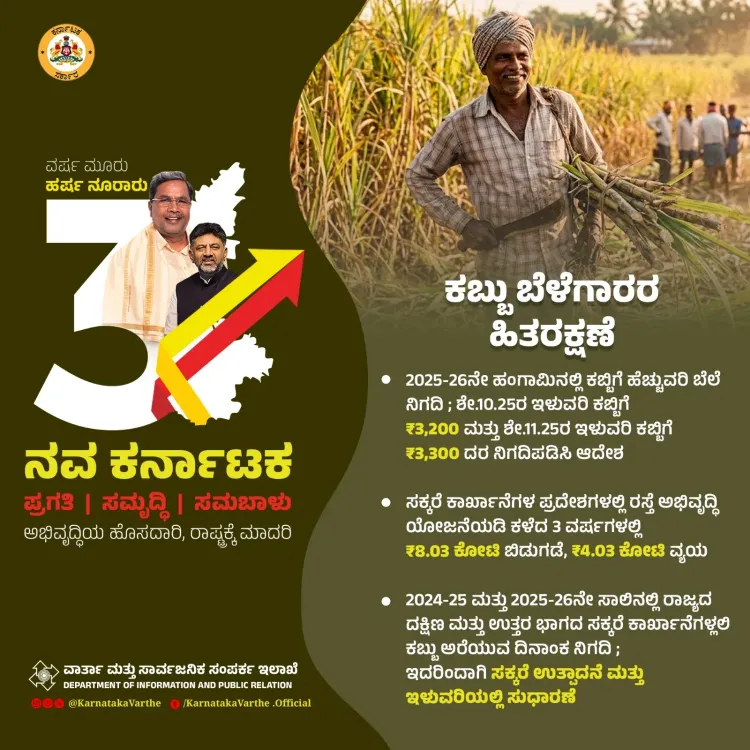
An additional sugarcane price of ₹3,200 per tonne has been fixed for 10.25% recovery and ₹3,300 per tonne for 11.25% recovery for the 2025-26 season . ₹8.03 crore was released over three years for road development in sugar-mill areas; ₹4.03 crore has been spent so far.
Crushing start dates for sugar mills in southern and northern Karnataka have been fixed for 2024-25 and 2025-26 , improving production and recovery yields.
The government credited all achievements to 'every Kannadiga' and pledged faster implementation in the years ahead.
The Chief Minister's Office of Karnataka marked three years of the Siddaramaiah-led Congress government on Saturday, 23 May 2026, crediting every Kannadiga for the administration's achievements and reaffirming its commitment to pre-election promises — with a focus on sugarcane farmer welfare and sugar-mill infrastructure.
Context
The post, shared under the hashtags #3YearsOfNavaKarnataka and #NavaKarnataka, states: 'On this meaningful occasion of completing three years in power with the blessings of the people of the state, we dedicate the credit for all the achievements of our government to every Kannadiga.' The message adds that the government takes pride in having 'walked the talk' on every promise made before the elections.
The announcement lists concrete policy actions in the sugarcane sector as evidence of that commitment. For the 2025-26 crushing season, the government has fixed an additional price of ₹3,200 per tonne for sugarcane with a recovery rate of 10.25 per cent and ₹3,300 per tonne for cane with a recovery rate of 11.25 per cent.
Policy Backdrop
Karnataka has a long-standing practice of supplementing the central government's Fair and Remunerative Price (FRP) with a state-level additional price linked to recovery rates at individual mills. The Siddaramaiah government, which came to power in May 2023 on a farmer-welfare platform, formalised this mechanism as part of its Nava Karnataka — or 'New Karnataka' — reconstruction agenda.
Beyond pricing, the government says it has released ₹8.03 crore over the past three years under a road development scheme covering areas around sugar factories, of which ₹4.03 crore has been spent. Additionally, crushing start dates for sugar mills in both the southern and northern zones of the state have been fixed for 2024-25 and 2025-26, a step the government says has improved sugar production and recovery yields.
Stakeholders and Impact
The primary beneficiaries are sugarcane farmers in Karnataka's rain-fed and irrigated belts — particularly in the northern districts where cooperative and private mills are concentrated — as well as the mills themselves, which gain operational certainty from pre-fixed crushing calendars. Improved road connectivity around factories also reduces post-harvest losses and transport costs for growers.
The broader Nava Karnataka framework positions these interventions as part of a larger promise of building a 'strong, prosperous, and self-respecting Karnataka' (sashakta, samruddha, swabhimani Karnataka). The government's three-year scorecard in the sugar sector serves as a political signal ahead of future electoral cycles.
What's Next
The government has signalled that its efforts will become 'faster and more effective' going forward. Attention will now turn to the pricing order for the 2026-27 crushing season, any supplementary budget allocations for sugar-mill road works, and whether the administration can sustain its delivery pace as it moves into the second half of its term.
Point of View
Road funds released, crushing dates fixed — the administration is attempting to convert welfare delivery into durable electoral goodwill among farming communities. The sugar sector focus is telling: Karnataka's northern belt, where mills are dense, is also a region of intense political competition, making these announcements structurally significant beyond their face value. The pledge that efforts will be 'faster and more effective' going forward signals the government is already in campaign-preparation mode.
NationPress
13 Oct 2026
Frequently Asked Questions
What is the new sugarcane price fixed by the Karnataka government for 2025-26?
The Karnataka government has fixed an additional price of ₹3,200 per tonne for sugarcane with a 10.25% recovery rate and ₹3,300 per tonne for cane with an 11.25% recovery rate for the 2025-26 crushing season.
How much has the Karnataka government spent on roads near sugar mills?
The Karnataka government released ₹8.03 crore for road development in sugar-mill areas over three years, of which ₹4.03 crore has been spent so far.
What is Nava Karnataka?
Nava Karnataka, meaning 'New Karnataka,' is the slogan and development vision of the current Siddaramaiah-led Congress government, framing its governance agenda around rebuilding the state as strong, prosperous, and self-reliant.
When did the Siddaramaiah government complete three years in power?
The Siddaramaiah-led Karnataka Congress government completed three years in office on 23 May 2026, having come to power after the May 2023 assembly elections.
How does Karnataka fix sugarcane prices for farmers?
Karnataka supplements the central government's Fair and Remunerative Price with a state-level additional price linked to recovery rates at individual sugar mills, issued through a seasonal government order before each crushing season begins.