CM Siddaramaiah marks 3 years with water, property wins
Synopsis
The Chief Minister's Office of Karnataka marked three years in power on 23 May 2026, highlighting 2,148 km of new drinking water pipelines, nearly one lakh household tap connections, over ₹2,400 crore in urban water projects, and the launch of an online B-Khata to A-Khata property conversion portal under the Nava Karnataka governance drive.
Key Takeaways
The Karnataka Congress government completed three years in office on 23 May 2026 , marking the occasion under the #NavaKarnataka banner.
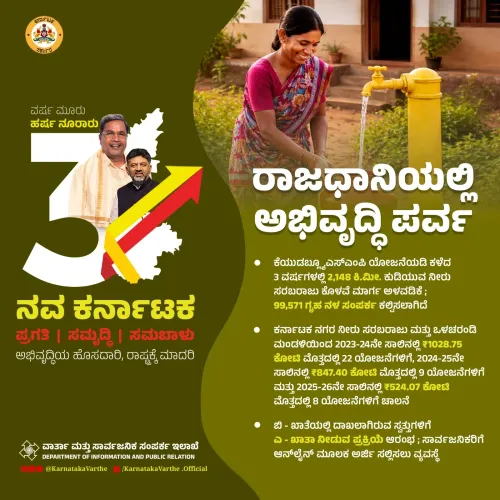
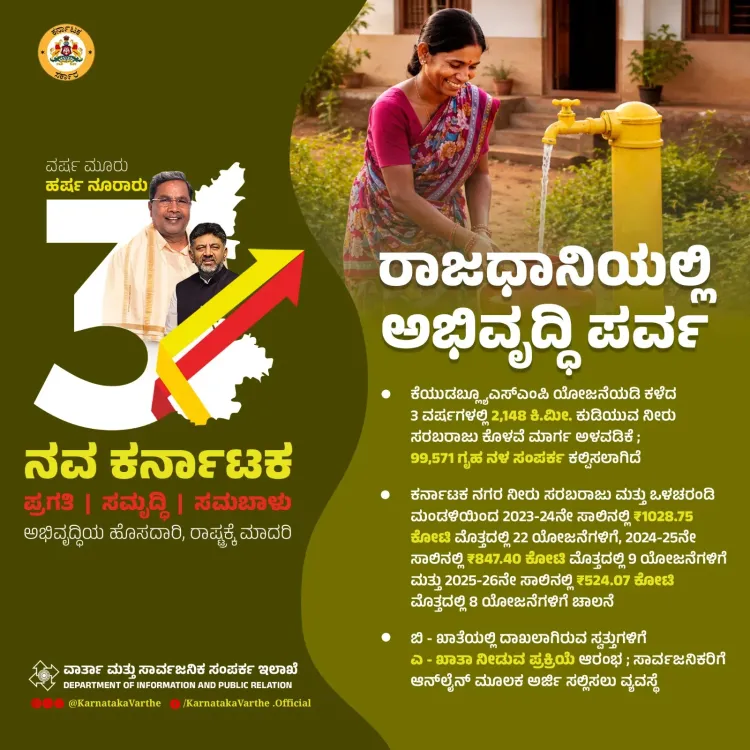
Under KUWSMP , 2,148 km of drinking water pipelines were laid and 99,571 household tap connections were established in three years.
The Karnataka Urban Water Supply and Drainage Board sanctioned 39 projects worth a combined ₹2,400+ crore across financial years 2023-24 , 2024-25 , and 2025-26 .
The government initiated the conversion of B-Khata properties to A-Khata status, with an online application portal now available to citizens.
The CMO credited every Kannadiga for the government's achievements and pledged faster, more effective delivery in the remaining term.
The Chief Minister's Office of Karnataka on Saturday, 23 May 2026 marked the completion of three years in power, crediting every Kannadiga for the government's achievements and reaffirming its commitment to delivering on all pre-election promises under the Nava Karnataka vision.
The post, written in Kannada, declared: 'ರಾಜ್ಯದ ಜನರ ಆಶೀರ್ವಾದದೊಂದಿಗೆ ನಾವು ಅಧಿಕಾರಕ್ಕೆ ಬಂದು ಮೂರು ವರ್ಷಗಳು ಪೂರೈಸಿರುವ ಈ ಸಾರ್ಥಕ ಸಂದರ್ಭದಲ್ಲಿ' ('On this fulfilling occasion of completing three years in power with the blessings of the people of the state'). The office attributed all credit to citizens and pledged that the work of rebuilding a 'strong, prosperous, and self-respecting Karnataka' would accelerate further.
Context
Chief Minister Siddaramaiah's Congress government took office in May 2023 after winning the Karnataka assembly elections on a platform of urban infrastructure expansion and civic governance reforms. The three-year milestone post lists specific infrastructure and property-record achievements as evidence of promise-keeping, framed under the #NavaKarnataka and #3YearsOfNavaKarnataka campaign.
The announcement comes as the government prepares to enter the second half of its five-year term, a period typically marked by intensified delivery ahead of the next electoral cycle.
Policy Backdrop
Under the Karnataka Urban Water Supply Modernisation Project (KUWSMP), the government states that 2,148 kilometres of drinking water supply pipelines have been laid over the past three years, along with 99,571 household tap connections established across urban and peri-urban areas. The KUWSMP has roots in earlier World Bank-supported phases from the 2010s, aimed at addressing chronic drinking-water shortages in Karnataka's towns.
The Karnataka Urban Water Supply and Drainage Board (KUWSDB) has sanctioned projects worth ₹1,028.75 crore across 22 schemes in 2023-24, ₹847.40 crore across 9 schemes in 2024-25, and ₹524.07 crore across 8 schemes in 2025-26 — a combined outlay of over ₹2,400 crore across three financial years. These investments continue the state's pattern of front-loading capital expenditure on water networks to deliver measurable civic outcomes.
Separately, the government has initiated the conversion of B-Khata properties to A-Khata status, a long-standing demand of lakhs of urban property owners whose assets were listed as unauthorised or on revenue sites. An online application portal has been set up for citizens to apply for this conversion. A-Khata status entitles owners to formal municipal services and makes properties eligible for bank loans, addressing a significant barrier to financial inclusion for urban households.
Stakeholders and Impact
Urban households across Karnataka's towns and cities are the primary beneficiaries of the water supply expansion, with nearly one lakh new tap connections providing direct access to piped drinking water. The pipeline network additions are intended to reduce dependence on tanker water and groundwater, particularly in rapidly growing secondary cities.
B-Khata property owners — a large constituency in cities like Bengaluru, Mysuru, and Hubballi-Dharwad — stand to gain formal land-title recognition through the A-Khata conversion process. Regularisation of property records is also expected to improve municipal revenue collections and widen the property tax base for urban local bodies.
What's Next
The government has signalled that the pace of delivery will increase going forward, with the remaining sanctioned water projects under KUWSDB expected to move toward completion through 2026. The functionality and public uptake of the new online A-Khata application portal will be a key indicator of how effectively the property regularisation drive translates into ground-level change.
With the Nava Karnataka brand now entering its consolidation phase, the administration's ability to demonstrate completed — not just sanctioned — infrastructure will shape its political narrative ahead of the next assembly election.
Point of View
Anchoring the Nava Karnataka brand to tangible civic deliverables rather than aspirational language — a strategic shift from promise to proof. By highlighting pipeline kilometres, household connections, and crore-wise project sanctions, the CMO is building a quantitative narrative that is harder to contest than qualitative claims. The A-Khata conversion drive is particularly significant: it targets a politically sensitive urban constituency that has long felt excluded from formal property systems, and digitising the process signals an attempt to reduce rent-seeking at the civic level. As the government crosses the midpoint of its term, the pressure to move from sanctions to completions will define whether the Nava Karnataka story holds through the next election cycle.
NationPress
20 Sept 2026
Frequently Asked Questions
How many years has the Karnataka Congress government completed in 2026?
The Karnataka Congress government led by Chief Minister Siddaramaiah completed three years in office in May 2026 , having assumed power after winning the 2023 state assembly elections.
What is KUWSMP and what has it achieved in Karnataka?
KUWSMP (Karnataka Urban Water Supply Modernisation Project) is a state scheme to expand piped drinking water networks. The government states that over the past three years it has laid 2,148 km of pipelines and established 99,571 household tap connections under this project.
What is the difference between A-Khata and B-Khata in Karnataka?
In Karnataka's property record system, A-Khata denotes a fully regularised property title that is eligible for bank loans and municipal services, while B-Khata covers properties on revenue sites or those considered unauthorised. The current government has begun converting B-Khata properties to A-Khata status through an online portal.
How much has Karnataka spent on urban water supply projects in the last three years?
The Karnataka Urban Water Supply and Drainage Board sanctioned projects worth ₹1,028.75 crore in 2023-24, ₹847.40 crore in 2024-25, and ₹524.07 crore in 2025-26, totalling over ₹2,400 crore across 39 projects .
How can I apply for A-Khata conversion in Karnataka?
The Karnataka government has set up an online application portal for citizens to apply for the conversion of B-Khata properties to A-Khata status. Applicants can submit their requests digitally without visiting government offices.