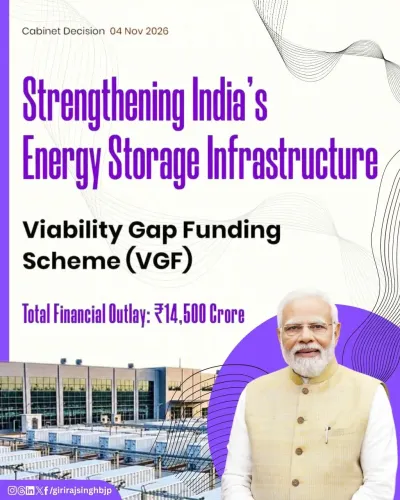
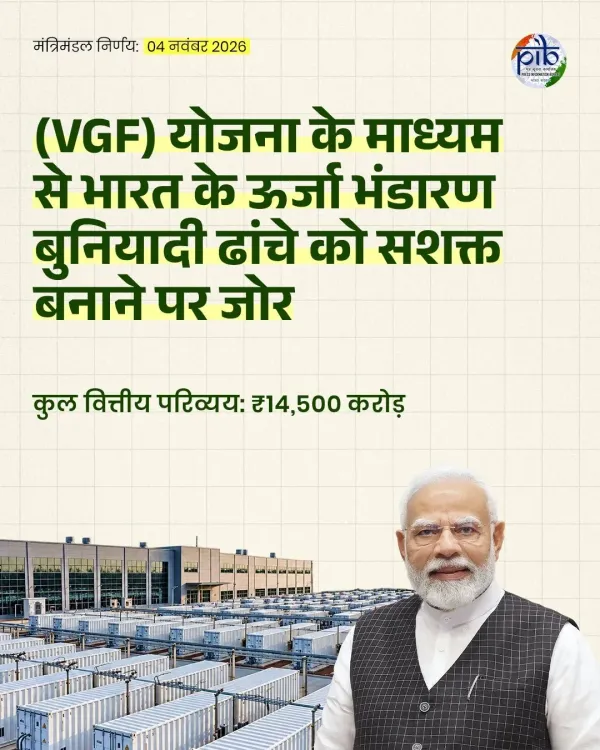
Cabinet Clears ₹14,500 Cr Energy Storage Scheme: Shekhawat
Synopsis
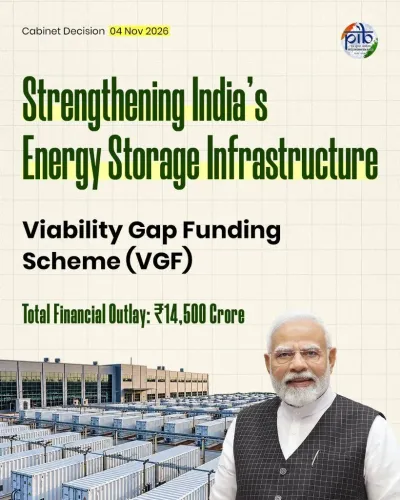
The Union Cabinet has approved a ₹14,500 crore scheme to develop 92 GWh of energy storage capacity in India by 2030-31, reinforcing the country's clean energy transition and grid security goals under PM Modi.
Key Takeaways
The Union Cabinet approved a ₹14,500 crore energy storage scheme on November 4, 2026 .
The scheme targets 92 GWh of new grid-scale storage capacity to be developed by 2030-31 .
The move directly supports India's Panchamrit commitment of 500 GW non-fossil fuel capacity by 2030, made at COP26.
It builds on the PLI scheme for Advanced Chemistry Cells (2021), which aimed to build domestic battery manufacturing capability.
Renewable energy developers and power distribution companies are the primary direct beneficiaries.
Issuance of tenders and year-on-year commissioning progress will be the key metrics to watch.
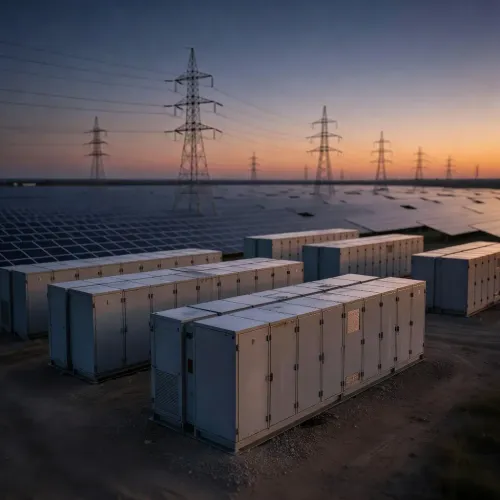
India's grid is about to get a major buffer. The Union Cabinet, under Prime Minister Narendra Modi, has approved a ₹14,500 crore energy storage scheme aimed at building 92 GWh of new storage capacity across the country by 2030-31 — a decision that directly targets one of renewable energy's most stubborn problems: the lights go out when the sun sets and the wind stops.
Union Culture and Tourism Minister Gajendra Singh Shekhawat posted about the cabinet decision on Wednesday, November 4, 2026, highlighting it as a step toward 'promoting clean energy and strengthening India's energy security' — स्वच्छ ऊर्जा को बढ़ावा देने और भारत की ऊर्जा सुरक्षा को मजबूत करने में महत्वपूर्ण भूमिका (playing a vital role in promoting clean energy and strengthening India's energy security).
Why 92 GWh and Why Now
India's solar and wind buildout has been among the fastest in the world, but speed alone creates its own crisis. Without storage, surplus daytime solar power is curtailed and peak evening demand goes unmet — a classic intermittency trap. Grid-scale battery storage is the bridge, and 92 GWh of new capacity by 2030-31 would represent a transformational addition to what currently exists. The timing connects directly to India's Panchamrit commitments made at COP26 in 2021, which included a target of 500 GW of non-fossil fuel electricity capacity by 2030. Hitting that number without matching storage would leave the grid fragile. This scheme is, in effect, the insurance policy on that pledge.From PLI Cells to Cabinet-Backed Storage Scale
The government's energy storage push is not new. The Production Linked Incentive (PLI) scheme for Advanced Chemistry Cells, approved in 2021, was designed to seed domestic battery manufacturing and reduce India's dependence on imported cells — primarily from China. The latest ₹14,500 crore approval layers a demand-side deployment push on top of that supply-side manufacturing bet. Renewable energy developers and power distribution companies — the two groups most directly affected by intermittency — stand to benefit most immediately. Discoms struggling with peak-hour shortfalls could lean on commissioned storage assets rather than expensive and polluting peaking gas plants.Tenders, Timelines, and What Gets Watched Next
A cabinet approval is a starting gun, not a finish line. The critical next steps are the issuance of tenders under the scheme, the pace at which projects get awarded, and whether commissioned capacity tracks against the 92 GWh target on a year-by-year basis. India's renewable sector has seen ambitious targets announced before; the credibility of this approval will be tested in procurement windows over the next two to three years. For now, the cabinet decision plants a large stake in the ground: India is making energy storage a national infrastructure priority, not an afterthought.Point of View
500 crore energy storage approval signals that the Modi government is moving from renewable capacity announcements to solving the harder, structural problem of grid reliability — storage is where the energy transition either holds or unravels. Linking this decision to the Panchamrit framework gives it diplomatic credibility beyond domestic politics. However, India has a well-documented gap between cabinet approvals and on-ground project commissioning; the real test will be whether tender pipelines are cleared and capacity is added on schedule. If it tracks, this could become a template for how emerging economies underwrite the storage gap at scale.
NationPress
5 Nov 2026
Frequently Asked Questions
What is the Cabinet's new energy storage scheme in India?
The Union Cabinet approved a ₹14,500 crore scheme on November 4, 2026, to develop 92 GWh of new grid-scale energy storage capacity in India by 2030-31, supporting the country's renewable energy transition.
What is 92 GWh energy storage and why does India need it?
92 GWh refers to the total energy that the new storage systems will be able to hold and dispatch. India needs large-scale storage because solar and wind power are intermittent — storage ensures the electricity generated during the day is available during peak evening demand.
How does the energy storage scheme connect to India's 2030 climate targets?
India committed at COP26 in 2021 to achieving 500 GW of non-fossil fuel electricity capacity by 2030. Grid-scale storage is essential to that goal, as it prevents renewable energy from being wasted and keeps the grid stable.
What is the PLI scheme for Advanced Chemistry Cells?
The Production Linked Incentive scheme for Advanced Chemistry Cells, approved in 2021, provides financial incentives to manufacturers to produce battery storage technology domestically in India, reducing import dependence.
Who will benefit from India's new energy storage scheme?
Renewable energy developers and power distribution companies (discoms) are the primary beneficiaries, as storage helps them manage supply gaps, reduce curtailment of solar and wind power, and meet peak demand without costly peaking plants.