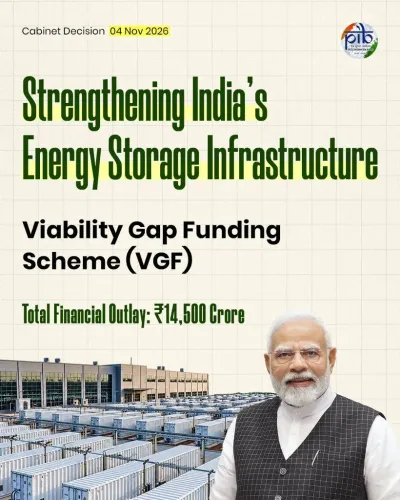
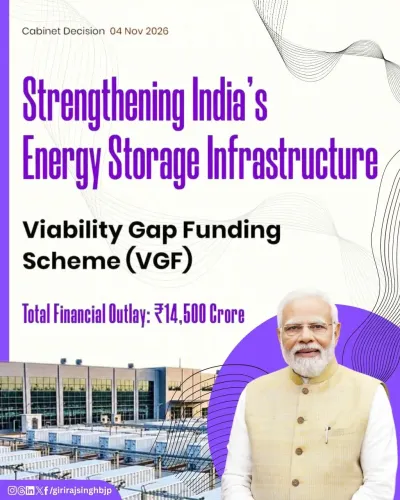
Pralhad Joshi: Cabinet clears ₹14,500 cr energy storage scheme
Synopsis
The Union Cabinet has approved a ₹14,500 crore Viability Gap Funding Scheme for Grid-Scale Energy Storage Systems covering FY 2026–27 to FY 2030–31, targeting 92 GWh of storage capacity to stabilise India's growing renewable energy grid and advance the country's 500 GW clean-power ambition.
Key Takeaways
The Union Cabinet approved a ₹14,500 crore Viability Gap Funding Scheme for Grid-Scale Energy Storage Systems.
The scheme targets 92 GWh of energy storage capacity across India over five years ( FY 2026–27 to FY 2030–31 ).
The VGF mechanism subsidises the financial viability gap to attract private developers into large-scale battery storage projects.
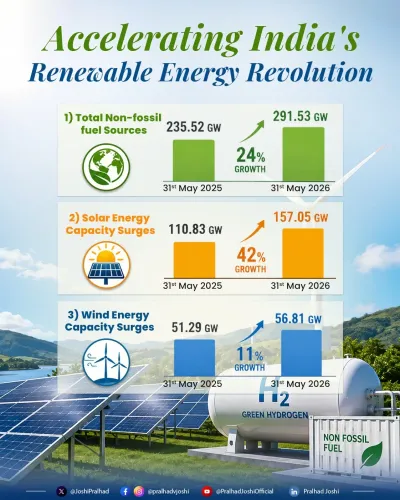
The approval directly supports India's 500 GW non-fossil fuel capacity target by 2030 , announced at COP26.
Union Minister Pralhad Joshi made the announcement in English and Kannada, signalling nationwide political reach for the decision.
Detailed scheme guidelines, bidding rounds, and capacity addition milestones are the key implementation steps to watch through 2031.
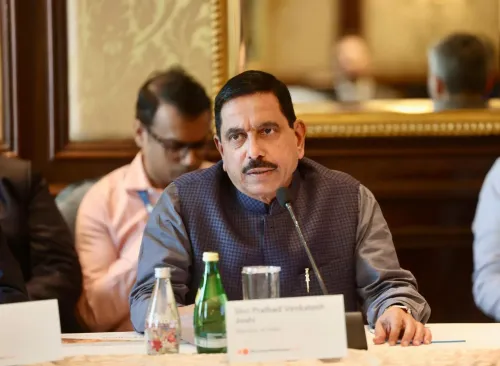
India's grid is about to get a serious memory upgrade. Union Minister of New and Renewable Energy Pralhad Joshi announced on Wednesday, November 4, 2026 that the Union Cabinet has approved a ₹14,500 crore Viability Gap Funding (VGF) Scheme for Grid-Scale Energy Storage Systems — a five-year programme designed to anchor India's clean-energy ambitions with the storage muscle they have long demanded.
What ₹14,500 crore buys India — and why 92 GWh is the number to watch
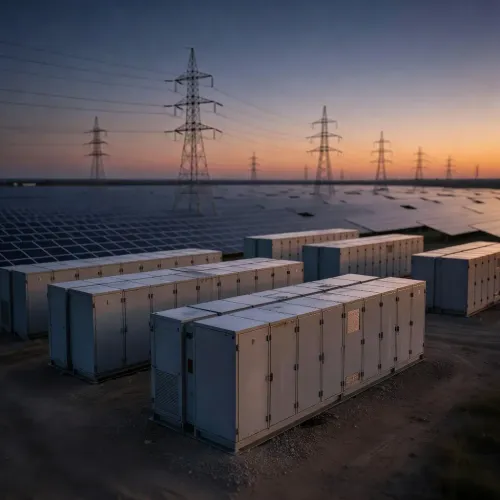
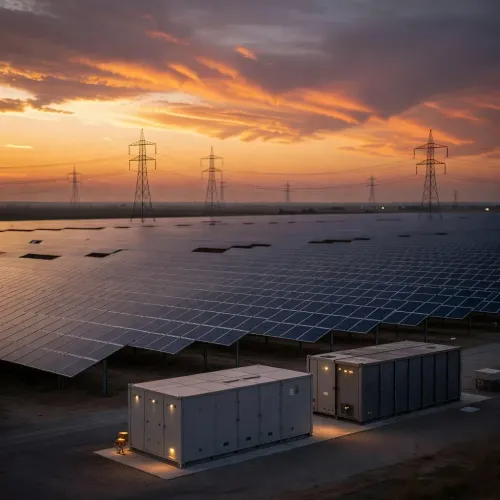
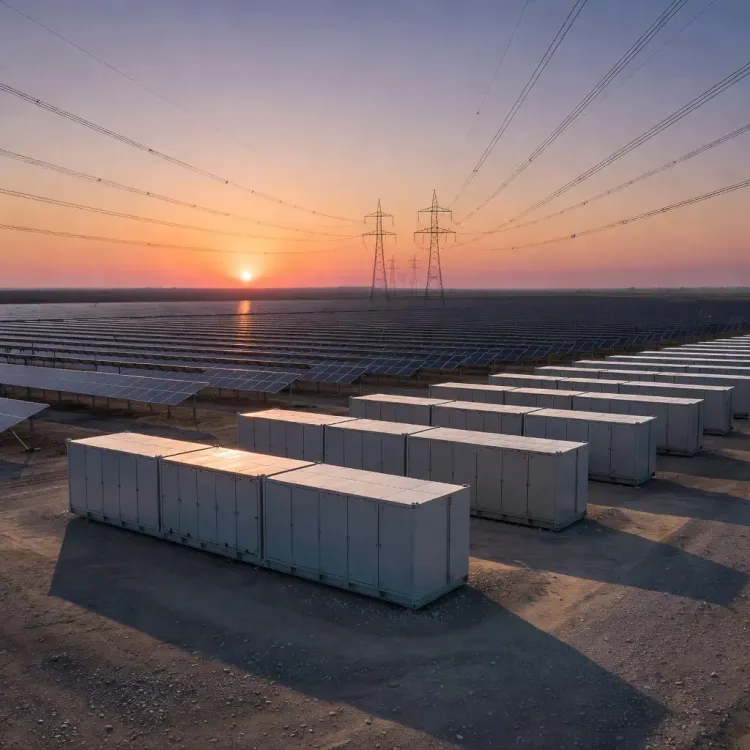
The scheme targets the development of 92 GWh of energy storage capacity nationwide between FY 2026–27 and FY 2030–31. That five-year window is deliberate: it maps directly onto the sprint India needs to hit its 500 GW non-fossil fuel capacity target by 2030, a commitment Prime Minister Narendra Modi anchored at COP26 in Glasgow in 2021. Solar panels and wind turbines generate power on the sky's schedule, not the grid's. Without large-scale storage, every new gigawatt of variable renewable capacity added is a gigawatt that can destabilise supply the moment clouds roll in or wind drops. The VGF scheme is the bridge between generation ambition and grid reliability.
Viability Gap Funding works as a demand-creation subsidy: the government steps in to cover the financial gap that makes early-stage, capital-intensive storage projects commercially unviable for private developers on their own. By underwriting that risk now, the scheme is designed to catalyse private investment, drive down battery storage costs through scale, and build a domestic market thick enough to sustain itself after the support window closes.
Building on PLI foundations — the storage policy arc takes shape
This approval does not arrive in a vacuum. India has spent several years constructing a layered policy architecture around clean energy — Production Linked Incentive (PLI) schemes have targeted domestic battery manufacturing, while state-level tenders have tested smaller storage deployments. The Cabinet's latest move effectively shifts the story from manufacturing supply to grid-level demand: it tells the market that India will buy storage at scale, and it backs that signal with ₹14,500 crore of public money.
Pralhad Joshi, who holds the dual charge of New and Renewable Energy alongside Consumer Affairs, posted the announcement in both English and Kannada — 'ಭಾರತದ ಇಂಧನ ಭದ್ರತೆ ಮತ್ತಷ್ಟು ಬಲಗೊಳ್ಳಲಿದೆ' (India's energy security will be further strengthened) — signalling the political reach the government wants this decision to have across states, particularly in solar-rich Karnataka and beyond. Renewable energy developers and state power utilities are the immediate beneficiaries; they now have a clearer financial framework within which to plan large storage bids.
From Cabinet approval to kilowatt-hours: the road to 2031
Cabinet approvals set the ceiling; implementation fills it. The next critical milestones will be the issuance of detailed scheme guidelines, the structure of competitive bidding rounds, and the pace at which projects actually break ground and commission capacity. India's experience with large-scale renewable tenders shows that the gap between policy announcement and megawatt delivery can be wide — grid connectivity, land acquisition, and supply-chain bottlenecks have all slowed previous programmes. How quickly the Ministry of New and Renewable Energy translates this approval into live tenders will determine whether 92 GWh remains a target or becomes a reality by 2030–31.
What is not in doubt is the strategic logic. A grid that cannot store clean power cannot reliably deliver it — and a country that cannot reliably deliver clean power cannot credibly claim energy transition leadership. With this single Cabinet decision, India has moved that logic from aspiration to funded policy.
Point of View
500 crore VGF approval marks a structural shift in India's energy transition playbook — moving from generation-side incentives to demand-side storage mandates, which is precisely where the policy gap has been most acute. For the BJP government, this is both an economic-security argument and a climate-diplomacy asset as India approaches the next COP cycle. The five-year horizon to 2030–31 is calibrated to coincide with the 500 GW renewable target, suggesting coordinated policy sequencing rather than ad hoc intervention. The harder test will be execution speed: storage project pipelines in India have historically lagged announced targets, and the credibility of this scheme will ultimately rest on live capacity, not Cabinet minutes.
NationPress
4 Nov 2026
Frequently Asked Questions
What is the Viability Gap Funding Scheme for energy storage?
The Viability Gap Funding (VGF) Scheme for Grid-Scale Energy Storage Systems is a central government programme that provides financial support to bridge the commercial viability gap for large-scale battery storage projects, making them attractive for private developers. The Cabinet approved a ₹14,500 crore outlay for the scheme covering FY 2026–27 to FY 2030–31.
What is the energy storage target under India's new VGF scheme?
The scheme targets the development of 92 GWh of grid-scale energy storage capacity across India by FY 2030–31.
Why does India need large-scale energy storage?
Solar and wind power generation is variable — it depends on sunlight and wind conditions. Without storage systems to bank surplus power and release it on demand, adding more renewable capacity can destabilise the grid. Large-scale storage is therefore essential to India meeting its 500 GW non-fossil fuel target reliably.
Who announced the Cabinet approval of the energy storage VGF scheme?
Union Minister of New and Renewable Energy Pralhad Joshi announced the Cabinet decision on November 4, 2026, posting in both English and Kannada on X.
How does VGF funding work for energy storage projects?
Viability Gap Funding is a government subsidy that covers the financial shortfall making early-stage, capital-intensive storage projects unviable on a purely commercial basis. By underwriting part of the cost, the government de-risks private investment and encourages developers to build storage infrastructure at scale.