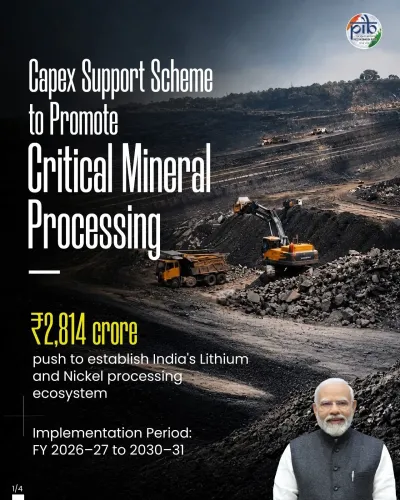
Cabinet Clears ₹2,814 Cr Scheme for Critical Minerals Push
Synopsis
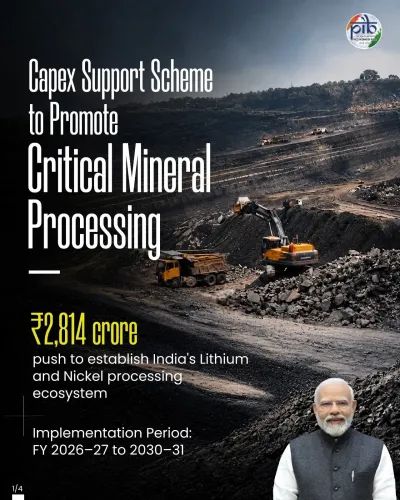
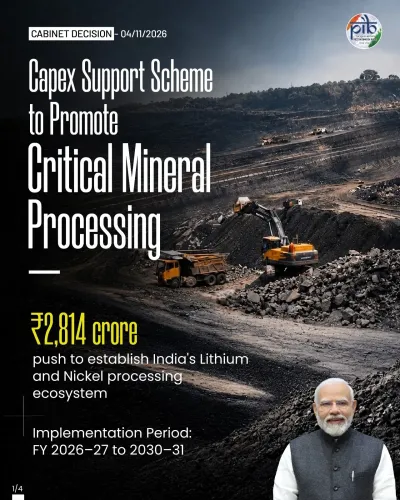
The Union Cabinet has approved a ₹2,814 crore capital expenditure support scheme to boost India's domestic critical minerals capacity. Minister Chirag Paswan announced the decision, framing it as a step toward self-reliance and deeper integration into global value chains for minerals powering EVs, renewables, and defence.
Key Takeaways
The Union Cabinet approved a ₹2,814 crore capital expenditure support scheme for critical minerals on 4 November 2026 .
The scheme aims to strengthen domestic production capacity, attract investment, and deepen India's role in global critical mineral value chains.
It builds on the Mines and Minerals (Development and Regulation) Amendment Act, 2023 , which opened critical mineral blocks to private sector auctions.
Key beneficiaries include EV manufacturers, solar energy producers, and defence contractors dependent on specialty minerals.
The approval aligns India with a global trend of 'friend-shoring' and supply-chain diversification away from concentrated mineral suppliers.
Full scheme guidelines, eligible project categories, and linked block auctions are yet to be published.
India's bid to break free from critical mineral import dependence just got a serious financial engine. Union Food Processing Minister Chirag Paswan announced on Wednesday, 4 November 2026 that the Union Cabinet, under the leadership of Prime Minister Narendra Modi, has approved a ₹2,814 crore capital expenditure support scheme aimed at accelerating domestic capacity in critical minerals — the foundational materials powering everything from electric vehicles to defence systems.
What ₹2,814 Crore Buys India in the Minerals Race
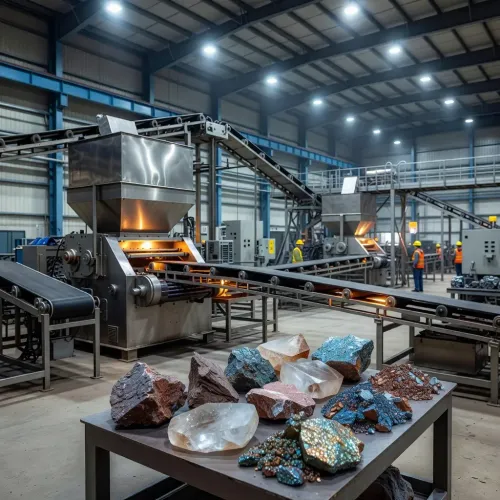
Critical minerals — think lithium, cobalt, graphite, rare earth elements — are the crude oil of the 21st-century economy. Nations that control them set the terms; nations that import them accept them. India has long sat uncomfortably in the second camp, dependent on concentrated global suppliers for inputs that feed its electronics, renewable energy, and defence manufacturing sectors.
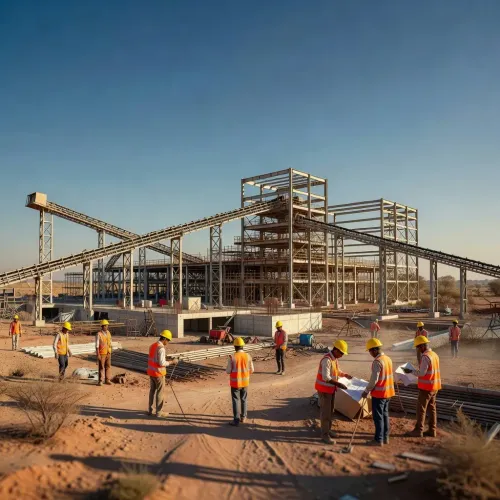
The newly approved scheme targets that vulnerability directly. According to the minister's post, the outlay will strengthen 'domestic capacity, investment, and India's participation in global value chains' — translating policy intent into rupees on the ground. The capital expenditure model means funds flow toward building real infrastructure and production assets, not just studies or subsidies.
The Regulatory Foundation Already in Place
This approval does not arrive in a vacuum. The Mines and Minerals (Development and Regulation) Amendment Act, 2023 had already cracked open India's critical mineral blocks to private sector participation through competitive auctions — a structural shift that made investment viable but left financing as the remaining bottleneck. The ₹2,814 crore capex support is designed to address exactly that gap, giving mining investors and downstream manufacturers the fiscal certainty to commit capital at scale.
The move fits a recognisable global pattern: the United States, the European Union, Japan, and Australia have all raced to build domestic or allied-nation mineral supply chains, explicitly to reduce exposure to any single dominant supplier. India is now moving with similar urgency — and the scale of this single cabinet decision signals that urgency is no longer rhetorical.
Who Stands to Gain — and What Comes Next
The immediate beneficiaries span a wide industrial canvas: EV manufacturers who need battery-grade lithium and cobalt, solar panel producers reliant on polysilicon and rare earths, and defence contractors that require specialty alloys and magnets. Domestic mining investors gain a clearer financial pathway into blocks that were technically auctionable but commercially uncertain without state support.
The scheme's full impact will crystallise once guidelines are published — specifically, which mineral categories qualify, what project sizes are eligible, and whether the capex support is linked to specific block auctions already in the pipeline. Those details will determine whether this becomes a transformative industrial push or a well-funded pilot.
India has spent years declaring Atmanirbhar Bharat (self-reliant India) as an ambition. A ₹2,814 crore cabinet-level commitment to the precise minerals the global energy transition runs on is the kind of line item that starts to make that ambition measurable.
Point of View
814 crore critical minerals scheme represents a tangible escalation in India's industrial self-reliance agenda — moving from regulatory enablement, achieved through the 2023 mines amendment, to direct fiscal intervention. Coming as major economies race to lock in mineral supply chains for the clean energy transition, the timing is strategically deliberate. The cabinet's backing signals that critical minerals are now firmly a national security and economic priority, not merely a sectoral concern. How the scheme is operationalised — particularly the eligibility criteria and linkage to pending block auctions — will determine whether it catalyses a structural shift or remains an incremental step.
NationPress
5 Nov 2026
Frequently Asked Questions
What is the ₹2,814 crore critical minerals scheme approved by the Cabinet?
It is a capital expenditure support scheme approved by the Union Cabinet on 4 November 2026 to build India's domestic capacity in critical minerals, attract investment, and strengthen the country's position in global mineral value chains.
What are critical minerals and why does India need them?
Critical minerals such as lithium, cobalt, and rare earth elements are essential inputs for electric vehicles, solar panels, electronics, and defence equipment. India currently imports a significant share of these, creating strategic and economic vulnerabilities the scheme aims to reduce.
How does the 2023 Mines Amendment Act relate to this scheme?
The Mines and Minerals (Development and Regulation) Amendment Act 2023 enabled auctions of critical mineral blocks to private players, creating the regulatory framework. The new ₹2,814 crore capex support complements that by providing the financial incentive for investors to actually develop those blocks.
Who will benefit from India's critical minerals capex support scheme?
Primary beneficiaries include domestic mining companies, EV manufacturers, solar energy producers, and defence contractors who rely on specialty minerals and alloys for their products.
What does Chirag Paswan have to do with the critical minerals scheme?
Union Minister Chirag Paswan publicly announced the Cabinet's approval of the ₹2,814 crore critical minerals scheme on 4 November 2026 via a post on X, crediting the decision to the leadership of Prime Minister Narendra Modi.