CM Fadnavis Witnesses Mercedes-Benz Electric GLC Rollout in Pune
Synopsis
Maharashtra Chief Minister Devendra Fadnavis witnessed the rollout of the Mercedes-Benz electric GLC at the Chakan plant in Pune on November 4, 2026, declaring the state's intent to become a global hub for EVs, battery technology, semiconductors and automotive AI, backed by a policy targeting 30% EV registrations by 2030.
Key Takeaways
CM Devendra Fadnavis attended the Mercedes-Benz electric GLC rollout at the Chakan plant, Pune on November 4, 2026 .
Fadnavis first inaugurated the Chakan facility's expansion in 2015 , making the return a decade-spanning industrial milestone.
Maharashtra's EV policy targets 30% electric vehicle registrations by 2030 , with focus on charging infrastructure, battery recycling and a full EV ecosystem.
The state's ambition extends to battery technology, semiconductors, automotive AI and advanced electronics — not just vehicle assembly.
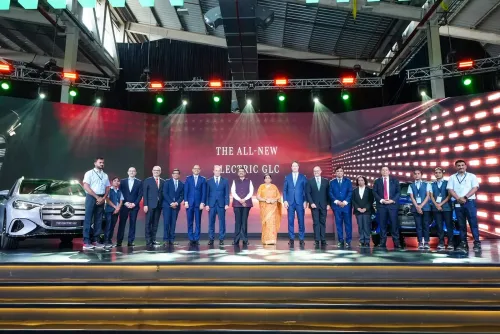
Senior Mercedes-Benz Group AG global leadership, including Supervisory Board Chairman Dr Martin Brudermüller and Board of Management Chairman Ola Källenius , attended the event.
Deputy Chief Minister Sunetra Pawar was also present alongside top Mercedes-Benz India executives.
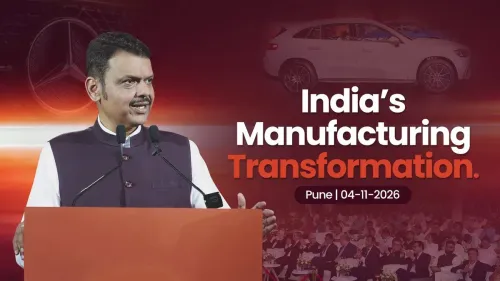
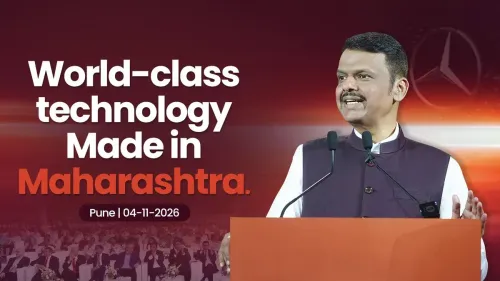
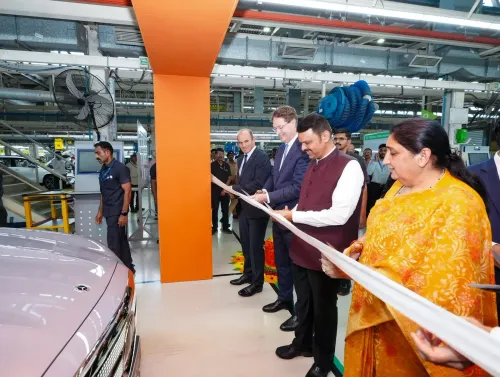
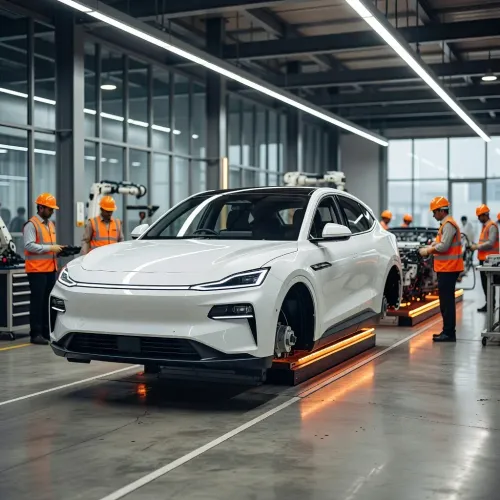
A decade after he cut the ribbon on its Chakan expansion, Maharashtra Chief Minister Devendra Fadnavis returned to the Mercedes-Benz plant in Chakan, Pune, on Wednesday, November 4, 2026 — this time to witness the rollout of the brand's electric GLC car, a moment he called a marker of the state's shift from automotive manufacturing powerhouse to global future-mobility hub.
From the 2015 Expansion to an Electric Milestone
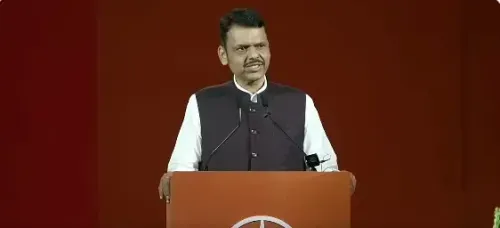
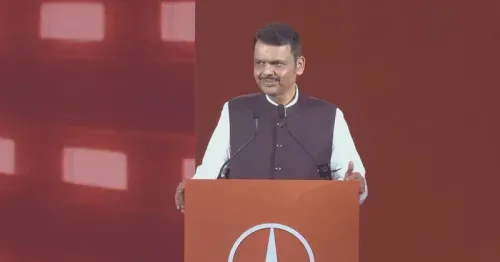
Fadnavis inaugurated the Mercedes-Benz Chakan facility's 2015 expansion during his first term as Chief Minister — a move framed then as an anchor investment to signal Maharashtra's industrial seriousness. Eleven years on, the same plant is rolling out battery-electric vehicles for the Indian market, tracing an arc from assembly-line ambition to electrification. 'What began as a vision to make Maharashtra a trusted global manufacturing destination has evolved into a remarkable journey of industrial growth and technological advancement,' Fadnavis wrote in his post on X.
Chakan, the industrial belt roughly 35 kilometres northeast of Pune, hosts one of India's densest clusters of automotive plants. Its emergence as a manufacturing magnet — drawing carmakers, component suppliers and logistics firms — underpins Fadnavis's claim that Maharashtra has built 'one of India's strongest automotive ecosystems.'
The 30% EV Target and What It Demands
Maharashtra's EV policy sets a target of 30% electric vehicle registrations by 2030. Reaching that number requires far more than assembling cars — it demands charging infrastructure at scale, battery recycling capacity, and a domestic supply chain that currently depends heavily on imported cells and components. Fadnavis explicitly named the full stack: battery technology, semiconductors, automotive AI, advanced electronics and research — signalling that the state's ambition is not just to sell EVs but to manufacture the intelligence inside them.
That ambition aligns with the national FAME India scheme, launched in 2015 alongside the Chakan expansion, which seeded demand incentives for electric and hybrid vehicles. Maharashtra has consistently positioned itself as the state most capable of converting that national policy headroom into industrial output.
Who Was in the Room at Chakan
The event drew a high-profile cross-section of Mercedes-Benz's global leadership. Dr Martin Brudermüller, Chairman of the Supervisory Board of Mercedes-Benz Group AG, and Ola Källenius, Chairman of the Board of Management, attended alongside Jörg Burzer, Chief Technology Officer of the Group, and Santosh Iyer and Manu Saale, who lead Mercedes-Benz India operations and its Indian R&D arm respectively. Deputy Chief Minister Sunetra Pawar represented the Maharashtra government alongside Fadnavis.
The presence of the group's supervisory and management chairs — not just the India unit chiefs — underscores how seriously Stuttgart is treating the Indian EV market. For Fadnavis, the optics matter: a sitting CM flanked by Germany's most senior auto executives is exactly the image Maharashtra's investment-pitch machine is built around.
Taking 'the Best of Chakan' to the World
Fadnavis framed the ultimate goal as taking Maharashtra 'from a manufacturing powerhouse to a global innovation hub.' That language is deliberate — it positions Pune's industrial belt not as a cost-arbitrage destination but as a knowledge economy in formation, capable of producing the software, research and advanced components that define next-generation mobility.
The metrics to watch are concrete: how quickly charging infrastructure rolls out across Maharashtra's tier-2 cities, whether semiconductor or automotive R&D facilities break ground in the Pune region, and how much of the EV supply chain — especially battery cells — shifts to domestic production before 2030.
Maharashtra staked its industrial identity on the automobile a generation ago. The electric GLC rolling off a Chakan line is the state's public declaration that it intends to do the same for the EV era — and this time, it wants to own the technology, not just the factory floor.
Point of View
Shifting the conversation from intent to accountability. Aligning the event with PM Modi's 'Make in India' and technology-sovereignty narrative also insulates the policy from political challenge at the national level. The deeper bet is that Chakan can replicate, in EVs and semiconductors, the gravity it built for internal combustion — a wager Maharashtra's rivals in Gujarat and Tamil Nadu are watching very closely.
NationPress
5 Nov 2026
Frequently Asked Questions
What is Maharashtra's EV policy target?
Maharashtra's EV policy targets 30% electric vehicle registrations by 2030 , with measures covering charging infrastructure expansion, battery recycling and building a complete EV manufacturing and research ecosystem in the state.
Where is the Mercedes-Benz plant in Maharashtra?
The Mercedes-Benz manufacturing plant is located in Chakan , an industrial area approximately 35 kilometres northeast of Pune , which also hosts several other major automotive manufacturers.
What electric car was rolled out at the Chakan plant?
The Mercedes-Benz electric GLC was rolled out at the Chakan plant in Pune on November 4, 2026 , with CM Devendra Fadnavis and senior Mercedes-Benz global executives in attendance.
What is the FAME India scheme?
The FAME India scheme (Faster Adoption and Manufacturing of Electric Vehicles) was launched nationally in 2015 to promote the adoption of electric and hybrid vehicles through demand incentives and infrastructure support.
What industries is Maharashtra targeting beyond car manufacturing?
Maharashtra is targeting battery technology, semiconductors, automotive AI, advanced electronics, software development and automotive R&D as it seeks to evolve from a traditional automotive manufacturing base into a global future-mobility innovation hub.