CM Siddaramaiah marks 3 years in office, cites power sector gains
Synopsis
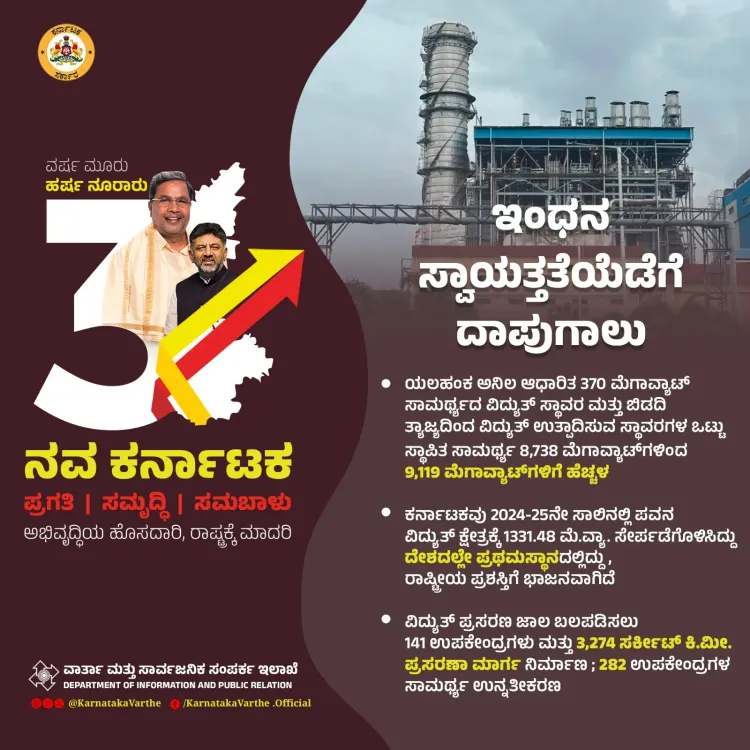
Karnataka Chief Minister Siddaramaiah marked three years in office on 22 May 2026, dedicating the government's achievements to every Kannadiga. Key highlights include raising installed power capacity to 9,119 MW, ranking first nationally in wind energy addition at 1,331.48 MW in 2024-25, and building 141 new substations and 3,274 circuit km of transmission lines.
Key Takeaways
Karnataka CM Siddaramaiah completed three years in office on 22 May 2026 , marking the occasion under the Nava Karnataka banner.
The state's total installed power capacity rose from 8,738 MW to 9,119 MW , aided by the Yelahanka 370 MW gas-based plant and Bidadi waste-to-energy facility .
Karnataka added 1,331.48 MW of wind power in 2024-25 , ranking first nationally and receiving a national award.
141 new substations and 3,274 circuit kilometres of transmission lines were constructed to strengthen the power grid.
Capacity at 282 existing substations was upgraded as part of the transmission network reinforcement drive.
The Chief Minister pledged that development efforts would be 'faster and more effective' in the years ahead.
Karnataka Chief Minister Siddaramaiah on Friday, 22 May 2026 marked the completion of three years of his government in office, crediting every Kannadiga for the administration's achievements and reaffirming commitment to all pre-election promises. The post, shared on X in Kannada under the hashtag #NavaKarnataka, listed specific gains in the state's power sector as evidence of delivery on those pledges.
Context
Siddaramaiah's Indian National Congress government came to power in Karnataka in May 2023, winning a decisive mandate on the back of five guarantee schemes and promises of inclusive development. The three-year mark is being observed under the banner 'Nava Karnataka' — meaning 'New Karnataka' — which frames the administration's narrative of rebuilding the state as 'empowered, prosperous, and self-respecting,' as the Chief Minister put it in his post.
In his message, Siddaramaiah wrote: 'ರಾಜ್ಯದ ಜನರ ಆಶೀರ್ವಾದದೊಂದಿಗೆ ನಾವು ಅಧಿಕಾರಕ್ಕೆ ಬಂದು ಮೂರು ವರ್ಷಗಳು ಪೂರೈಸಿರುವ ಈ ಸಾರ್ಥಕ ಸಂದರ್ಭದಲ್ಲಿ...' ('On this meaningful occasion of completing three years in power with the blessings of the people of the state, we dedicate all the achievements of our government to every Kannadiga.')
Policy Backdrop
The government's listed power-sector achievements centre on three areas. First, the total installed generation capacity has been raised from 8,738 MW to 9,119 MW, driven in part by the Yelahanka 370 MW gas-based power plant and a waste-to-energy facility at Bidadi in Ramanagara district.
Second, Karnataka is cited as ranking first nationally in wind power addition during 2024-25, having added 1,331.48 MW of wind capacity — a performance the government says earned it a national award. Third, the transmission network has been strengthened through the construction of 141 new substations and 3,274 circuit kilometres of transmission lines, alongside capacity upgrades at 282 substations.
Karnataka has historically been among India's leading states in renewable energy, and these steps align with broader national targets for non-fossil fuel capacity by 2030. The transmission upgrades are particularly significant for a state with heavy industrial and IT-sector electricity demand concentrated around Bengaluru.
Stakeholders and Impact
The direct beneficiaries of expanded generation and transmission capacity are Karnataka's electricity consumers — households, farmers, and the large industrial and technology-services sector. Renewable energy developers operating in the state also stand to gain from improved grid infrastructure, which reduces curtailment risks for wind and solar projects.
State power utilities, including the transmission and distribution companies under the Karnataka Power Transmission Corporation, are central to executing the substation and line projects cited. The waste-to-energy plant at Bidadi additionally addresses urban solid-waste management, linking power policy to municipal governance objectives.
What's Next
Siddaramaiah indicated that the government's efforts would become 'faster and more effective' going forward, suggesting further announcements on infrastructure and welfare delivery are likely as the administration enters its second half. Progress on additional substation projects and any new renewable capacity tenders will be closely watched by the energy sector. With the 2028 Karnataka assembly elections on the horizon, the ruling party's ability to sustain this delivery narrative will be a key political variable.
Point of View
Circuit kilometres, substation counts — the Congress government is countering opposition claims of promise-fatigue with specifics rather than slogans. The wind-energy national-rank claim, if sustained, positions Karnataka as a model for state-led energy transition, lending the administration a technocratic credibility that complements its welfare-scheme identity. The forward-looking pledge of faster delivery also signals that the party is in campaign-preparation mode, looking to consolidate its base before the political season intensifies.
NationPress
7 Oct 2026
Frequently Asked Questions
How many years has Siddaramaiah's government completed in Karnataka?
The Siddaramaiah-led Congress government completed three years in office in Karnataka as of 22 May 2026 , having come to power in May 2023.
What is Karnataka's total installed power capacity after three years of the Congress government?
Karnataka's total installed power capacity stands at 9,119 MW , up from 8,738 MW , according to the government's three-year report. The increase includes contributions from the Yelahanka 370 MW gas-based plant and the Bidadi waste-to-energy facility .
Did Karnataka rank first in wind energy addition in India?
The Karnataka government claims the state ranked first nationally in wind power addition during 2024-25 , having added 1,331.48 MW of wind capacity, and says it received a national award for this performance.
What is Nava Karnataka?
Nava Karnataka means 'New Karnataka' and is the overarching governance theme of the Siddaramaiah administration, framing its agenda as rebuilding the state to be empowered, prosperous, and self-reliant.
What transmission infrastructure was built in Karnataka in three years?
The government says it constructed 141 new substations and 3,274 circuit kilometres of transmission lines, and upgraded capacity at 282 existing substations to strengthen Karnataka's power grid.