Rajnath Singh: Food Security Is the Bedrock of National Security
Synopsis
Union Defence Minister Rajnath Singh on 8 July 2026 declared food security the bedrock of India's national security and sovereignty, arguing that farmers and soldiers share the same national duty of protecting the country's self-respect — a framing that connects agricultural self-sufficiency to strategic autonomy doctrine.
Key Takeaways
Rajnath Singh on 8 July 2026 stated that food security is the foundation of India's national security, strategic autonomy, and sovereignty.
He drew a direct equivalence between soldiers at the border and farmers in the field, calling both fulfilling the same national duty.
The framing builds on the National Food Security Act of 2013 , which made subsidised food grains a legal entitlement for roughly two-thirds of India's population.
The Atmanirbhar Bharat Abhiyan (2020) explicitly linked agricultural and defence self-reliance as interlocking strategic goals.
The statement signals that rural and agricultural investment may increasingly be framed as a national-security imperative in upcoming budget and legislative cycles.
Eyes are on Union Budget 2027 allocations and the monsoon session of Parliament for concrete policy follow-through.
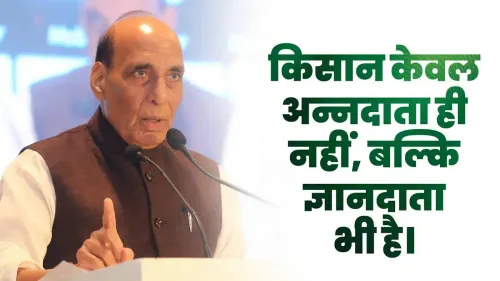
Union Defence Minister Rajnath Singh on Wednesday, 8 July 2026, drew a direct equivalence between a soldier guarding India's borders and a farmer toiling in the fields, arguing that food security is the foundation of the nation's strategic autonomy and sovereignty.
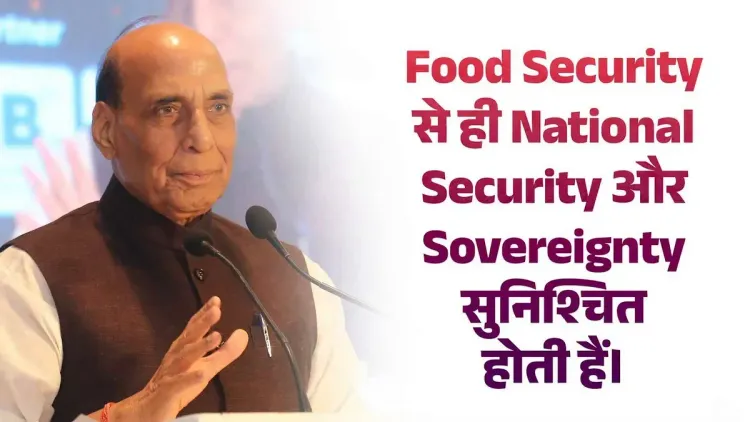
Posting in Hindi on X, Singh wrote: 'Food Security देश की National Security, Strategic Autonomy और Sovereignty का आधार है।' — translated: 'Food Security is the foundation of the country's National Security, Strategic Autonomy and Sovereignty.' He added that the soldier deployed at the border and the farmer labouring in the field are both fulfilling the same national duty — the protection of the country's self-respect (aatmsamman).
Context
The statement reframes food security not merely as a welfare concern but as a pillar of national defence doctrine. By placing the farmer alongside the soldier in a single frame of 'national duty,' Singh signals that agricultural self-sufficiency is as strategically vital as military preparedness. The post, which accompanied a video, was made in his capacity as the country's chief defence authority, lending the framing institutional weight.
Policy Backdrop
India's linkage of food self-sufficiency with strategic security has deep roots. The National Food Security Act of 2013 converted access to subsidised food grains into a legal entitlement for roughly two-thirds of the population — codifying food access as a state obligation rather than a charity. The Atmanirbhar Bharat Abhiyan, launched in 2020, extended the self-reliance logic explicitly to agriculture and defence manufacturing, treating both as interlocking components of supply-chain resilience.
India's post-Green Revolution trajectory has long treated grain self-sufficiency as a strategic asset, particularly after the supply shocks and border tensions of earlier decades. The framing has grown sharper since 2014, as successive administrations pursued defence indigenisation alongside agricultural infrastructure investment, arguing that a nation dependent on food imports is strategically vulnerable.
Stakeholders and Impact
The statement speaks to two of India's largest constituencies: the armed forces and the country's estimated 140 million farm households. By elevating the farmer to the moral status of a border sentinel, Singh reinforces a political narrative that agricultural distress is not merely an economic problem but a national-security concern. For defence policymakers, the framing supports arguments for rural infrastructure investment — cold-chain logistics, road connectivity, and water security — as dual-use strategic assets.
The message also resonates with ongoing debates about the National Food Security Act and potential revisions in the upcoming monsoon session of Parliament, where food subsidy coverage and procurement policy are expected to be discussed.
What's Next
Attention will now turn to the Union Budget 2027, where allocations for agriculture infrastructure and defence capital expenditure will be scrutinised for whether the rhetorical convergence Singh articulates translates into coordinated fiscal policy. Any move to link rural development spending with strategic autonomy goals under the Atmanirbhar Bharat framework would represent a concrete policy expression of the equivalence the Defence Minister has now stated publicly. The monsoon session of Parliament also presents an opportunity to revisit the National Food Security Act, potentially widening its ambit or strengthening implementation mechanisms in border and conflict-prone regions.
Point of View
The Defence Minister aligns farmer welfare with the BJP's nationalist security narrative, making cuts to agricultural subsidies politically harder to justify. The soldier-farmer equivalence also echoes a long-standing RSS ideological thread that treats the 'kisan' (farmer) and 'sainik' (soldier) as twin pillars of the nation. Whether this translates into coordinated fiscal architecture — linking defence and agriculture budgets under an Atmanirbhar umbrella — will be the real test of the doctrine Singh has now articulated from the highest defence office.
NationPress
9 Jul 2026
Frequently Asked Questions
What did Rajnath Singh say about food security and national security?
On 8 July 2026, Rajnath Singh stated that food security is the foundation of India's national security, strategic autonomy, and sovereignty, and that farmers and soldiers are both fulfilling the same national duty of protecting the country's self-respect.
Why did Rajnath Singh compare farmers to soldiers?
Singh drew the comparison to argue that agricultural self-sufficiency is as strategically vital as military defence — a nation that cannot feed itself is strategically vulnerable, making the farmer's role equivalent in national importance to a border soldier's.
What is the National Food Security Act and why is it relevant here?
The National Food Security Act of 2013 provides subsidised food grains to roughly two-thirds of India's population as a legal entitlement. Singh's statement reinforces the view that this food access guarantee is not just a welfare measure but a pillar of national security.
How does Atmanirbhar Bharat connect food security to defence?
The Atmanirbhar Bharat Abhiyan, launched in 2020, explicitly linked agricultural self-reliance with defence manufacturing and supply-chain resilience, framing both as components of India's strategic autonomy — the same doctrine Singh invoked in his post.
What policy changes could follow Rajnath Singh's food security statement?
Analysts will watch Union Budget 2027 for coordinated allocations linking agriculture infrastructure and defence capital expenditure, as well as the monsoon session of Parliament for possible amendments to the National Food Security Act.