Rajnath Singh: Tradition and Technology are India's Greatest Strength
Synopsis
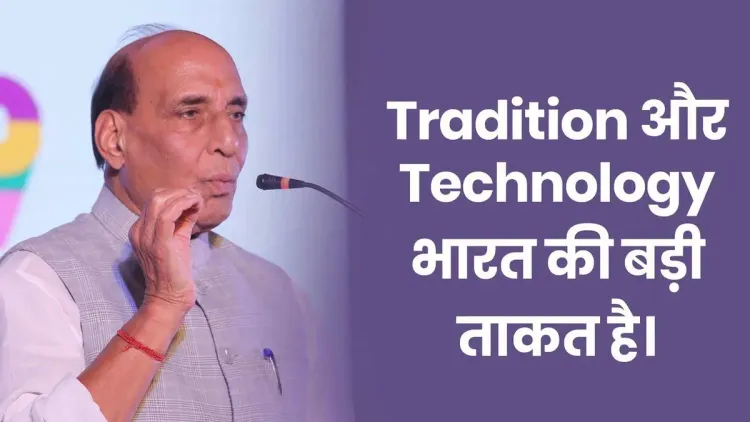
Union Defence Minister Rajnath Singh on 4 July 2026 declared that pride in India's civilisation combined with modern progress defines New India, and that the confluence of tradition and technology is the country's greatest strength for 21st-century global leadership.
Key Takeaways
Rajnath Singh posted on 4 July 2026 articulating his vision of 'New India' as a blend of civilisational heritage and modernity.
He stated that pride in India's civilisation, culture, and heritage alongside modernisation is the defining identity of New India.
He described the confluence of Tradition and Technology as India's single greatest strength.
The message positions India as having the self-confidence to lead the 21st century on its own terms.
The framing aligns with the BJP -led government's consistent 'New India' narrative active since 2014 .
The post was shared with a video attachment, suggesting it may accompany a speech or audio-visual message.
Union Defence Minister Rajnath Singh on Saturday, 4 July 2026, posted a message on X articulating his vision of a 'New India' that draws equal strength from its civilisational heritage and its embrace of modern technology. The post, in Hindi and English, frames this balance as the defining characteristic of India's identity and the source of its confidence to lead in the 21st century.
Context
In his post, Rajnath Singh wrote: 'Apni sabhyata, sanskriti aur virasat par garv karte hue aadhunikata ke saath chalna naye Bharat ki pehchaan hai' — ('Walking with modernity while taking pride in our civilisation, culture, and heritage is the identity of the New India'). He added that this balance gives India the strength to lead the 21st century with self-confidence. The post concluded with the assertion that the 'confluence of Tradition and Technology is India's greatest strength.'
The message carries no reference to a specific event or occasion, but its timing — on a Saturday afternoon — and its broad, declarative tone suggest it forms part of the ruling Bharatiya Janata Party (BJP)'s sustained ideological communication around India's national identity.
Policy Backdrop
The 'New India' framing has been a central pillar of the BJP-led government's messaging since 2014, championed most prominently by Prime Minister Narendra Modi. It positions India as a civilisational state — one that does not treat modernity and tradition as opposites, but as complementary forces. This narrative has been deployed consistently across official communication tied to landmark achievements in space exploration, the push for domestic semiconductor manufacturing, and artificial intelligence policy.
Rajnath Singh, as a senior ideologue within the BJP and a former Union Home Minister and Chief Minister of Uttar Pradesh, has long been one of the party's most prominent voices on questions of cultural nationalism and national security. His articulation of the tradition-technology synthesis echoes a broader governmental effort to project India as a confident global actor that is rooted in, rather than embarrassed by, its ancient heritage.
Stakeholders and Impact
The post is addressed, in effect, to all Indian citizens — particularly the younger demographic that the BJP has long sought to engage on questions of national pride and aspiration. By linking civilisational identity with technological ambition, the message attempts to make both conservative and forward-looking audiences feel included in the same national project.
The framing also carries significance for India's external image. At a time when India is actively seeking a larger role in multilateral forums, space missions, and global technology supply chains, the argument that heritage and innovation reinforce rather than contradict each other serves as a soft-power statement to international audiences as well.
What's Next
Observers of government messaging will watch for whether this post presages a formal address, a policy announcement, or a cultural event linking India's civilisational institutions with its technology missions — particularly in areas such as the National AI Mission, semiconductor incentive programmes, or upcoming space milestones. The consistency of this narrative across senior BJP leaders suggests it will remain a cornerstone of the party's communication as India approaches the latter half of the decade and positions itself for a larger global leadership role.
Point of View
He is reinforcing a political identity that distinguishes the BJP's India from both a purely Westernised modernisation model and a nostalgic retreat from progress. The post's broad, philosophical tone, rather than any specific policy hook, indicates this is ideological consolidation ahead of what could be a significant policy or cultural moment. Consistent repetition of this narrative across senior leaders signals it will anchor BJP's pitch to younger, aspirational voters through the remainder of the decade.
NationPress
3 Oct 2026
Frequently Asked Questions
What did Rajnath Singh say about tradition and technology in India?
Rajnath Singh posted on 4 July 2026 that the confluence of tradition and technology is India's greatest strength, and that walking with modernity while taking pride in its civilisation and heritage is the defining identity of New India.
What is the 'New India' vision that Rajnath Singh referred to?
'New India' is a vision promoted by the BJP-led government since 2014, positioning India as a civilisational state that blends cultural confidence with modern progress in areas such as technology, space, and digital infrastructure.
Why does Rajnath Singh say India can lead the 21st century?
According to his post, India's ability to balance pride in its ancient civilisation, culture, and heritage with the embrace of modernity gives it the self-confidence and strength to lead the 21st century.
Who is Rajnath Singh?
Rajnath Singh is India's Union Minister of Defence and a senior BJP leader. He has previously served as Chief Minister of Uttar Pradesh and as Union Home Minister.
What broader policy does Rajnath Singh's tradition-technology message connect to?
The message connects to the BJP government's sustained effort since 2014 to project India as a confident global actor — evident in official communication around space achievements, the National AI Mission, semiconductor programmes, and cultural diplomacy.