Rajnath Singh backs Yantra India as defence self-reliance driver
Synopsis
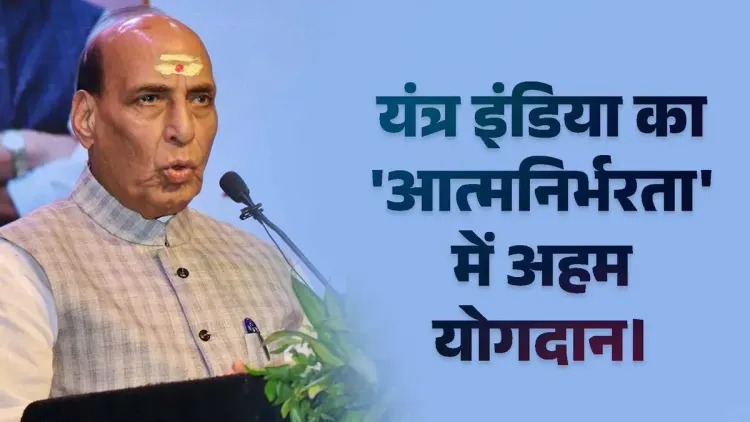
Union Defence Minister Rajnath Singh on 19 June 2026 spotlighted Yantra India's contribution to defence self-reliance, arguing that Atmanirbhar Bharat's true foundation lies in critical components and sub-systems, not just large weapons platforms.
Key Takeaways
Rajnath Singh on 19 June 2026 credited Yantra India with advancing defence indigenisation through 'foundational products.' The Minister stated that Atmanirbhar Bharat in defence rests on critical components, not just large weapons systems.
Yantra India is a Ministry of Defence PSU specialising in components and sub-systems for defence platforms.
The Atmanirbhar Bharat Abhiyan , launched in May 2020 , set defence indigenisation as a core national priority.
Four Positive Indigenisation Lists notified between 2021 and 2023 mandate domestic procurement of specified weapons, platforms, and components.
The policy push includes 74 per cent FDI via automatic route in defence and corporatisation of the Ordnance Factory Board .
Union Defence Minister Rajnath Singh on Friday, 19 June 2026, highlighted the role of Yantra India in advancing the country's defence indigenisation goals, stating that the foundation of a self-reliant defence sector rests not just on large weapons systems but on the critical components that power them.
Posting in Hindi on X, the Minister said: 'रक्षा क्षेत्र में आत्मनिर्भर भारत की मजबूत नींव केवल बड़े हथियारों और प्लेटफॉर्म्स से नहीं, बल्कि उनके पीछे काम करने वाले महत्वपूर्ण कंपोनेंट्स पर आधारित है।' ('The strong foundation of Atmanirbhar Bharat in the defence sector rests not merely on large weapons and platforms, but on the critical components working behind them.')
Context
Yantra India is a Ministry of Defence public sector undertaking focused on producing foundational components and sub-systems that feed into larger defence platforms. Rajnath Singh described these as 'foundational products' (फाउंडेशनल प्रोडक्ट्स) that are quietly but decisively strengthening the country's defence capabilities. The Minister credited Yantra India with giving 'new momentum' to the self-reliance mission.
The post comes at a time when India's defence establishment has been systematically shifting its procurement posture away from imports and towards domestic sourcing across the supply chain — from finished platforms down to individual components and sub-assemblies.
Policy Backdrop
The Atmanirbhar Bharat Abhiyan, launched in May 2020, placed defence manufacturing at the centre of India's self-reliance push. The Ministry of Defence subsequently notified four Positive Indigenisation Lists between 2021 and 2023, covering weapons, platforms, and components that must be procured exclusively from domestic producers.
Parallel measures — including liberalisation of foreign direct investment in defence up to 74 per cent via the automatic route and the corporatisation of the Ordnance Factory Board — were designed to deepen the domestic industrial base. The explicit recognition of component-level indigenisation in the Minister's post signals that policy attention is now moving beyond headline platforms to the underlying supply chain.
Stakeholders and Impact
The primary beneficiaries of a robust component ecosystem are the Indian Armed Forces, which gain greater operational security when critical parts are domestically sourced rather than subject to import disruptions. Defence public sector undertakings like Yantra India stand to see expanded mandates as indigenisation lists are broadened.
Private sector vendors in the defence supply chain also stand to gain, as government emphasis on foundational components opens procurement windows beyond the large platform contracts that have historically dominated capital acquisition. The message reinforces that the indigenisation drive is a full-stack effort, not limited to visible end-products.
What's Next
The next revision of the Defence Procurement Procedure is expected to further raise indigenous content thresholds in capital acquisition proposals, with component-level sourcing likely to receive specific targets. Yantra India's role as a supplier of foundational products positions it as a direct instrument of that policy direction.
As India looks to consolidate its gains in defence manufacturing, the Minister's emphasis on components over platforms suggests that future indigenisation milestones will increasingly be measured at the sub-system level — a shift that could redefine how defence self-reliance is tracked and reported.
Point of View
' the Minister is building political and institutional legitimacy for supply-chain indigenisation, which has historically received less attention than fighter jets or warships. This fits a consistent arc since 2020: each successive policy measure has pushed indigenisation deeper into the defence ecosystem, and ministerial communication is now following that trajectory. The framing also pre-empts criticism that self-reliance remains superficial by anchoring it at the component level.
NationPress
19 Sept 2026
Frequently Asked Questions
What is Yantra India and what does it do?
Yantra India is a Ministry of Defence public sector undertaking that produces foundational components and sub-systems used in larger defence platforms, supporting India's indigenisation goals.
What did Rajnath Singh say about Yantra India?
Rajnath Singh said on 19 June 2026 that the foundation of Atmanirbhar Bharat in defence rests on critical components — not just large weapons — and that Yantra India is giving new momentum to self-reliance through its foundational products.
What is the Atmanirbhar Bharat Abhiyan in defence?
Launched in May 2020, the Atmanirbhar Bharat Abhiyan aims to make India self-reliant across sectors, with a major focus on indigenous defence manufacturing and reducing dependence on imports through positive indigenisation lists and FDI liberalisation.
What are Positive Indigenisation Lists in Indian defence?
Positive Indigenisation Lists are notifications by the Ministry of Defence that mandate procurement of specified weapons, platforms, and components exclusively from domestic sources; four such lists were notified between 2021 and 2023.
Why are defence components important for self-reliance?
Critical components are the building blocks of every weapon system; domestically sourcing them reduces vulnerability to import disruptions, lowers costs over time, and builds a deeper industrial base beyond just assembling finished platforms.