Rajnath Singh backs private sector in India's defence push
Synopsis
Union Defence Minister Rajnath Singh on 23 May 2026 reaffirmed that private sector participation is essential for Atmanirbhar Bharat and Make in India, highlighting policy reforms and schemes like iDEX, ADITI, and TDF as drivers of indigenous defence manufacturing and innovation.
Key Takeaways
Union Defence Minister Rajnath Singh on 23 May 2026 called private sector participation 'absolutely essential' for Atmanirbhar Bharat and Make in India . iDEX (launched April 2018 ) connects startups and MSMEs with defence requirements, enabling faster innovation cycles outside traditional procurement.
ADITI extends the iDEX model to critical dual-use technologies required by the armed forces.
The TDF , run by DRDO , provides grants for indigenous R&D by industry and academic institutions.
The Defence Procurement Procedure was revised in 2020 to prioritise indigenous design and manufacture categories.
Budget allocations for these three schemes and any new negative import list additions are the next key policy signals to watch.
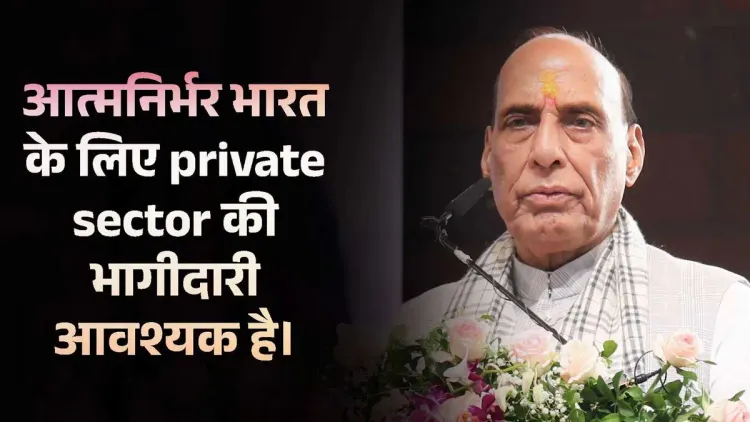
Union Defence Minister Rajnath Singh on Saturday, 23 May 2026, underscored the indispensable role of private industry in advancing Atmanirbhar Bharat and Make in India, citing landmark policy reforms and innovation schemes as catalysts for indigenous defence manufacturing.
Posting on X, the Minister stated: 'Atmanirbhar Bharat' aur 'Make in India' ke liye private sector ki bhaagidaari atyant aavashyak hai — 'Private sector participation is absolutely essential for Atmanirbhar Bharat and Make in India.' He added that significant policy reforms have been carried out in this spirit, and that schemes such as iDEX, ADITI, and TDF have given fresh momentum to innovation and indigenous defence manufacturing.
Context
Rajnath Singh has been a consistent advocate for reducing India's dependence on defence imports since assuming charge of the Ministry of Defence. His statement on 23 May 2026 reaffirms the government's standing position that strategic self-reliance cannot be achieved without meaningful private-sector engagement alongside public-sector undertakings.
The post references three distinct government instruments: iDEX (Innovations for Defence Excellence), ADITI (Acing Development of Innovative Technologies with iDEX), and the TDF (Technology Development Fund) — each targeting a different segment of the defence innovation pipeline, from early-stage startups to established industry and academia.
Policy Backdrop
The architecture the Minister invoked has been built over more than a decade. Make in India was launched in September 2014 with defence as a priority sector, followed by the Atmanirbhar Bharat package announced in May 2020, which set explicit indigenisation targets and introduced a negative import list barring procurement of specified weapon systems from abroad.
The iDEX platform, established in April 2018 by the Ministry of Defence, was designed to connect startups and MSMEs directly with defence requirements, bypassing the traditionally slow procurement cycle. The TDF, administered by DRDO, provides grants for indigenous research and development by industry and academic institutions. ADITI extended the iDEX model specifically to critical dual-use technologies needed by the armed forces.
The Defence Procurement Procedure was revised in 2020 to give priority to the 'indigenous design and manufacture' category, further tilting the playing field toward domestic producers. Successive upward revisions to the foreign direct investment cap in defence manufacturing have complemented these measures.
Stakeholders and Impact
The primary beneficiaries of the schemes cited by Rajnath Singh are private defence firms, defence-tech startups, MSMEs, and research institutions that previously had limited access to defence contracts dominated by public sector units. The iDEX ecosystem in particular has enabled hundreds of startups to prototype and test solutions for the Indian Army, Navy, and Air Force.
Broader strategic imperatives — including supply-chain vulnerabilities exposed by border tensions and global disruptions — have lent urgency to the indigenisation drive. Reducing import dependence is seen as both an economic and a national-security objective, with the defence sector identified as a high-priority domain for domestic value addition.
What's Next
Analysts tracking the sector will watch allocations for iDEX, ADITI, and TDF in the next Union Defence Budget as a measure of the government's financial commitment to the rhetoric. Any fresh additions to the negative import list or tweaks to offset policy in the upcoming Defence Procurement Procedure review will be key indicators of how far the private-sector partnership model is being pushed. The Minister's statement signals that the policy direction remains firmly set toward deeper indigenisation, with private capital and startup innovation positioned as essential engines of that transition.
Point of View
Possibly a budget allocation boost or a new negative import list. By naming iDEX, ADITI, and TDF together, the Minister is signalling that the startup-and-MSME pipeline, not just large private conglomerates, is central to the indigenisation strategy. This framing is politically useful: it broadens the constituency for defence reform beyond industrial houses to include a younger, tech-entrepreneurial base. The broader arc points toward a defence economy where the state sets requirements and funds early-stage risk, while private capital scales proven solutions — a model increasingly common in allied democracies.
NationPress
7 Oct 2026
Frequently Asked Questions
What is iDEX in Indian defence?
iDEX, or Innovations for Defence Excellence, is a Ministry of Defence platform launched in April 2018 that connects startups, MSMEs, and innovators with defence requirements, offering funding and a fast-track route to prototype and field new technologies.
What is the ADITI scheme?
ADITI stands for Acing Development of Innovative Technologies with iDEX. It is a funding window within the iDEX framework specifically designed to support development of critical and dual-use technologies needed by India's armed forces.
What is the TDF scheme in defence?
The Technology Development Fund (TDF) is a DRDO-administered grant programme that finances indigenous research and development projects in defence technologies undertaken by private industry and academic institutions.
What is Atmanirbhar Bharat in defence?
Atmanirbhar Bharat, announced in May 2020, is a self-reliance initiative that set explicit indigenisation targets for the defence sector, introduced negative import lists banning overseas procurement of specified systems, and prioritised domestic design and manufacture in procurement procedures.
Why is private sector participation important in Indian defence?
Private sector participation brings capital, speed, and innovation that public sector units alone cannot match. It helps India reduce strategic dependence on arms imports, builds domestic industrial capacity, and aligns with both economic and national-security objectives under Make in India and Atmanirbhar Bharat.