BRICS Adopts Guwahati Declaration on Drug Trafficking

Synopsis
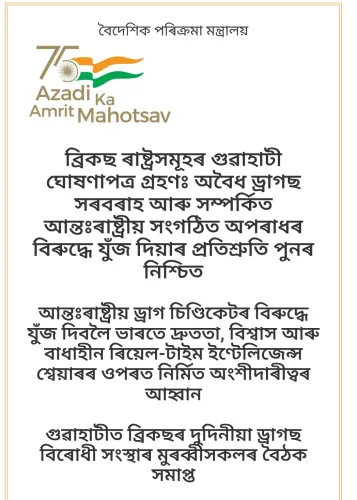
BRICS has adopted the Guwahati Declaration to deepen cooperation against drug trafficking, announced by the Chief Minister's Office of Assam on 8 July 2026. The move places Assam's largest city at the centre of a major multilateral security commitment, reflecting India's Northeast as a frontline zone in combating narcotics flows from the Golden Triangle.
Key Takeaways
BRICS adopted the Guwahati Declaration on 8 July 2026 to strengthen the multilateral fight against drug trafficking.
The declaration was shared by the Chief Minister's Office of Assam , highlighting the state's direct stake in the agreement.
Guwahati , Assam's largest city, lent its name to the declaration, marking a significant sub-national visibility moment within a major intergovernmental forum.
Assam borders Myanmar and Bangladesh , placing it along key drug-trafficking corridors linked to the Golden Triangle .
BRICS has progressively expanded its agenda from economic coordination to non-traditional security threats, including narcotics, since the 2010s .
Follow-up working-group meetings and joint operations will determine how the declaration is operationalised across member states.
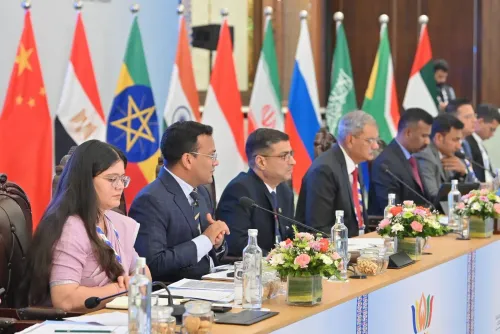
The Chief Minister's Office of Assam announced on Wednesday, 8 July 2026 that BRICS has adopted the Guwahati Declaration, a multilateral commitment aimed at strengthening the collective fight against drug trafficking. The declaration marks a significant moment for Guwahati, Assam's largest city, which lent its name to the landmark agreement.
Context
The Guwahati Declaration places the northeastern Indian city at the centre of a major multilateral security initiative. Assam shares borders with Myanmar and Bangladesh, positioning it along active drug-trafficking corridors linked to the Golden Triangle — one of the world's largest opium-producing regions. By hosting or associating the declaration with Guwahati, India has drawn direct attention to the region's frontline role in combating narcotics flows.
The Chief Minister's Office of Assam shared the development, signalling the state government's active stake in the outcome. The move aligns with India's broader pattern of using sub-national venues to highlight regional dimensions within larger intergovernmental groupings.
Policy Backdrop
BRICS — the intergovernmental grouping of major emerging economies including Brazil, Russia, India, China, and South Africa, expanded in 2024 with additional members — has progressively broadened its agenda from economic coordination to non-traditional security threats. Annual BRICS declarations since the 2010s have consistently included provisions on countering transnational organised crime and drug trafficking, reflecting shared concerns over supply routes spanning Asia, Africa, and Latin America.
At the domestic level, India's 2014 National Policy on Narcotic Drugs and Psychotropic Substances emphasised international cooperation alongside enforcement. The Guwahati Declaration represents a continuation of that multilateral approach, now embedded within the BRICS framework at a time when synthetic drugs and heroin remain serious concerns across India's Northeast.
Stakeholders and Impact
Law enforcement agencies across BRICS member states stand to benefit from the enhanced cooperation framework the declaration envisions. For Assam and neighbouring northeastern states, which have long served as both transit and consumption zones for illicit narcotics, the declaration offers multilateral backing for local and regional enforcement efforts.
Border communities in Assam, Manipur, and Mizoram — areas most directly affected by drug trafficking from Myanmar — are among the primary stakeholders. A strengthened BRICS framework could translate into better intelligence-sharing, coordinated interdiction operations, and capacity-building for agencies operating in difficult terrain.
What's Next
Attention will now turn to follow-up BRICS working-group meetings and whether the declaration is operationalised through joint operations or formal bilateral arrangements. References to the Guwahati Declaration are likely to surface in India's upcoming parliamentary sessions and in bilateral talks with Myanmar and Bangladesh. The declaration's real impact will ultimately be measured by the concrete enforcement actions and institutional mechanisms that member states put in place in the months ahead.
Point of View
The association offers political capital — framing a state-level crisis within a prestigious multilateral framework. The true test will be whether the declaration produces binding enforcement cooperation or remains aspirational language, as many BRICS security commitments have historically done.
NationPress
8 Jul 2026
Frequently Asked Questions
What is the Guwahati Declaration adopted by BRICS?
The Guwahati Declaration is a multilateral agreement adopted by BRICS member states on 8 July 2026 to strengthen collective action against drug trafficking, with Guwahati, the largest city in Assam, lending its name to the accord.
Why was the BRICS declaration named after Guwahati?
Guwahati, as Assam's largest city and a key hub in India's Northeast, was associated with the declaration to highlight the region's frontline role in combating narcotics flows from the Golden Triangle corridor spanning Myanmar and Southeast Asia.
What is BRICS and who are its members?
BRICS is an intergovernmental grouping of major emerging economies originally comprising Brazil, Russia, India, China, and South Africa, expanded in 2024 with additional member states, focused on reforming global governance and addressing shared security and economic challenges.
How does Assam relate to drug trafficking in India?
Assam shares borders with Myanmar and Bangladesh and sits along active drug-trafficking corridors linked to the Golden Triangle, making it both a transit zone and a region significantly affected by the flow of heroin and synthetic drugs.
What happens after the Guwahati Declaration is adopted?
Follow-up BRICS working-group meetings and potential joint operations are expected to operationalise the declaration, with its provisions likely to feature in India's bilateral talks with Myanmar and Bangladesh and in parliamentary discussions.