Niti Valley Emerges as Uttarakhand's New Tourism Hub
Synopsis
The Chief Minister's Office of Uttarakhand has highlighted Niti Valley in Chamoli district as an emerging tourism destination, with growing employment opportunities in the Indo-Tibetan border region — part of the state's broader push to develop frontier areas economically.
Key Takeaways
Niti Valley in Chamoli district is being promoted as Uttarakhand's newest tourism destination by the state's Chief Minister's Office.
The valley lies near the Indo-Tibetan border and was historically a trans-Himalayan trade corridor.
New employment opportunities for border communities and local youth are cited as a key benefit of tourism growth in the area.
The development aligns with Uttarakhand Tourism Policy 2018 , which prioritised border tourism circuits beyond traditional pilgrimage sites.
The push mirrors India's national strategy of increasing civilian infrastructure and presence along the Line of Actual Control .
Future indicators include tourist arrival figures for Chamoli and state budget allocations for Niti Valley infrastructure.
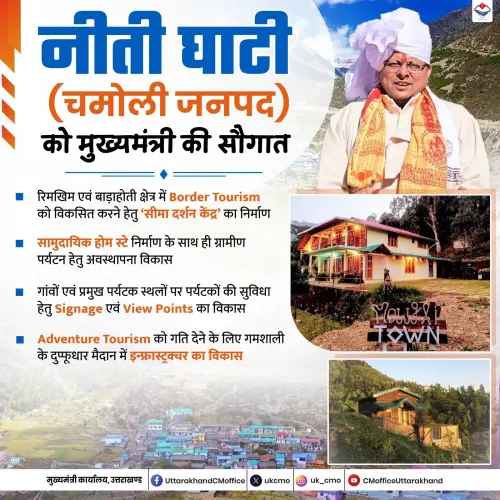
The Chief Minister's Office of Uttarakhand announced on 8 July 2026 that Niti Valley in Chamoli district is rapidly emerging as a new tourism destination for the state, with fresh employment opportunities taking shape in the frontier region.
The official post declared: 'Niti Ghati ban rahi Uttarakhand ka naya paryatan kendra, simant kshetra mein badh rahe rojgar ke naye avsar' — 'Niti Valley is becoming Uttarakhand's new tourism centre, with new employment opportunities growing in the border area.'
Context
Niti Valley is a remote Himalayan valley tucked into Chamoli district, situated close to the Indo-Tibetan border. Historically, the valley served as a corridor for trans-Himalayan trade routes before those links were severed following the 1962 Sino-Indian conflict. Its high-altitude landscape, biodiversity, and proximity to the border have long made it a point of strategic and ecological interest.
Chamoli district already draws large numbers of pilgrims and tourists to sites such as Badrinath and the Valley of Flowers, a UNESCO World Heritage Site. Niti Valley represents an effort to broaden that tourist footprint beyond established pilgrimage circuits into less-visited frontier terrain.
Policy Backdrop
The push aligns with Uttarakhand's Tourism Policy 2018, which explicitly identified the development of new destinations and border tourism circuits as a strategic priority, aiming to reduce dependence on a handful of pilgrimage sites and spread economic benefits more evenly across the state's Himalayan districts.
Across several Himalayan states, controlled opening of border valleys for civilian tourism has become a recognised tool for generating local livelihoods and sustaining year-round economic activity. The approach also dovetails with India's broader national strategy of building infrastructure and increasing civilian presence in areas adjacent to the Line of Actual Control (LAC), reinforcing the state's strategic geography through economic activity.
Stakeholders and Impact
The communities most directly affected are border villages in and around Niti Valley, whose residents have historically faced limited livelihood options due to the region's remoteness and restricted access. Tourism development offers the prospect of income through homestays, guiding services, porter work, and local handicrafts.
Local youth stand to benefit from hospitality and adventure-tourism roles that do not require migration to urban centres. Sustained tourist inflows can also incentivise the state to invest further in road connectivity, medical facilities, and digital infrastructure in these strategically sensitive villages, strengthening both civilian welfare and border security indirectly.
What's Next
Observers will watch for tourist arrival data from Chamoli district in coming seasons and any dedicated budget allocations for Niti Valley infrastructure in upcoming state fiscal announcements. The pace of road and accommodation development in the valley will be a key indicator of whether the government's stated ambition translates into measurable ground-level change.
If Niti Valley successfully establishes itself on the adventure and border-tourism map, it could serve as a template for opening other frontier valleys in Uttarakhand and neighbouring Himalayan states, creating a replicable model for frontier-area economic development.
Point of View
Which carries political weight in a region where migration has long hollowed out villages. This fits a broader pattern across Himalayan states where tourism is being deployed as an instrument of both economic policy and soft border management. The real test will come in budget allocations and infrastructure delivery timelines, which have historically lagged behind announcements in Uttarakhand's more remote districts.
NationPress
9 Jul 2026
Frequently Asked Questions
Where is Niti Valley located in Uttarakhand?
Niti Valley is located in Chamoli district of Uttarakhand, close to the Indo-Tibetan border . It is a high-altitude Himalayan valley that historically served as a trans-Himalayan trade route.
Why is Niti Valley being developed for tourism?
The Uttarakhand government is developing Niti Valley to diversify tourism beyond established pilgrimage sites, generate employment in border communities, and increase civilian activity near the Line of Actual Control, in line with the state's Tourism Policy 2018 .
What employment opportunities does Niti Valley tourism offer?
Tourism in Niti Valley is expected to create livelihoods in homestays, guiding, porter services, and local handicrafts, particularly benefiting local youth and border village communities who have had limited economic options due to the region's remoteness.
Is Niti Valley open for tourists?
Niti Valley has been progressively opened for tourism as part of Uttarakhand's border-area development push. Visitors typically require Inner Line Permits due to its proximity to the international border. Travellers should check current permit requirements before planning a visit.
How does Niti Valley compare to other Chamoli tourist spots?
Unlike the well-established pilgrimage site of Badrinath and the Valley of Flowers in Chamoli district, Niti Valley is a frontier destination being developed to attract adventure and nature tourists, offering a less-visited, high-altitude experience near the Indo-Tibetan border.