CM Siddaramaiah marks 3 years with Karnataka revenue milestones
Synopsis
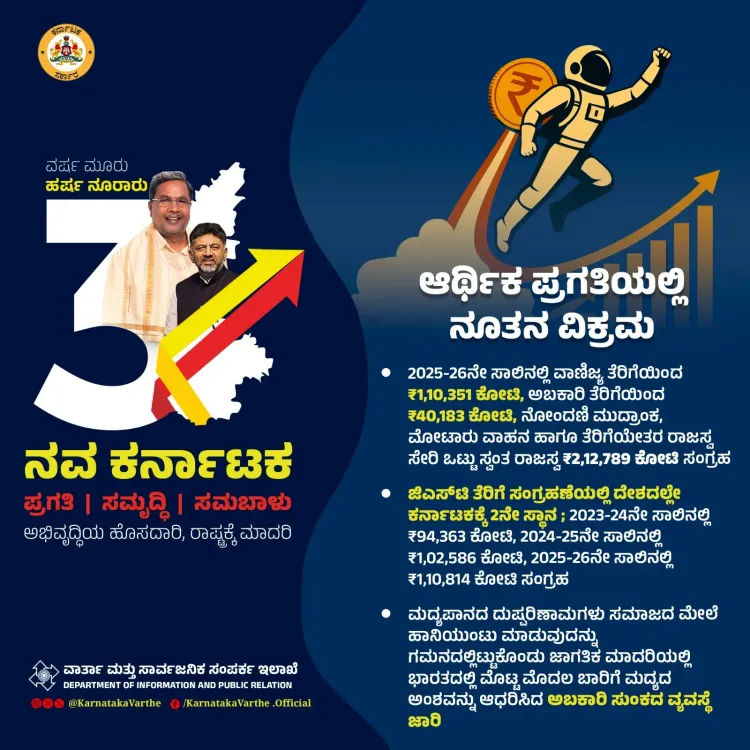
The Chief Minister's Office of Karnataka marked three years of the Congress government on 24 May 2026, highlighting ₹2,12,789 crore in own-state revenue for 2025-26, a second-place national GST ranking, and the rollout of India's first alcohol-content-based excise duty under the Nava Karnataka programme.
Key Takeaways
The Karnataka Congress government completed three years in office on 24 May 2026 , dedicating its achievements to every Kannadiga.
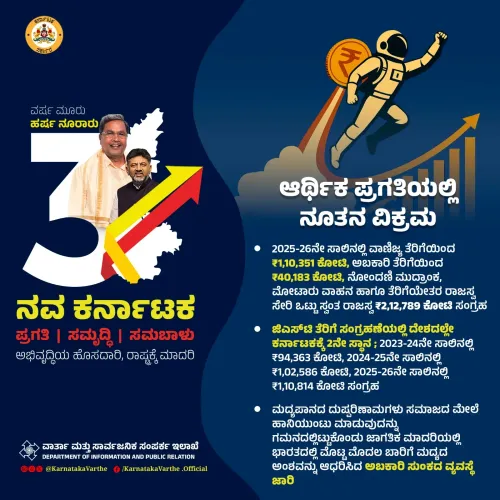
Total own-state revenue for 2025-26 stood at ₹2,12,789 crore , including ₹1,10,351 crore from commercial taxes and ₹40,183 crore from excise.
Karnataka ranked second nationally in GST collections, with receipts growing from ₹94,363 crore (2023-24) to ₹1,10,814 crore (2025-26).
The state introduced what it described as India's first alcohol-content-based excise duty , aligning with global public-health taxation models.
The government pledged that its reform efforts would be 'even faster and more effective' in the years ahead under the Nava Karnataka framework.
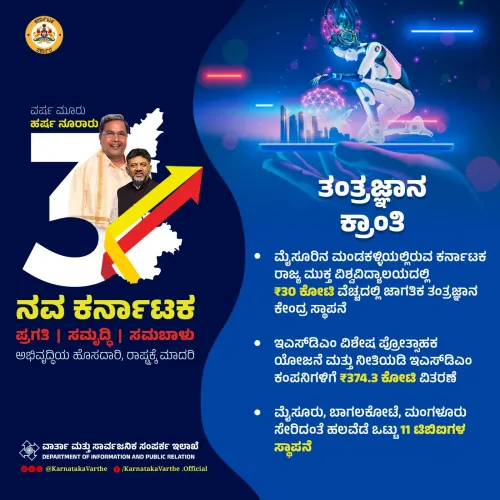
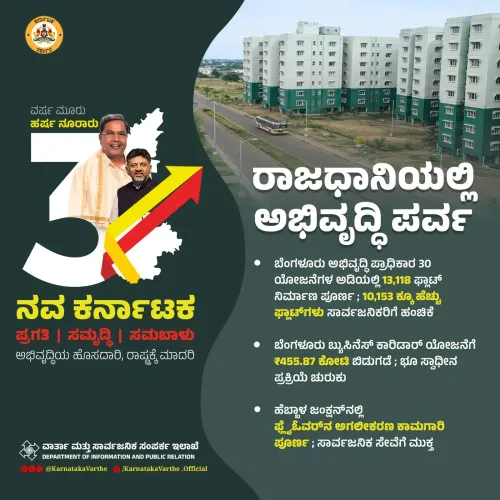
The Chief Minister's Office of Karnataka marked the third anniversary of the Congress government on 24 May 2026, crediting every Kannadiga for the administration's achievements and reaffirming its commitment to fulfilling all pre-election promises made to the people of the state.
The post, written in Kannada, stated: 'ರಾಜ್ಯದ ಜನರ ಆಶೀರ್ವಾದದೊಂದಿಗೆ ನಾವು ಅಧಿಕಾರಕ್ಕೆ ಬಂದು ಮೂರು ವರ್ಷಗಳು ಪೂರೈಸಿರುವ...' ('With the blessings of the people of the state, as we complete three years in power, we dedicate the credit for all our government's achievements to every Kannadiga.')
Context
Chief Minister Siddaramaiah led the Karnataka Congress to a decisive assembly election victory in May 2023, forming the government under the banner of Nava Karnataka — a five-year programme anchored on welfare delivery, revenue mobilisation, and social justice. The anniversary post frames three years of governance as proof that the party 'walked the talk' on its manifesto commitments. The statement declared: 'We are proud to have lived up to every word given to the people of the state before the elections.'
Policy Backdrop
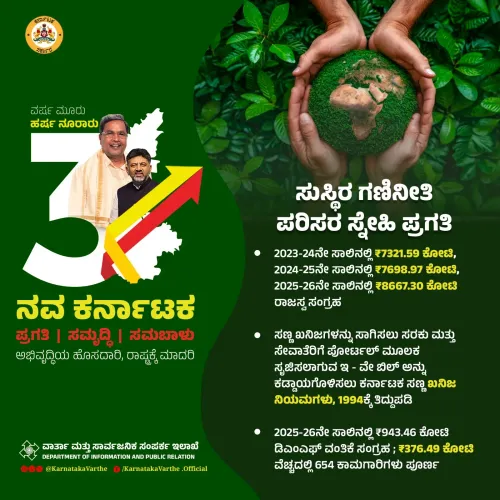
On the fiscal front, the government cited ₹2,12,789 crore in total own-state revenue for 2025-26, comprising ₹1,10,351 crore from commercial taxes, ₹40,183 crore from excise, and the remainder from registration, stamp duty, motor-vehicle levies, and non-tax sources. Karnataka also claimed the second rank nationally in GST collections, with receipts rising from ₹94,363 crore in 2023-24 to ₹1,02,586 crore in 2024-25 and ₹1,10,814 crore in 2025-26.
The state's consistent GST performance is underpinned by its large manufacturing and information-technology base, which has made Bengaluru a significant contributor to national indirect-tax receipts. Indian states have leaned harder on own non-GST revenues since the GST compensation guarantee to states lapsed, making excise and motor-vehicle taxes increasingly strategic levers.
A notable policy announcement in the post is the introduction of an alcohol-content-based excise duty — described as a first in India, modelled on global frameworks that calibrate levies to the actual alcohol percentage in a beverage rather than on its retail price or slab category. Such systems are common across OECD countries and are designed to simultaneously generate revenue and discourage consumption of high-strength liquor. The government framed the move as a public-health measure, noting the harmful social effects of alcohol.
Stakeholders and Impact
For Karnataka taxpayers, the revenue figures signal a state that has expanded its fiscal base without leaning entirely on central transfers. For the alcohol industry, the shift to content-based excise restructures cost calculations across product categories, potentially raising duties on high-strength spirits while easing them on low-alcohol beverages. State revenue officials will need to administer a more complex assessment mechanism than the existing slab or ad-valorem systems.
The Nava Karnataka branding also carries political weight: the Congress government has used the three-year milestone to contrast its delivery record against opposition criticism ahead of the next assembly cycle. Welfare schemes promised in the 2023 manifesto — including free electricity units, women's bus travel, and cash transfers — form the social-spending counterpart to the revenue achievements highlighted in this post.
What's Next
The government signalled that its pace of reform and delivery would accelerate, stating that 'our efforts will be even faster and more effective going forward.' The 2026-27 state budget and subsequent quarterly revenue disclosures will be the primary test of whether the new excise structure sustains collection growth while achieving its stated public-health objectives. How the alcohol-content duty performs in its first full fiscal year will also determine whether other states adopt similar models, as Karnataka's GST methods have already drawn study from peer governments.
Point of View
The Siddaramaiah government signals fiscal credibility to bond markets and rating agencies while simultaneously reassuring its core voters that promises have been kept. The alcohol-content excise claim is the most substantively novel element — if it withstands scrutiny, it positions Karnataka as a policy laboratory for the rest of India at a moment when states are competing to diversify revenue post-GST compensation. The accelerating GST collection trajectory also gives the government a counter-narrative against any centre-state fiscal friction arguments heading into the 2027-28 election cycle.
NationPress
19 Sept 2026
Frequently Asked Questions
How many years has the Karnataka Congress government completed?
The Karnataka Congress government led by Chief Minister Siddaramaiah completed three years in office as of May 2026 , having come to power after the May 2023 assembly election victory.
What is Karnataka's total own-state revenue for 2025-26?
Karnataka's total own-state revenue for 2025-26 was reported at ₹2,12,789 crore , covering commercial taxes, excise, registration, stamp duty, motor-vehicle levies, and non-tax sources.
What rank does Karnataka hold in GST collection in India?
Karnataka holds the second rank nationally in GST collection, with receipts reaching ₹1,10,814 crore in 2025-26, up from ₹94,363 crore in 2023-24.
What is the alcohol-content-based excise duty announced by Karnataka?
Karnataka introduced an excise duty system that levies tax based on the actual alcohol content in a beverage — a first in India according to the government — modelled on global public-health frameworks used in several OECD countries to curb high-strength liquor consumption.
What is Nava Karnataka?
Nava Karnataka is the Congress government's governance and branding framework launched after its 2023 election win, encompassing welfare schemes, infrastructure investment, and revenue reforms aimed at building what the government calls a 'strong, prosperous, and self-respecting Karnataka'.