CM Siddaramaiah marks 3 yrs with wildlife conflict push
Synopsis
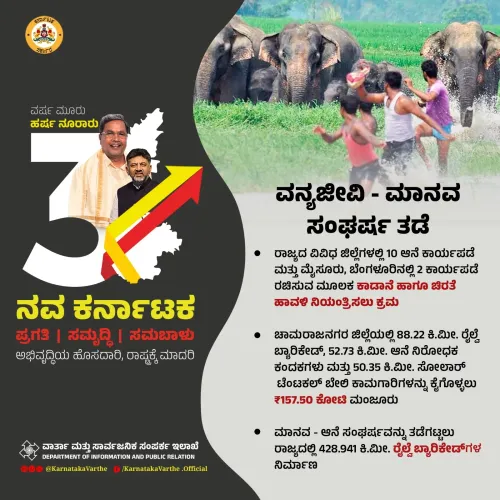
The Karnataka CMO marked three years of the Siddaramaiah government on 23 May 2026, spotlighting wildlife conflict measures including 12 elephant task forces, ₹157.50 crore sanctioned for Chamarajanagar barriers, and 428.941 km of railway barricades built statewide under the Nava Karnataka agenda.
Key Takeaways
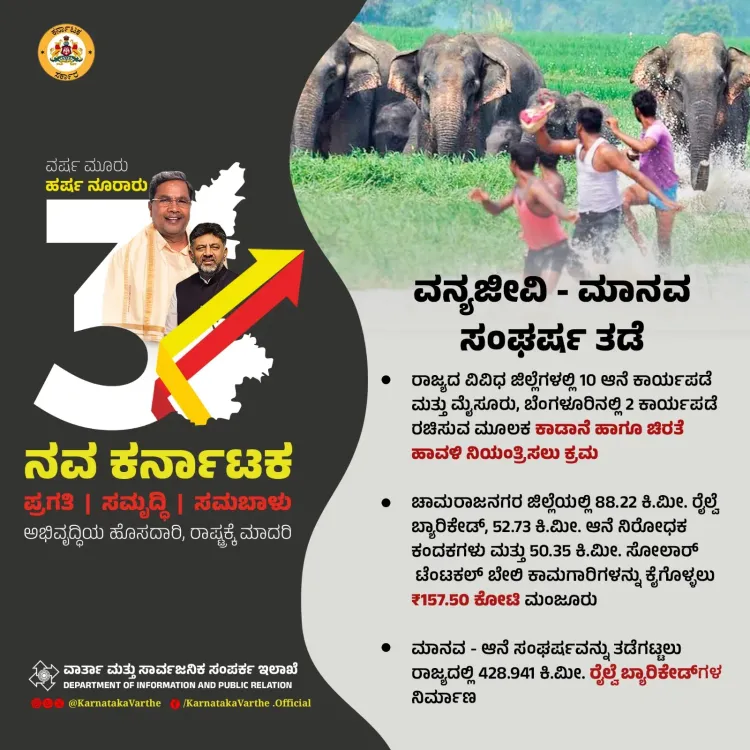
12 elephant task forces formed — 10 across various districts and 2 each in Mysuru and Bengaluru — to control wild elephant and leopard incursions. ₹157.50 crore sanctioned for wildlife conflict infrastructure in Chamarajanagar district alone.
Works in Chamarajanagar include 88.22 km of railway barricades, 52.73 km of elephant-proof trenches, and 50.35 km of solar tentacle fencing.
A total of 428.941 km of railway barricades constructed statewide to prevent human-elephant encounters.
Announcements made on the third anniversary of the Congress government in Karnataka, framed under the #NavaKarnataka vision.
The Chief Minister's Office of Karnataka marked the Congress government's third anniversary in power on Saturday, 23 May 2026, crediting every Kannadiga for the administration's achievements and reaffirming its commitment to pre-election promises — including a series of measures to curb human-elephant and leopard conflict across the state.
Posting in Kannada, the office stated: 'ರಾಜ್ಯದ ಜನರ ಆಶೀರ್ವಾದದೊಂದಿಗೆ ನಾವು ಅಧಿಕಾರಕ್ಕೆ ಬಂದು ಮೂರು ವರ್ಷಗಳು ಪೂರೈಸಿರುವ ಈ ಸಾರ್ಥಕ ಸಂದರ್ಭದಲ್ಲಿ' ('On this meaningful occasion of completing three years in power with the blessings of the people of the state'). The post listed wildlife conflict mitigation as one of the government's key deliverables under the hashtag #3YearsOfNavaKarnataka.
Context
The Siddaramaiah-led Karnataka government came to power in May 2023 after the Congress party won the state assembly elections. The third-anniversary communication, framed around the 'Nava Karnataka' (New Karnataka) vision, lists sectoral achievements across governance, and the wildlife conflict segment stands out for its scale of physical infrastructure announced. The post credits the government with pride in having 'walked the talk' — honouring every pre-election promise made to the people of the state, and pledging that efforts toward building a 'strong, prosperous, and self-respecting Karnataka' will accelerate further.Policy Backdrop
Karnataka has long grappled with human-elephant conflict, particularly in the forest-fringe zones of the Western Ghats and the Cauvery basin. Elephant-proof trenches, solar fences, and railway barricades have been deployed by the state since the 2000s as part of ongoing wildlife management programmes. The current government's announcements extend this lineage with a larger funding envelope and a dedicated task-force structure. According to the post, the government has constituted 10 elephant task forces across various districts and 2 additional task forces in Mysuru and Bengaluru to control wild elephant and leopard incursions. In Chamarajanagar district — one of southern Karnataka's most conflict-prone forest zones — the state has sanctioned ₹157.50 crore for works covering 88.22 km of railway barricades, 52.73 km of elephant-proof trenches, and 50.35 km of solar tentacle fencing. Across the state, a total of 428.941 km of railway barricades have been constructed to prevent human-elephant encounters.Stakeholders and Impact
The primary beneficiaries of these interventions are forest-fringe farming communities whose crops, livelihoods, and lives are most directly threatened by straying wildlife. Elephant incursions routinely destroy standing crops and, in the worst cases, result in human fatalities — making conflict mitigation both an ecological and a social-justice priority. The Karnataka Forest Department, which administers wildlife protection and conflict-response operations, is the implementing agency for these barrier projects. Dedicated task forces are expected to improve response time when animals stray into human settlements, reducing both animal casualties and human injuries. Similar barrier and task-force models have been adopted by other elephant-range states facing rising conflict incidents, suggesting Karnataka's approach is in line with emerging national best practice in wildlife management.What's Next
With the ₹157.50 crore Chamarajanagar package now sanctioned, attention will shift to implementation timelines and whether the physical infrastructure translates into a measurable reduction in conflict incidents. Independent impact assessments — tracking year-on-year conflict data before and after barrier completion — will be critical to evaluating the programme's effectiveness. Any supplementary allocation in the next state budget will signal whether the government intends to scale the model to other high-conflict districts in the Western Ghats corridor.Point of View
The CMO is attempting to shift the anniversary discourse from promise to proof. The scale of the Chamarajanagar package — ₹157.50 crore for a single district — also indicates that human-elephant conflict has moved from a peripheral conservation issue to a mainstream governance priority. Whether implementation matches the announcement will define how this record is judged as the government heads into its final two years.
NationPress
9 Oct 2026
Frequently Asked Questions
What has the Karnataka government done to control human-elephant conflict?
The Karnataka government has formed 12 elephant task forces statewide, sanctioned ₹157.50 crore for barriers in Chamarajanagar district, and constructed 428.941 km of railway barricades across the state to reduce human-elephant encounters.
How much money has Karnataka sanctioned for elephant-proof barriers in Chamarajanagar?
Karnataka has sanctioned ₹157.50 crore for works in Chamarajanagar district, covering 88.22 km of railway barricades, 52.73 km of elephant-proof trenches, and 50.35 km of solar tentacle fencing.
What is Nava Karnataka and why is it trending?
'Nava Karnataka' (New Karnataka) is the development vision of the Siddaramaiah-led Congress government. It trended on 23 May 2026 as the government marked three years in power with a recap of key achievements under the hashtag #3YearsOfNavaKarnataka.
Where is human-elephant conflict most severe in Karnataka?
Chamarajanagar district in southern Karnataka, along with forest-fringe zones of the Western Ghats and the Cauvery basin, are among the most conflict-prone areas, prompting the largest share of barrier infrastructure investment.
What are elephant task forces in Karnataka?
Elephant task forces are dedicated wildlife response units constituted by the Karnataka government to rapidly intervene when wild elephants or leopards stray into human settlements, aiming to reduce both animal and human casualties.