CM Siddaramaiah Marks 3 Years With Wildlife Push
Synopsis
Karnataka CM Siddaramaiah marked three years in office on 23 May 2026, highlighting ₹157.50 crore sanctioned for elephant-conflict barriers in Chamarajanagar, 12 wildlife task forces, and 428.941 km of railway barricades statewide under the Nava Karnataka agenda.
Key Takeaways
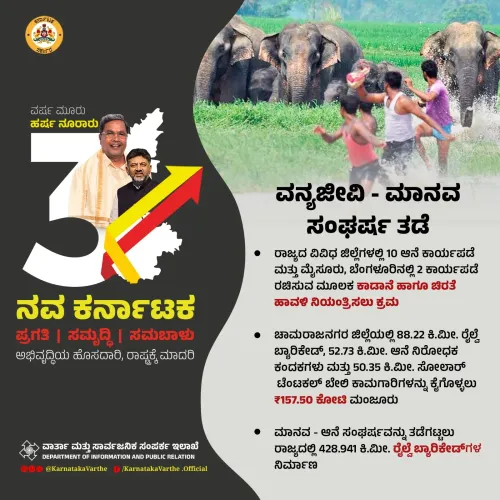
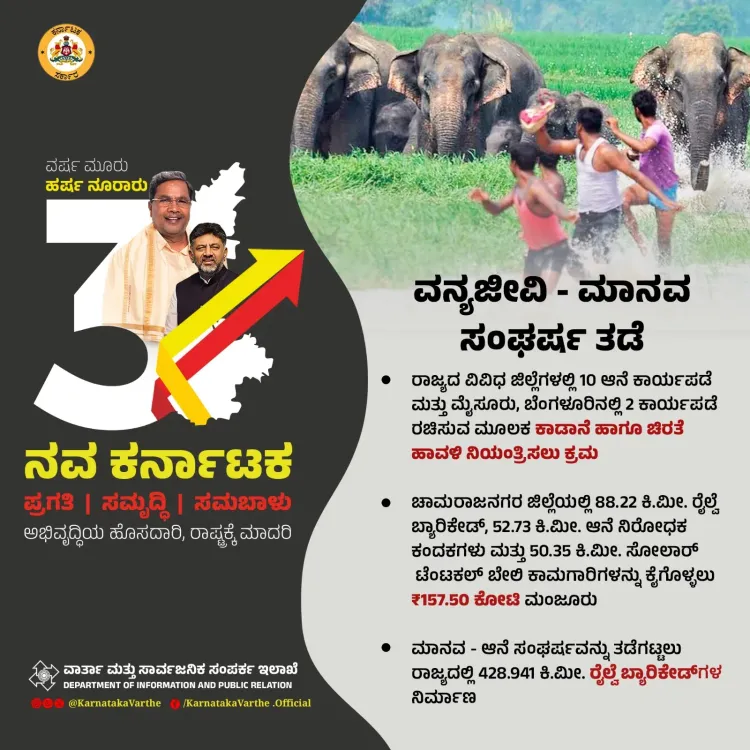
Karnataka CM Siddaramaiah completed three years in office on 23 May 2026 , dedicating the government's achievements to every Kannadiga. ₹157.50 crore has been sanctioned for wildlife-conflict infrastructure in Chamarajanagar district , including 88.22 km of railway barricades, 52.73 km of elephant-proof trenches, and 50.35 km of solar tentacle fencing.
A total of 428.941 km of railway barricades have been constructed across Karnataka to prevent human-elephant conflict.
10 elephant task forces have been formed across various districts, with 2 more in Mysuru and Bengaluru to tackle elephant and leopard incidents.
The government's campaign is branded Nava Karnataka , framing these measures as fulfilment of pre-election promises made in 2023 .
Karnataka Chief Minister Siddaramaiah on Saturday, 23 May 2026, marked three years of his Congress government in office by listing key governance achievements, with a significant focus on measures taken to curb human-elephant and human-leopard conflict across the state.
Context
Posting in Kannada on X, Siddaramaiah dedicated the government's record to every Kannadiga, writing: 'ರಾಜ್ಯದ ಜನರ ಆಶೀರ್ವಾದದೊಂದಿಗೆ' ('With the blessings of the people of the state'). He said the government had kept every promise made before the 2023 Karnataka Assembly elections and pledged that efforts toward building a 'strong, prosperous, and self-respecting Karnataka' would accelerate further.
The post was tagged #3YearsOfNavaKarnataka and #NavaKarnataka — the Congress government's branding for its five-year governance agenda centred on empowerment and inclusive development.
Policy Backdrop
Human-elephant conflict has been a persistent challenge in Karnataka, particularly in districts bordering the Western Ghats and the eastern forest fringe, driven by habitat fragmentation and agricultural expansion. Chamarajanagar, a southern Karnataka district with dense forest cover, has been among the most affected zones.
The government says it has sanctioned ₹157.50 crore for works in Chamarajanagar district alone, covering 88.22 km of railway barricades, 52.73 km of elephant-proof trenches, and 50.35 km of solar tentacle fencing. Across the state, the government claims construction of 428.941 km of railway barricades to prevent human-elephant encounters. Physical barriers, task forces, and solar fencing have been standard mitigation tools in Karnataka and neighbouring states such as Tamil Nadu and Kerala for several years.
The post also states that 10 elephant task forces have been formed across various districts, with 2 additional task forces in Mysuru and Bengaluru, to control incidents involving wild elephants and leopards. These measures align broadly with the objectives of Project Elephant, the centrally sponsored conservation and conflict-mitigation scheme launched by the Government of India in 1992.
Stakeholders and Impact
The primary beneficiaries of these interventions are farmers and residents in forest-fringe communities, who face recurring crop destruction and safety risks from wildlife straying into human settlements. Wildlife department personnel managing the task forces are also directly involved in implementation.
If the barricade and fencing works proceed as announced, they would represent one of the larger single-district investments in conflict mitigation in Karnataka's recent history. Independent verification of completion figures and their impact on conflict incident rates remains to be established.
What's Next
Attention will now turn to state budget allocations for the next phase of infrastructure, and whether independent assessments confirm a reduction in human-wildlife conflict incidents in areas where task forces and barriers have been deployed. With two years remaining in the government's term, Siddaramaiah has signalled that the pace of delivery will increase, setting the stage for these programmes to become a key plank of the Congress party's performance record ahead of the next Karnataka election.
Point of View
Foregrounding tangible infrastructure numbers — barricade kilometres, crore figures, task force counts — that are difficult for opponents to immediately contest. By anchoring the milestone to human-wildlife conflict, a politically safe issue that cuts across caste and community lines in forest-fringe Karnataka, the Congress government sidesteps more contentious performance debates. The Nava Karnataka branding signals that the party intends to fight the next state election on a delivery record rather than ideology. How much of the announced infrastructure is verifiably complete, and whether conflict incidents have actually declined, will be the real test of this narrative in the months ahead.
NationPress
7 Oct 2026
Frequently Asked Questions
How many years has Siddaramaiah been Chief Minister of Karnataka?
Siddaramaiah has completed three years as Chief Minister of Karnataka as of 23 May 2026, having taken office after the Congress party won the 2023 Karnataka Assembly elections.
What is Nava Karnataka?
Nava Karnataka is the Karnataka Congress government's branding for its five-year governance agenda, focused on empowerment, prosperity, and inclusive development for the state.
How much money has Karnataka sanctioned to control human-elephant conflict in Chamarajanagar?
The Karnataka government has sanctioned ₹157.50 crore for Chamarajanagar district, covering railway barricades, elephant-proof trenches, and solar tentacle fencing to reduce human-elephant conflict.
How many elephant task forces has Karnataka formed?
Karnataka has formed 10 elephant task forces across various districts, plus 2 additional task forces in Mysuru and Bengaluru, to control incidents involving wild elephants and leopards.
How long are the railway barricades built in Karnataka to prevent elephant attacks?
According to the government's announcement, a total of 428.941 km of railway barricades have been constructed across Karnataka to prevent human-elephant conflict.