CM Karnataka Marks 3 Years With Transport Worker Welfare Push
Synopsis
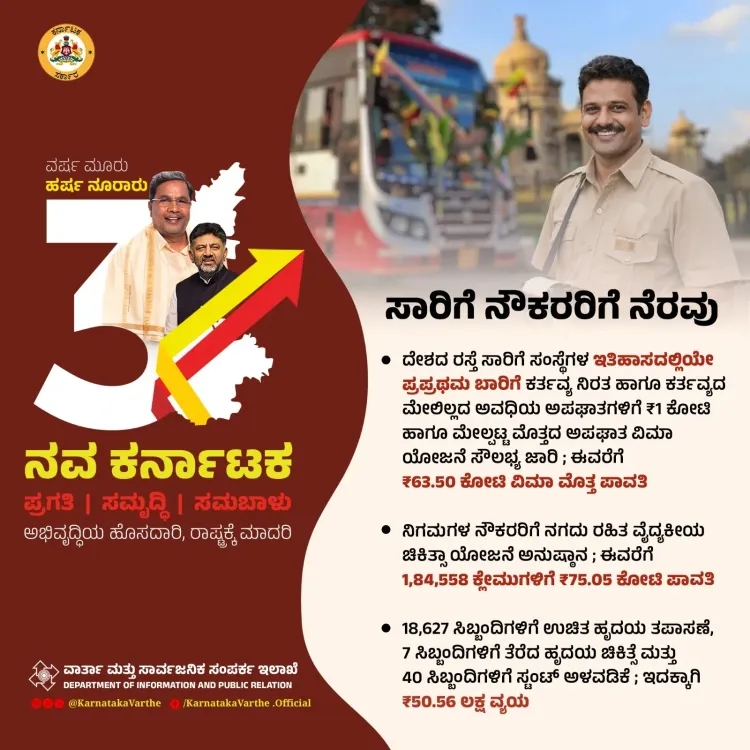
On its three-year anniversary, the Karnataka Congress government highlighted landmark welfare measures for road-transport corporation staff, including a first-of-its-kind ₹1 crore accident insurance scheme with ₹63.50 crore paid out, a cashless medical scheme covering over 1.84 lakh claims, and free cardiac care for thousands of employees.
Key Takeaways
The Karnataka Congress government completed three years in office on 24 May 2026 , marking the occasion under the #NavaKarnataka campaign.
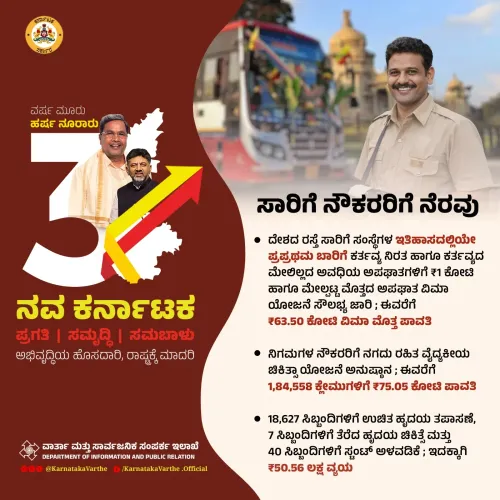
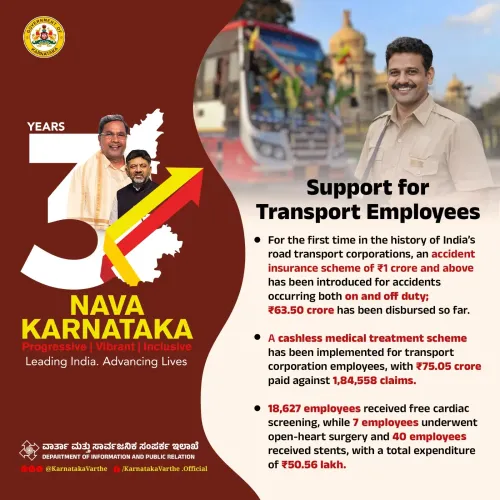
A ₹1 crore-and-above accident insurance scheme for road-transport corporation employees — covering both on-duty and off-duty periods — has paid out ₹63.50 crore so far, described as a first for any road-transport body in India.
A cashless medical treatment scheme for corporation staff has settled 1,84,558 claims totalling ₹75.05 crore .
18,627 employees received free cardiac screenings; 7 underwent open-heart surgery and 40 received stent implants at a cost of ₹50.56 lakh .
The government stated it has honoured every pre-election promise and pledged to accelerate development efforts in the remaining term.
The Chief Minister's Office of Karnataka marked the Congress government's three-year anniversary in power on 24 May 2026 by releasing a detailed account of welfare and social-security deliverables, with a focus on road-transport corporation employees and public-sector staff across the state.
The post, written in Kannada, opened by dedicating all governmental achievements to every Kannadiga: 'ಪ್ರತಿಯೊಬ್ಬ ಕನ್ನಡಿಗನಿಗೂ ಅರ್ಪಿಸುತ್ತಿದ್ದೇವೆ' ('we dedicate this to every Kannadiga'). The government stated it had kept every pre-election promise and that its efforts to build a 'strong, prosperous, and self-respecting Karnataka' would accelerate further.
Context
Chief Minister Siddaramaiah led the Indian National Congress to a majority in the May 2023 Karnataka assembly elections, ending the BJP's tenure in the state. The government's three-year milestone, branded under the #NavaKarnataka and #3YearsOfNavaKarnataka campaign, is being used to highlight delivery on manifesto commitments, particularly for organised labour in the public sector.
The anniversary communication centres on three specific welfare measures rolled out for employees of state road-transport corporations, a constituency that has historically been central to Karnataka's public-sector policy debates.
Policy Backdrop
In what the government described as a first in the history of road-transport organisations across India, an accident insurance scheme of ₹1 crore and above has been implemented covering both on-duty and off-duty periods for transport workers. The government stated that ₹63.50 crore has been paid out under this scheme so far.
A cashless medical treatment scheme for corporation employees has processed 1,84,558 claims, with ₹75.05 crore disbursed. Separately, 18,627 staff members received free cardiac screenings; of these, 7 employees underwent open-heart surgery and 40 employees received stent implants, with a total expenditure of ₹50.56 lakh on these cardiac interventions.
Stakeholders and Impact
The primary beneficiaries are employees of Karnataka's state-run road-transport corporations, a large organised workforce that had long sought enhanced social security beyond basic government provisions. The cashless medical scheme in particular addresses a gap that left many lower-income transport workers dependent on out-of-pocket spending for hospitalisation.
State governments across India have increasingly used power anniversaries to enumerate welfare deliverables, a practice that reflects competitive federalism — states benchmarking their social-security offerings against one another. Karnataka's accident insurance coverage, framed as a national first for road-transport bodies, is positioned as a differentiator in that landscape.
What's Next
The government signalled that its welfare and development push would become 'faster and more effective' in the period ahead, suggesting further scheme expansions may be announced in upcoming state budgets or legislative sessions. Observers will watch whether the beneficiary and payout figures cited are tabled formally in the state assembly and whether the insurance and cashless-medical schemes are extended to additional categories of public-sector employees.
With the Karnataka government now entering the second half of its five-year term, the political pressure to demonstrate tangible delivery — particularly on the five guarantee schemes promised in 2023 — will intensify as the next election cycle approaches.
Point of View
Politically vocal constituency — road-transport workers — rather than broader infrastructure or fiscal metrics. By framing the accident insurance scheme as a national first, the Congress administration is positioning Karnataka as a model state for labour welfare, a narrative useful both domestically and in national party politics. With the government now past its midpoint, the shift in tone from 'we have delivered' to 'we will accelerate' signals an awareness that the second half of the term must produce visible momentum. The data-heavy communication style also reflects a broader Congress strategy of countering perception gaps with enumerated outcomes ahead of the next electoral cycle.
NationPress
14 Oct 2026
Frequently Asked Questions
How many years has the Karnataka Congress government completed in 2026?
The Karnataka Congress government completed three years in office as of May 2026 , having come to power after winning the state assembly elections in May 2023.
What is the accident insurance scheme for Karnataka transport workers?
The Karnataka government has implemented an accident insurance scheme of ₹1 crore and above for road-transport corporation employees, covering accidents both on duty and off duty. The government states this is the first such scheme in the history of road-transport organisations in India, with ₹63.50 crore paid out so far.
What is the cashless medical scheme for Karnataka corporation employees?
Karnataka's cashless medical treatment scheme for public-sector corporation employees has processed 1,84,558 claims and disbursed ₹75.05 crore in payments since its implementation.
What cardiac care has the Karnataka government provided to transport staff?
18,627 employees received free cardiac screenings; 7 underwent open-heart surgery and 40 received stent implants. The total expenditure on these cardiac interventions was ₹50.56 lakh .
What is Nava Karnataka?
'Nava Karnataka' is the official branding for the Karnataka Congress government's development and welfare agenda launched after the party's 2023 election victory. It serves as the umbrella identity for the government's schemes, campaigns, and three-year anniversary communications.