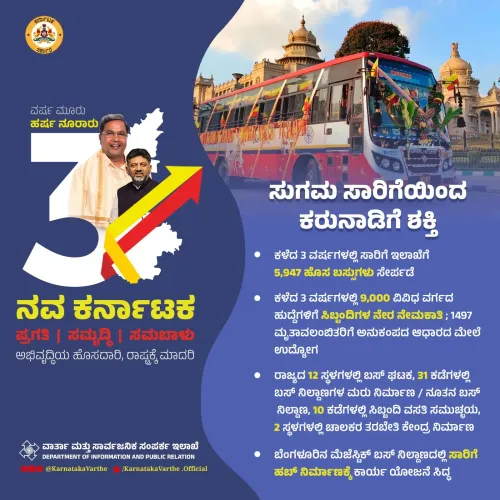
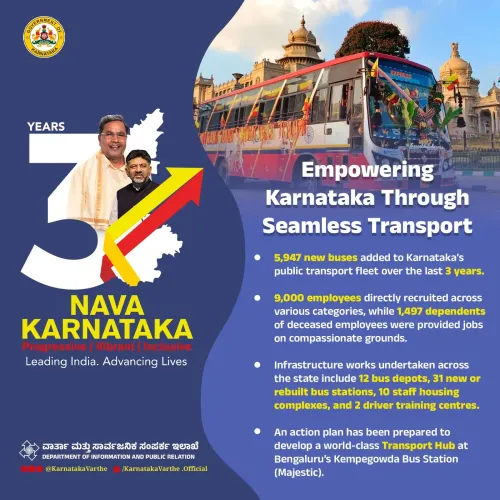
CM Siddaramaiah marks 3 years of transport worker welfare
Synopsis
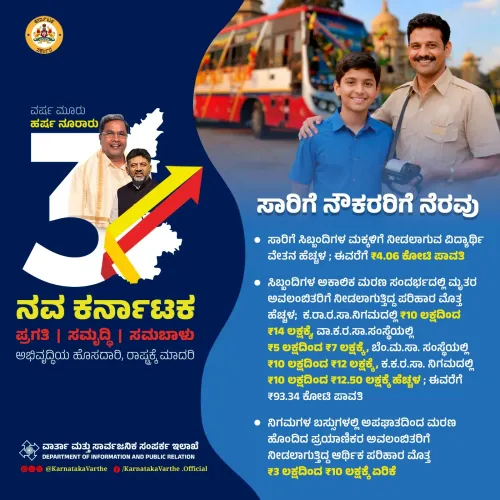
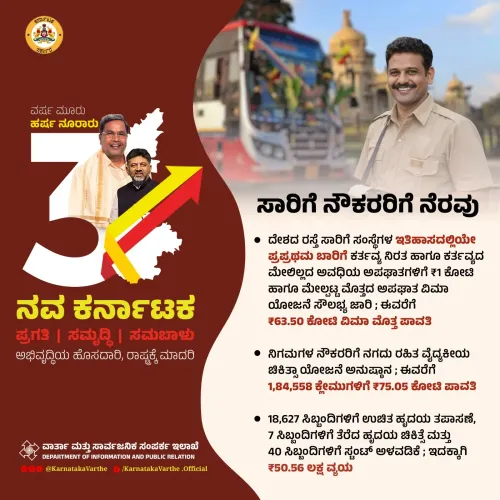
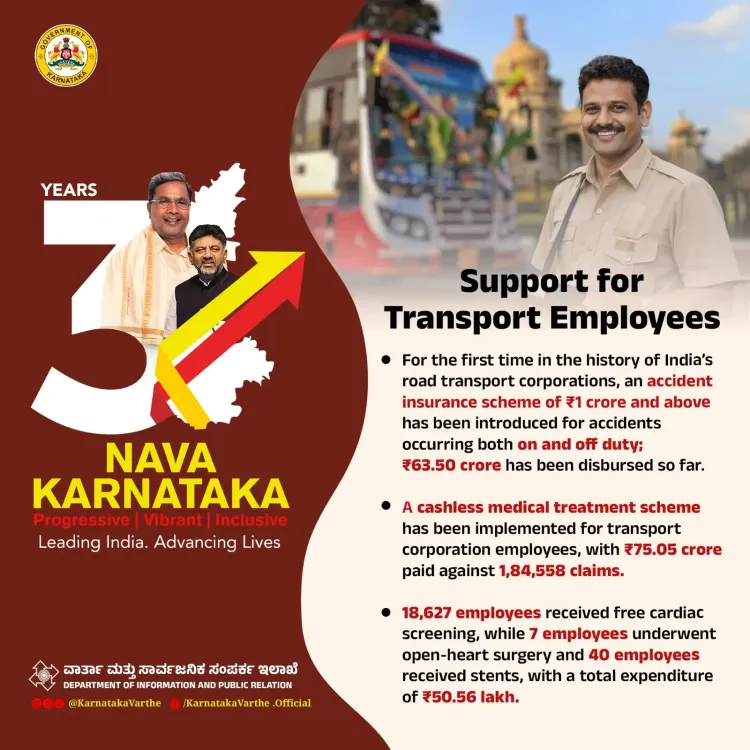
Karnataka Chief Minister Siddaramaiah has marked three years of his government's welfare drive for state transport employees, citing a first-of-its-kind accident insurance scheme, cashless medical treatment, and cardiac screening for KSRTC workers and their families under the 'Nava Karnataka' guarantee framework.
Key Takeaways
Chief Minister Siddaramaiah on 22 May 2026 commemorated three years of the Karnataka government's welfare initiatives for transport workers.
The government has introduced an accident insurance scheme described as a first-of-its-kind for Karnataka's transport employees.
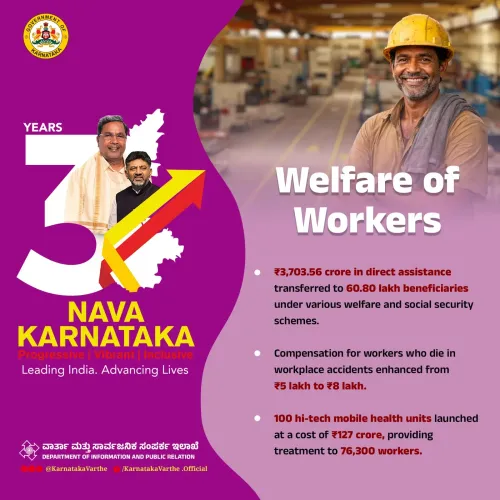
Cashless medical treatment and advanced cardiac screening are among the healthcare benefits extended to transport staff and their families.
The measures primarily benefit employees of the Karnataka State Road Transport Corporation (KSRTC) , the state's main public bus operator.
The initiatives form part of the broader 'Guarantee Sarkara' welfare framework introduced after the May 2023 assembly election victory.
Performance audits of the insurance and cardiac screening schemes are expected to feature in the next legislative session.
Karnataka Chief Minister Siddaramaiah on Friday, 22 May 2026, marked three years of the state government's welfare initiatives for transport employees, highlighting measures including an accident insurance scheme, cashless medical treatment, cardiac screening, and broader healthcare support for workers and their families.
Context
The post, shared under the hashtags #3YearsOfNavaKarnataka and #GuaranteeSarkara, commemorates the completion of three years since the Congress government assumed office in Karnataka following the May 2023 assembly elections. Siddaramaiah, who returned to the Chief Minister's office after a decade, has anchored his administration's identity around a set of guarantee schemes aimed at workers and vulnerable groups.
In his post, the Chief Minister stated: 'Three years of putting the wellbeing and security of Karnataka's transport employees at the centre of governance.' He added that 'a stronger public transport system begins with caring for the people who keep it running every day.'
Policy Backdrop
The welfare measures cited by Siddaramaiah target employees of state-run public transport, principally the Karnataka State Road Transport Corporation (KSRTC), the primary provider of road bus services across the state. The government has described the accident insurance scheme as a first-of-its-kind initiative for transport workers in the state.
The Congress government's broader 'guarantee' framework, introduced after the 2023 election, encompasses social security and welfare commitments across multiple sectors. The transport worker benefits — including cashless medical treatment and advanced cardiac screening — sit within this larger policy architecture aimed at professionalising essential public services through employee-centric measures.
Indian state governments have periodically introduced targeted health and insurance benefits for public sector transport staff, with evidence suggesting such measures help maintain service reliability and reduce absenteeism in states with large public transport networks.
Stakeholders and Impact
KSRTC and other state transport undertaking employees, along with their families, are the primary beneficiaries of the schemes cited. The cashless medical treatment and cardiac screening components are positioned as addressing the occupational health risks specific to professional drivers and transport staff, who face elevated cardiovascular and fatigue-related health burdens.
The government's framing connects employee welfare directly to service quality, arguing that the security and dignity of transport workers underpins the reliability of Karnataka's public bus network, which serves millions of daily commuters across urban and rural routes.
What's Next
Attention will turn to the next legislative session, where state budget allocations and performance audits of the accident insurance and cardiac screening schemes are expected to come under scrutiny. There is also a question of whether the government will extend comparable benefits to employees of other state transport undertakings beyond KSRTC.
The three-year milestone post signals that Siddaramaiah's administration intends to keep the 'Nava Karnataka' and 'Guarantee Sarkara' branding active heading into the latter half of its term, with welfare delivery as a central political narrative.
Point of View
Reinforcing the 'Guarantee Sarkara' brand ahead of the second half of his term. By centring transport workers — a large, organised constituency in a state with an extensive public bus network — the administration is signalling that its welfare commitments extend beyond headline cash-transfer schemes to occupational security. The cardiac screening and cashless treatment components are notable because they address sector-specific health risks, a more targeted approach than generic insurance coverage. Whether the government can demonstrate measurable outcomes in beneficiary numbers and claim settlements will determine how durable this narrative proves in the run-up to the next electoral cycle.
NationPress
22 Sept 2026
Frequently Asked Questions
What welfare schemes has the Karnataka government introduced for transport workers?
The Karnataka government has introduced an accident insurance scheme, cashless medical treatment, and advanced cardiac screening for state transport employees and their families, primarily targeting KSRTC staff.
What is the 'Guarantee Sarkara' in Karnataka?
'Guarantee Sarkara' refers to the Congress government's framework of welfare commitments introduced after its 2023 Karnataka assembly election victory, covering social security and support for workers and vulnerable groups across multiple sectors.
Who are the main beneficiaries of Karnataka's transport worker welfare schemes?
Employees of the Karnataka State Road Transport Corporation (KSRTC) and their families are the primary beneficiaries, with the schemes covering accident insurance, cashless hospitalisation, and cardiac health screening.
What is Nava Karnataka?
'Nava Karnataka' ('New Karnataka') is the branding used by Chief Minister Siddaramaiah's administration to describe its governance agenda, emphasising welfare delivery and social security as defining features of the Congress government since 2023.
Will Karnataka extend transport welfare benefits to other state undertakings?
A possible extension of similar accident insurance and healthcare benefits to employees of other state transport undertakings beyond KSRTC is being watched, though no formal announcement has been made.