CM Siddaramaiah marks 3 years of worker welfare under Nava Karnataka
Synopsis
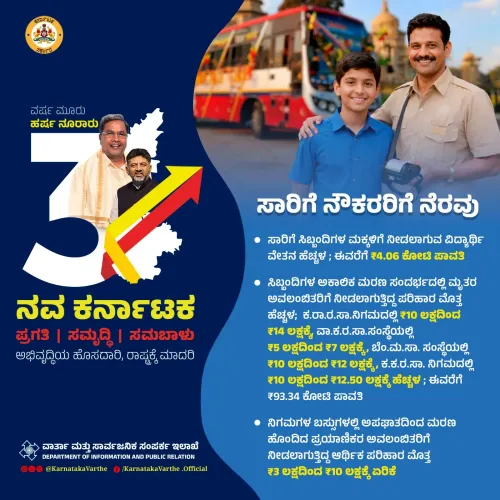
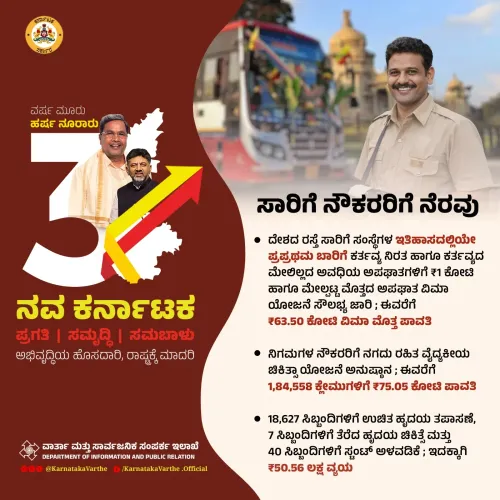
Karnataka Chief Minister Siddaramaiah marked three years of the Nava Karnataka government on 22 May 2026, highlighting direct financial aid, enhanced accident compensation, and hi-tech mobile health units as cornerstones of the administration's worker welfare agenda.
Key Takeaways
Karnataka CM Siddaramaiah posted on 22 May 2026 marking three years of the Nava Karnataka government.
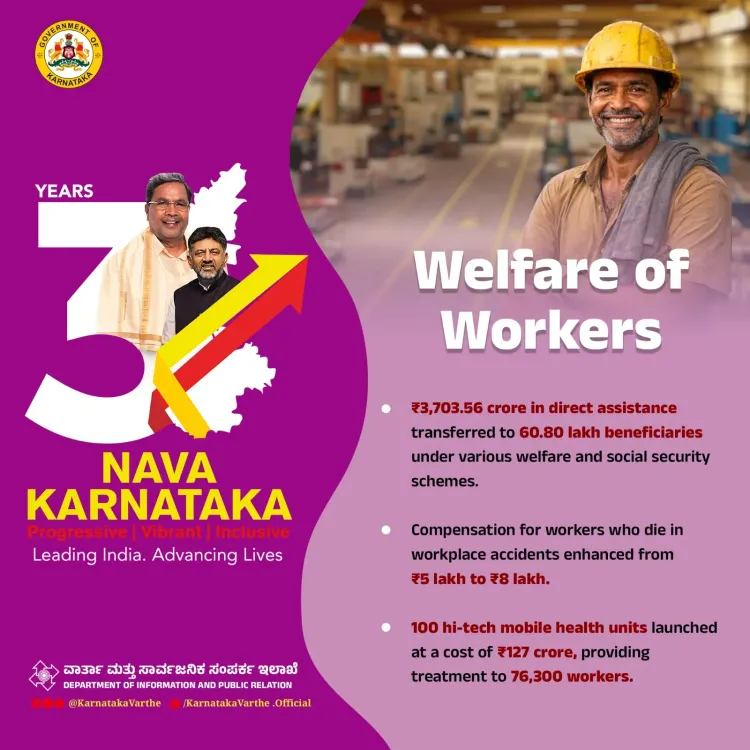
The government claims to have provided direct financial assistance and enhanced compensation for workplace accidents to workers.
Hi-tech mobile health units have been launched specifically to serve labourers across the state.
The initiatives target workers in construction and industrial sectors , a large segment of Karnataka's informal workforce.
The welfare push is framed under the broader GuaranteeSarkara framework, which positions welfare measures as binding commitments.
Scheme outcomes are expected to face scrutiny in upcoming Karnataka Legislative Assembly sessions.
Karnataka Chief Minister Siddaramaiah on Friday, 22 May 2026, highlighted three years of worker-focused welfare initiatives under the Nava Karnataka banner, citing direct financial assistance, enhanced workplace accident compensation, and hi-tech mobile health units for labourers as key achievements of his government.
Context
The post marks a symbolic milestone for the Congress-led Karnataka government, which came to power in May 2023. The Nava Karnataka initiative has served as the thematic umbrella under which the administration has framed its welfare and development agenda. Siddaramaiah described the effort as ensuring 'workers are not left behind in Karnataka's growth story.'
The Chief Minister's message centred on three pillars: financial aid to workers, compensation improvements for on-the-job accidents, and mobile health outreach for labourers — particularly those in construction and industrial sectors who form the backbone of the state economy.
Policy Backdrop
Siddaramaiah has a long record of labour-linked welfare policy. During his first term as Chief Minister from 2013 to 2018, his government introduced several schemes targeting marginalised groups, including measures for labour support. The current term has sought to build on that foundation under the 'GuaranteeSarkara' framework, which packages welfare commitments as binding guarantees to citizens.
Across India, states have increasingly expanded social security nets for informal and unorganised sector workers, drawing on both central labour codes and state-level welfare boards. Karnataka's approach — combining accident compensation with direct cash assistance and mobile health infrastructure — mirrors similar programmes in Tamil Nadu and Maharashtra, reflecting a broader pattern of state governments translating constitutional labour rights into concrete programmes.
Stakeholders and Impact
Karnataka has a substantial workforce in construction, manufacturing, and allied industries, with a significant share employed in the informal sector. These workers — often without formal employment contracts or employer-provided health cover — are the primary beneficiaries of the schemes referenced in the Chief Minister's post.
The introduction of hi-tech mobile health units specifically for labourers addresses a persistent gap in occupational healthcare access, particularly for migrant and daily-wage workers at construction sites and industrial clusters. Enhanced accident compensation directly reduces the financial vulnerability of families when a breadwinner is injured at work.
What's Next
Assessments of these welfare initiatives are expected to feature in upcoming Karnataka Legislative Assembly sessions, where opposition parties are likely to scrutinise implementation scale and beneficiary reach. Any alignment or conflict with revised central government labour welfare rules will also be watched closely, as states navigate the balance between their own welfare boards and the consolidated national labour codes.
The broader test for Nava Karnataka's worker welfare agenda will be whether scheme outcomes — in terms of disbursements, health unit coverage, and accident compensation settlements — can be independently verified and translated into measurable improvements in worker livelihoods ahead of the next electoral cycle.
Point of View
Reinforcing the Congress government's 'guarantee' brand by anchoring it to labour welfare — a constituency that cuts across caste and community lines in Karnataka. By spotlighting accident compensation and mobile health units, the messaging moves beyond headline cash transfers to signal institutional care for the informal workforce, a segment historically underserved by state policy. The framing — 'protecting the hands that build' Karnataka — is designed to counter opposition narratives about industrial-growth-first governance. Whether the rhetoric holds up against verifiable implementation data will determine its electoral resonance as the government enters the second half of its term.
NationPress
7 Oct 2026
Frequently Asked Questions
What is Nava Karnataka?
Nava Karnataka is the thematic initiative under which the Karnataka government, led by Chief Minister Siddaramaiah since May 2023, has framed its welfare and development agenda. The name translates broadly to 'New Karnataka' and encompasses a range of schemes targeting workers, marginalised communities, and infrastructure development.
What worker welfare schemes has the Karnataka government launched in three years?
According to Chief Minister Siddaramaiah, the government has provided direct financial assistance to workers, enhanced compensation for workplace accidents, and launched hi-tech mobile health units for labourers. Specific scheme names and precise disbursement figures have not been independently confirmed in public records.
What is GuaranteeSarkara?
GuaranteeSarkara is the Congress government's branding framework in Karnataka that packages welfare commitments — including cash transfers and social security measures — as guarantees to citizens. It has been central to the party's political messaging since winning the 2023 state assembly elections.
How does Karnataka's labour welfare approach compare to other states?
Karnataka's combination of accident compensation, direct financial aid, and mobile health outreach for workers mirrors similar programmes in Tamil Nadu and Maharashtra. Across India, states have been expanding social security for informal sector workers alongside industrial growth, drawing on both state welfare boards and central labour codes.
When did Siddaramaiah become Chief Minister of Karnataka?
Siddaramaiah became Chief Minister of Karnataka in May 2023 after the Indian National Congress won the state assembly elections. He had previously served as Chief Minister from 2013 to 2018.