CM Siddaramaiah marks 3 years in office with green cover push
Synopsis
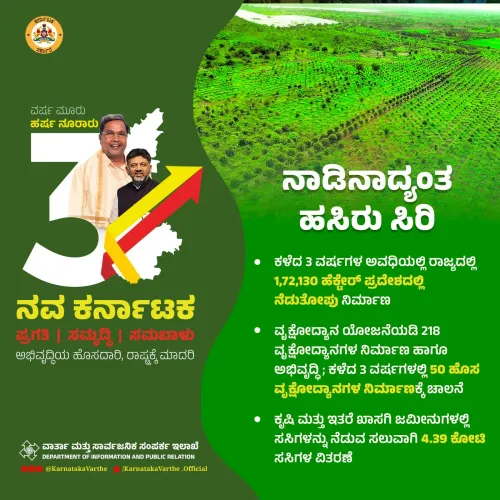
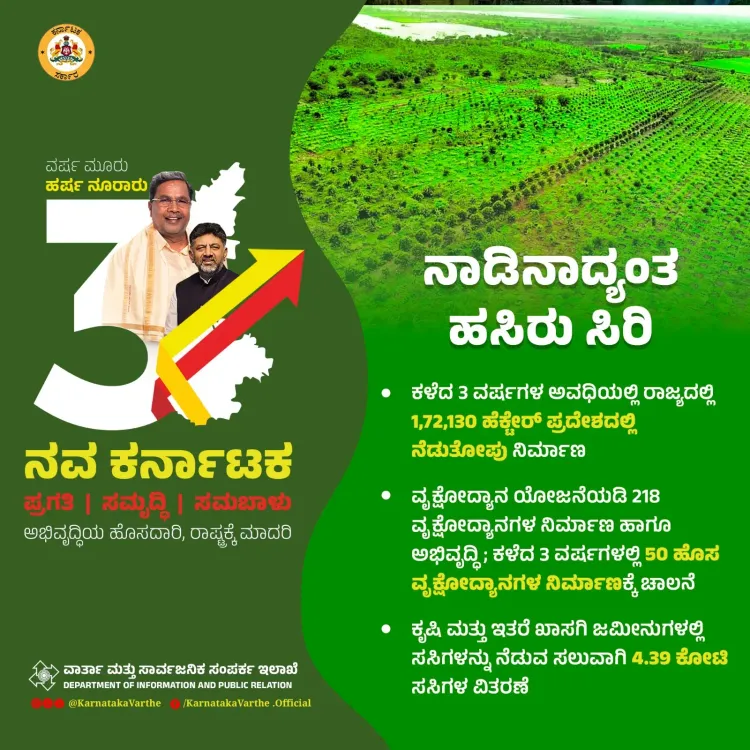
Karnataka Chief Minister Siddaramaiah marked three years in office on 23 May 2026, crediting every Kannadiga for his government's achievements and highlighting environmental milestones: 1,72,130 hectares of plantation, 218 tree parks under Vrikshodyana Yojane, and 4.39 crore saplings distributed to farmers and private landowners.
Key Takeaways
The Karnataka Congress government completed three years in office on 23 May 2026 , marking the occasion with a detailed achievement report.
The government claims plantation drives covering 1,72,130 hectares across the state over three years.
218 tree parks have been constructed or developed under the Vrikshodyana Yojane scheme, with 50 new parks initiated in the last three years.
4.39 crore saplings have been distributed for planting on agricultural and private lands, benefiting farmers and rural households.
The milestones are framed under the Nava Karnataka brand, the Congress government's development and welfare identity since May 2023 .
Sapling survival rates and 2026-27 budget allocations for Vrikshodyana will be key indicators to watch going forward.
Karnataka Chief Minister Siddaramaiah on Saturday, 23 May 2026 marked the completion of three years of his Congress government in office, crediting every Kannadiga for the administration's achievements and releasing a detailed environmental scorecard covering afforestation, urban tree parks, and sapling distribution across the state.
Context
Posting in Kannada under the hashtag #3YearsOfNavaKarnataka, the Chief Minister wrote: 'On this meaningful occasion of completing three years in power with the blessings of the people of the state, we dedicate the credit for all our government's achievements to every Kannadiga.' He added that the government had 'walked the talk' on every pre-election promise and pledged that future efforts would be 'faster and more effective.'
The post is part of the Nava Karnataka branding the Indian National Congress government has used since assuming power in May 2023 to communicate its development and welfare agenda to voters.
Policy Backdrop
The environmental figures cited by CM Siddaramaiah are government claims for the three-year period: plantation drives covering 1,72,130 hectares, the construction and development of 218 tree parks under the Vrikshodyana Yojane scheme — including 50 new parks initiated in the last three years — and the distribution of 4.39 crore saplings for planting on agricultural and other private lands.
The Vrikshodyana Yojane is a state scheme focused on creating urban gardens and tree parks. The Congress party's 2023 election manifesto had committed to large-scale afforestation and increasing green cover, building on earlier Karnataka Forest Department annual tree-planting drives from the 2010s that set targets for sapling distribution on public and private land.
Stakeholders and Impact
The sapling distribution programme directly touches farmers and rural households, who receive planting material for agricultural and private land, potentially improving both green cover and farm income through agroforestry. Urban residents in districts where new Vrikshodyana parks have been developed stand to benefit from improved green public spaces.
The push aligns with a broader pattern seen across several Indian states that are expanding urban forestry and agroforestry schemes to meet state climate action plan targets and India's national green cover goals under its climate commitments.
What's Next
Attention will now turn to the Karnataka Forest Department's next annual report, which is expected to include data on sapling survival rates — a key metric that determines whether plantation figures translate into lasting green cover. Analysts and opposition parties are likely to scrutinise supplementary budget allocations for the 2026-27 fiscal year to assess whether the government expands the Vrikshodyana network further.
With the Karnataka government entering what would be the final stretch of its five-year term, the three-year report card signals that environmental deliverables will remain a central plank of the Congress administration's re-election narrative.
Point of View
Converting administrative outputs into a voter-facing narrative as the Karnataka Congress government moves into the latter half of its term. By anchoring the anniversary post to verifiable-sounding numbers — hectares planted, parks built, saplings distributed — the Chief Minister is pre-empting opposition criticism with a data-first posture. The focus on environment is also strategically safe: green cover and tree parks carry cross-partisan appeal and align with national climate commitments, making them harder to attack than more divisive welfare schemes. However, the credibility of these claims will ultimately rest on independent verification of sapling survival rates, a metric the government has yet to foreground.
NationPress
7 Oct 2026
Frequently Asked Questions
How many years has Siddaramaiah's government completed in Karnataka?
The Siddaramaiah-led Congress government in Karnataka completed three years in office as of 23 May 2026 , having assumed power in May 2023.
What is the Vrikshodyana Yojane scheme in Karnataka?
Vrikshodyana Yojane is a Karnataka state government scheme focused on creating and developing tree parks and urban gardens. The government claims 218 parks have been constructed or developed under this scheme, with 50 new parks initiated in the last three years.
How many saplings has the Karnataka government distributed in three years?
The Karnataka government claims to have distributed 4.39 crore saplings for planting on agricultural and other private lands over the past three years.
What is Nava Karnataka?
Nava Karnataka is the branding used by the current Karnataka Congress government to communicate its development and welfare agenda since it came to power in May 2023 .
How much area has Karnataka covered under plantation drives in three years?
The Karnataka government claims plantation drives have covered 1,72,130 hectares across the state during the three-year period ending May 2026.