Rajasthan CM Bhajanlal Raises Ex-Servicemen's Contract Pay 10% for Two Years
Synopsis
The Rajasthan CMO announced a 10% annual honorarium hike for two consecutive years for ex-servicemen on contractual government service, a back-to-back increase credited to Chief Minister Bhajanlal Sharma under the 'Aapno AgraNi Rajasthan' initiative.
Key Takeaways
The Rajasthan government has raised the honorarium of contractually employed ex-servicemen by 10% per year for two consecutive years .
The announcement was made by the Chief Minister's Office on 2 November 2026 , tagging CM Bhajanlal Sharma .
Rajasthan's Sainik Kalyan Department is the nodal body overseeing ex-servicemen welfare, pensions, and re-employment in the state.
Rajasthan is among India's top states for armed-forces recruitment, giving veterans' welfare high political and social significance.
The consecutive-year structure of the hike suggests a systematic revision cycle rather than a one-time adjustment.
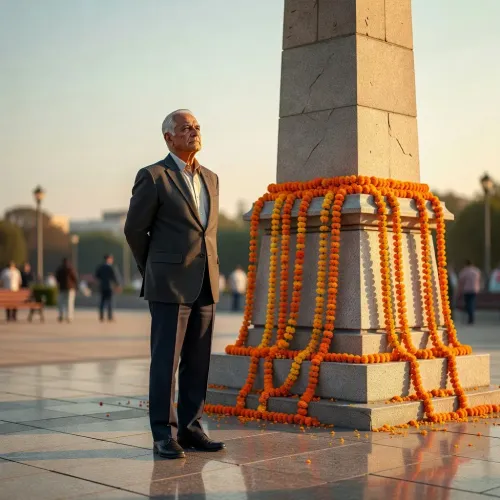
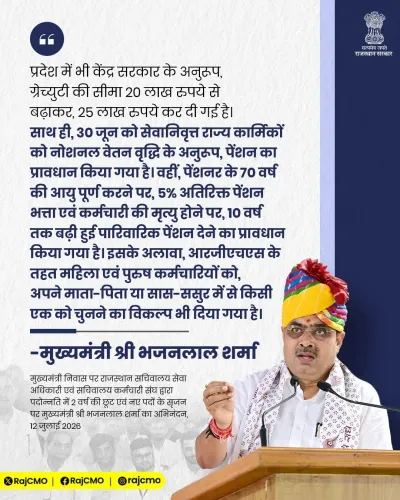
Ex-servicemen serving on contract for the Rajasthan government have received a tangible financial boost — a 10% annual rise in honorarium for two consecutive years, a back-to-back increment that signals the state's stated commitment to veterans' welfare. The Chief Minister's Office of Rajasthan announced the move on Monday, 2 November 2026, tagging Chief Minister Bhajanlal Sharma directly.
The post, shared under the hashtag #आपणो_अग्रणी_राजस्थान ('Our Leading Rajasthan'), stated: 'संविदा पर कार्यरत भूतपूर्व सैनिकों के मानदेय में लगातार, 2 वर्षों तक 10-10% की वृद्धि की गई है' — 'The honorarium of ex-servicemen working on contract has been increased by 10% each year, continuously, for 2 years.'Rajasthan's deep bond with the armed forces
Rajasthan is among India's highest contributors to armed-forces recruitment, a demographic reality that has long pushed successive state governments to maintain dedicated welfare infrastructure for veterans. The state's Sainik Kalyan Department manages pensions, re-employment schemes, and support networks for ex-servicemen and their families spread across the state's arid districts and cantonment towns.
Ex-servicemen employed on contractual rolls in government departments occupy a distinct category — they are not permanent employees but are engaged in security, administrative, and support roles, with their compensation typically reviewed through executive orders rather than pay-commission cycles. A back-to-back 10% honorarium hike spanning two years would, over that period, compound to a meaningful real-terms improvement against inflation.
CM Bhajanlal's veterans-welfare push since December 2023
Chief Minister Bhajanlal Sharma, who took office in December 2023 after the BJP's victory in Rajasthan's assembly elections, has sought to position his government as proactively responsive to the armed-forces community. The state has one of the largest concentrations of ex-servicemen households in northern India, making welfare announcements in this segment politically resonant and administratively significant in equal measure.
The consecutive nature of the hikes — year one and year two both at 10% — is the detail worth noting. A single adjustment can be a one-off; two in a row suggests a structured revision cycle rather than an ad-hoc gesture. Budgetary provisions and the specific contractual categories covered by the order will be the details to watch as implementation unfolds.
For veterans who chose government contractual service after hanging up their uniforms, the increment is more than arithmetic — it is recognition. Rajasthan's government appears determined to make that statement twice.
Point of View
Whose BJP government is still in its first full term after the December 2023 mandate, building a consistent track record on veterans' welfare — rather than a single headline announcement — is a deliberate signalling strategy. The consecutive structure of the hike also aligns with a broader national BJP emphasis on 'sainik samman' (soldier respect) as a governance theme. The real test, however, will be whether the budgetary orders and implementation circulars keep pace with the announcement.
NationPress
2 Nov 2026
Frequently Asked Questions
What is the honorarium hike announced for ex-servicemen in Rajasthan?
The Rajasthan government has announced a 10% increase in honorarium for two consecutive years for ex-servicemen working on contract with the state government.
Who announced the ex-servicemen honorarium hike in Rajasthan?
The announcement was made by the Chief Minister's Office of Rajasthan on 2 November 2026, crediting Chief Minister Bhajanlal Sharma .
Which Rajasthan department handles ex-servicemen welfare?
The Sainik Kalyan Department of the Rajasthan government is the dedicated body that manages welfare schemes, pensions, and support for ex-servicemen and their families.
Why does Rajasthan have special welfare schemes for ex-servicemen?
Rajasthan is one of India's highest contributors to armed-forces recruitment, resulting in a large veteran population across the state. Successive governments have maintained dedicated welfare infrastructure to address their needs.
When did Bhajanlal Sharma become Chief Minister of Rajasthan?
Bhajanlal Sharma was sworn in as Chief Minister of Rajasthan in December 2023 after the BJP's victory in the state assembly elections.