Rajasthan CMO to Launch District Domestic Product Portal
Synopsis
The Chief Minister's Office of Rajasthan announced plans to develop a District Domestic Product Portal for precise monitoring and evaluation of district-level development, tagging CM Bhajan Lal Sharma under the 'Our Leading Rajasthan' campaign on 23 June 2026.
Key Takeaways
The Chief Minister's Office of Rajasthan announced plans to develop a District Domestic Product (DDP) Portal on 23 June 2026 .
The portal aims to enable accurate monitoring and evaluation of development at the district level across Rajasthan.
The initiative is linked to the #आपणो_अग्रणी_राजस्थान ('Our Leading Rajasthan') campaign of the BJP government led by CM Bhajan Lal Sharma .
The proposal aligns with a 2019 Ministry of Statistics and Programme Implementation advisory encouraging states to compile District Domestic Product estimates.
No launch date, technical specifications, or implementing agency have been announced yet.
District administrations, state policymakers, and local economists are the primary stakeholders expected to benefit.
The Chief Minister's Office of Rajasthan announced on Tuesday, 23 June 2026 that a District Domestic Product (DDP) Portal will be developed to enable precise monitoring and evaluation of development at the district level, tagging Chief Minister Bhajan Lal Sharma in the post under the campaign hashtag #आपणो_अग्रणी_राजस्थान ('Our Leading Rajasthan').
Context
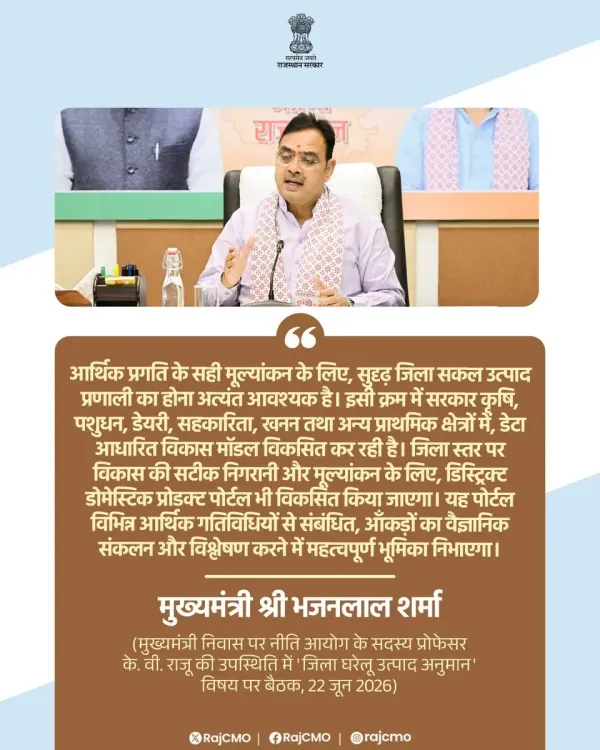
The official CMO post states: 'जिला स्तर पर विकास की सटीक निगरानी और मूल्यांकन के लिए, डिस्ट्रिक्ट डोमेस्टिक प्रोडक्ट पोर्टल भी विकसित किया जाएगा' — 'For accurate monitoring and evaluation of development at the district level, a District Domestic Product Portal will also be developed.' The announcement positions the portal as a tool to bring granular, data-driven accountability to Rajasthan's district administrations.
The hashtag #आपणो_अग्रणी_राजस्थान ('Our Leading Rajasthan') has been associated with the BJP government's broader communications around state development milestones since Chief Minister Bhajan Lal Sharma took office in December 2023.
Policy Backdrop
The proposal aligns with a 2019 advisory issued by the Ministry of Statistics and Programme Implementation, which encouraged states to compile District Domestic Product estimates to support decentralised planning. Rajasthan, like several other large Indian states, has historically relied on state-level GDP aggregates, making district-wise economic tracking a long-standing gap in sub-state planning data.
Across India, states have increasingly adopted digital dashboards and real-time data portals to monitor economic and development metrics below the state level. This initiative reflects a national trend toward evidence-based governance and more targeted resource allocation at the district scale — a priority that has gained momentum as welfare scheme delivery becomes more granular.
Stakeholders and Impact
District administrations and local planning bodies stand to be the primary beneficiaries, gaining access to standardised economic output data that can inform budget prioritisation and scheme targeting. State policymakers would be able to identify lagging districts more systematically and direct interventions with greater precision.
Local economists and civil society groups monitoring development outcomes in Rajasthan's 50 districts would also gain a structured data source that is currently fragmented across departmental reports. The portal, once operational, could also feed into the state's annual economic survey processes, strengthening the evidence base for legislative and administrative decisions.
What's Next
The announcement does not specify a launch timeline, technical architecture, or the agencies responsible for building and maintaining the portal. Key questions include how the platform will integrate with existing state data systems and whether it will be publicly accessible or restricted to government users.
Observers will watch for follow-up notifications from the Rajasthan government on the portal's rollout schedule, data methodology, and its linkage to the state's broader digital governance infrastructure under the #आपणो_अग्रणी_राजस्थान initiative.
Point of View
Particularly in the run-up to budget and planning cycles. Sub-state economic data has been a structural blind spot in Indian planning, and a functional DDP portal could meaningfully shift how Rajasthan targets welfare and infrastructure spending. However, the absence of a timeline or technical roadmap means the announcement remains aspirational until implementation details are made public. The move also reflects a competitive dynamic among BJP-governed states to demonstrate data-driven governance credentials at the national level.
NationPress
21 Sept 2026
Frequently Asked Questions
What is the District Domestic Product Portal announced by Rajasthan?
It is a proposed digital platform to track and evaluate district-wise economic output and development indicators across Rajasthan , announced by the Chief Minister's Office on 23 June 2026 .
Who announced the District Domestic Product Portal in Rajasthan?
The Chief Minister's Office of Rajasthan (RajCMO) made the announcement, tagging Chief Minister Bhajan Lal Sharma in the post.
What is the purpose of Rajasthan's District Domestic Product Portal?
The portal is intended to enable precise monitoring and evaluation of development at the district level, helping policymakers identify economic gaps and allocate resources more effectively.
When will Rajasthan's District Domestic Product Portal be launched?
No specific launch date has been announced. The CMO post states the portal 'will be developed,' indicating it is still in the planning stage as of June 2026 .
What is the #आपणो_अग्रणी_राजस्थान campaign?
#आपणो_अग्रणी_राजस्थान , meaning 'Our Leading Rajasthan,' is a campaign hashtag used by the Rajasthan BJP government to highlight state development initiatives under CM Bhajan Lal Sharma .