Rajasthan Youth Policy: CM Bhajanlal's Bet on Job Creators

Synopsis
The Chief Minister's Office of Rajasthan has announced the Rajasthan Youth Policy, aimed at transforming young people from job seekers into job creators. Backed by CM Bhajan Lal Sharma, the policy aligns with national Startup India and Skill India frameworks, though specific provisions and budget details are yet to be disclosed.
Key Takeaways
The Chief Minister's Office of Rajasthan announced the Rajasthan Youth Policy on August 3, 2026 .
The policy's stated goal is to shift Rajasthan's youth from being job seekers to becoming job creators and entrepreneurs .
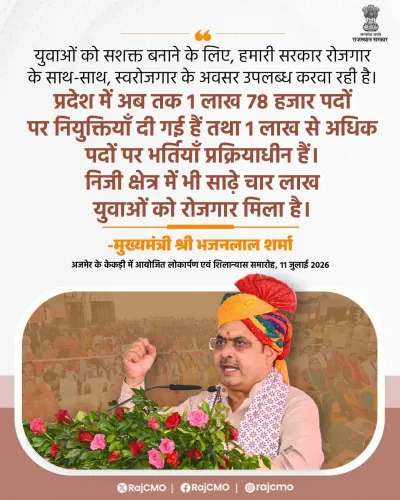
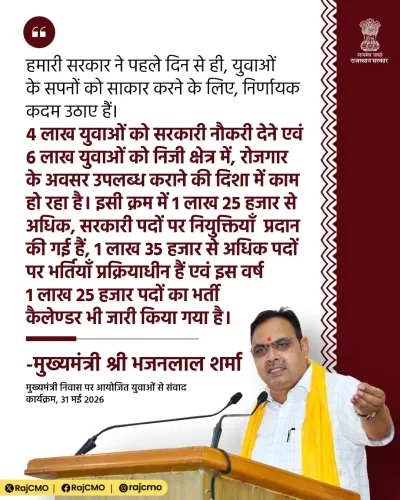
CM Bhajan Lal Sharma , in office since December 2023 , has championed youth welfare as a flagship priority of his administration.
The initiative aligns with national frameworks including Startup India and Skill India , following a pattern adopted by several other states.
Specific budget allocations, programme details, and rollout timelines have not yet been publicly disclosed.
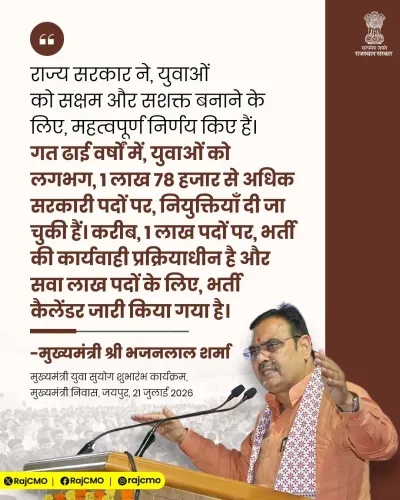
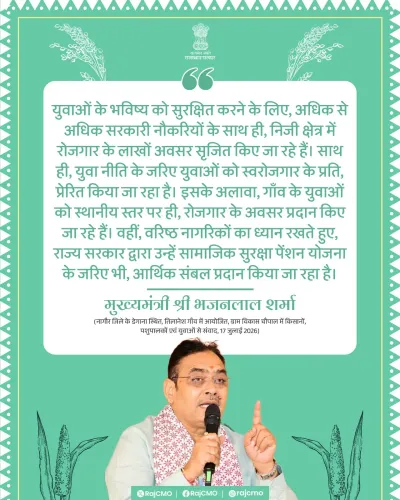
Rajasthan is making a deliberate pivot — from training its young people to seek jobs, to equipping them to create them. The Chief Minister's Office of Rajasthan announced on Monday, August 3, 2026 that the state has launched the Rajasthan Youth Policy, framing it as the cornerstone of Chief Minister Bhajan Lal Sharma's vision for an 'agrani' — frontrunner — Rajasthan.
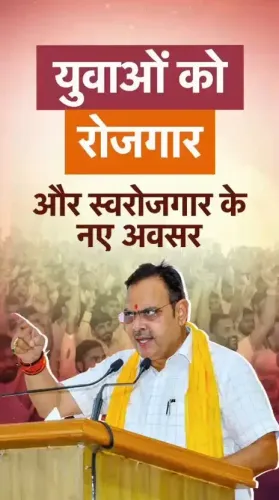
The CMO's post put it plainly: 'Pradesh ka yuva naukri lene wala nahin, balki naukri dene wala bane' — 'The youth of the state should not be job seekers, but job givers.' That single line captures the entire philosophy behind the policy: shift the aspirational default of Rajasthan's young population away from government employment and toward entrepreneurship and self-reliance.
From Startup India to Jaipur's doorstep
The move fits squarely into a national pattern. Since 2014, the National Youth Policy has provided a framework for states to build skill development and entrepreneurship pipelines, and central programmes like Startup India and Skill India have pushed the same philosophy from New Delhi outward. Several states have already rolled out youth-specific policies in this mould. Rajasthan, under the BJP government that took office in December 2023, is now formally joining that cohort.
CM Bhajan Lal Sharma has consistently positioned youth welfare and employment generation as flagship priorities since assuming office. The Rajasthan Youth Policy is the structural expression of that positioning — designed, at least in intent, to channel young energy into venture creation rather than vacancy hunting.
What the policy still needs to prove
The announcement carries genuine ambition, but the architecture matters as much as the aspiration. Specific provisions — budget allocations, mentorship infrastructure, credit-access mechanisms for first-generation entrepreneurs — have not yet been detailed publicly. Rajasthan's assembly sessions and the state budget will be the real test of how much fiscal muscle backs the vision.
The state's young population is large, geographically dispersed, and unevenly connected to urban opportunity networks. A policy that works in Jaipur must also reach Barmer, Dungarpur, and Dholpur. That last-mile question is the one worth watching.
Rajasthan has declared its direction. The next chapter is delivery — and that story will be written in budget lines and district-level rollout, not in a tweet.
Point of View
So the system must manufacture entrepreneurs instead. For CM Bhajan Lal Sharma, it serves a dual purpose: it signals ideological alignment with the BJP's national economic narrative while giving his relatively young administration a forward-looking, youth-centric identity. The real political test will come at budget time — whether the policy attracts genuine fiscal commitment or remains an aspirational banner. States that have made similar announcements without structural investment have seen youth disillusionment sharpen, not soften.
NationPress
3 Aug 2026
Frequently Asked Questions
What is the Rajasthan Youth Policy?
The Rajasthan Youth Policy is a state government initiative announced in 2026 under Chief Minister Bhajan Lal Sharma, designed to encourage young people in Rajasthan to become entrepreneurs and job creators rather than seeking traditional employment.
Who announced the Rajasthan Youth Policy?
The announcement was made by the Chief Minister's Office of Rajasthan, attributing the policy to Chief Minister Bhajan Lal Sharma's BJP-led government.
How does the Rajasthan Youth Policy connect to national schemes?
The policy aligns with the National Youth Policy 2014 framework and central government programmes like Startup India and Skill India, which promote entrepreneurship and self-employment across Indian states.
What are the specific benefits or programmes under the Rajasthan Youth Policy?
Specific provisions, budget allocations, and programme details have not yet been publicly disclosed; further details are expected to emerge through Rajasthan assembly sessions or the state budget.
When did Bhajan Lal Sharma become Chief Minister of Rajasthan?
Bhajan Lal Sharma became Chief Minister of Rajasthan in December 2023, leading the BJP government that came to power after the state assembly elections.