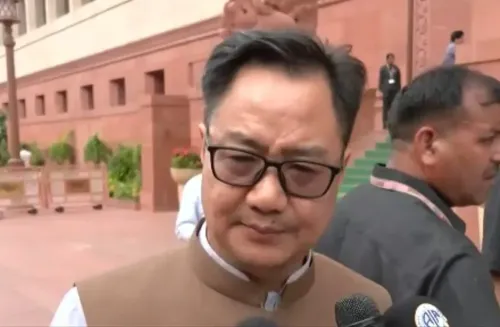
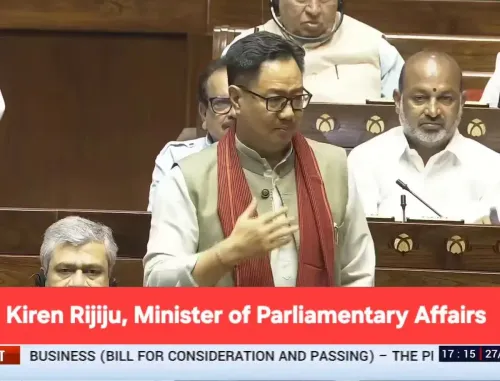
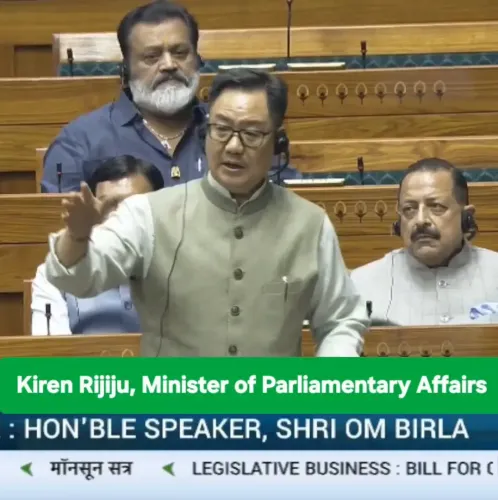
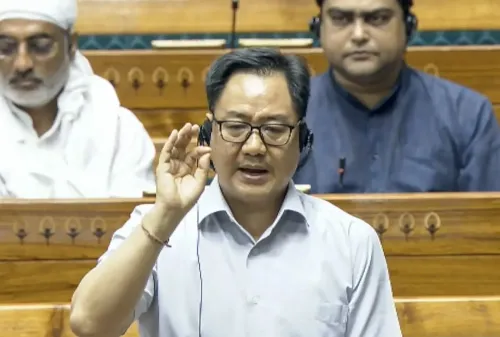
Rijiju: Congress skips key bill debates in Rajya Sabha
Synopsis
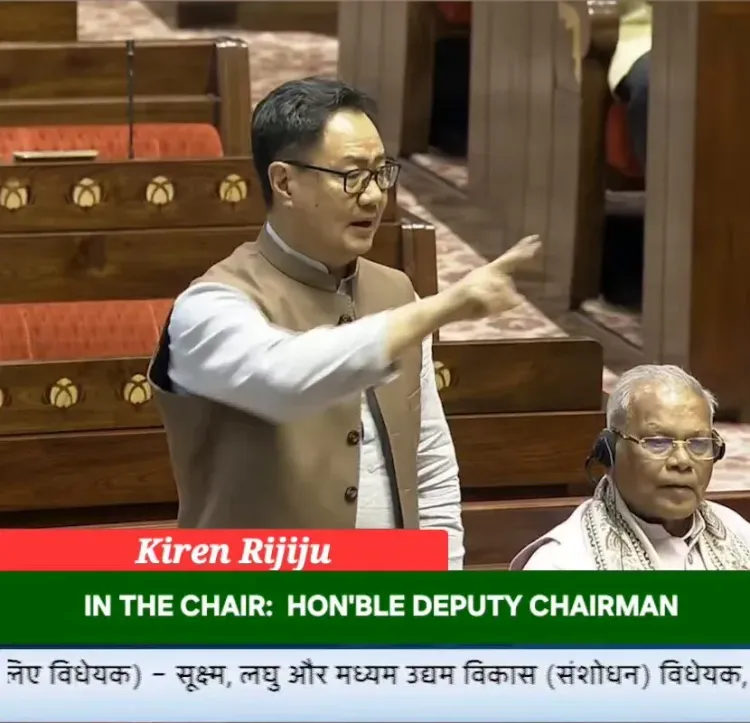
Union Parliamentary Affairs Minister Kiren Rijiju accused Congress of skipping important bill debates in the Rajya Sabha on August 3, 2026, asserting the Leader of the Opposition has been given unprecedented speaking time while calling on members to uphold the dignity of the House.
Key Takeaways
Union Parliamentary Affairs Minister Kiren Rijiju posted on August 3, 2026 accusing the Congress party of not participating in key bill discussions in the Rajya Sabha.
Rijiju claimed the Leader of the Opposition in the Rajya Sabha has been given more speaking opportunity than at any previous point.
The minister called on members to uphold the 'dignity of the House' alongside his criticism of Congress's conduct.
Parliamentary conventions since the 1950s mandate fixed speaking time for the Leader of the Opposition to ensure procedural balance.
The accusation reflects a recurring pattern in Indian parliamentary politics where the ruling party highlights procedural fairness while the opposition's participation remains contested.
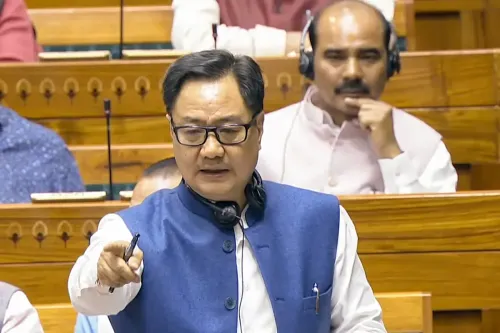
The opposition gets more floor time than ever before — and still walks away from the debate. That is the charge Union Parliamentary Affairs Minister Kiren Rijiju levelled on Monday, August 3, 2026, targeting the Congress party's conduct in the Rajya Sabha and igniting a fresh flashpoint over parliamentary participation.
Posting on X, Rijiju stated: 'राज्यसभा में नेता प्रतिपक्ष को बोलने का जितना मौका दिया गया है, उतना पहले कभी नहीं दिया गया।' — 'The Leader of the Opposition in the Rajya Sabha has been given more opportunity to speak than ever before.' He followed that with a pointed rebuke: 'Congress does not participate in discussions on important bills in Parliament.'
The speaking-time claim and what it means
At the heart of Rijiju's statement is a procedural assertion — that the government has extended generous floor time to the opposition's top voice in the upper house. Parliamentary conventions dating to the 1950s enshrine fixed time allocations for the Leader of the Opposition to preserve debate balance. Rijiju's claim, in essence, is that the government has not only honoured but exceeded that tradition.
The minister also added a call for decorum: 'We must keep in mind the dignity of the House.' The pairing of the two points — generous time given, dignity expected — frames the government's position as both magnanimous and principled, placing the onus for any disruption squarely on the opposition.
Congress and the pattern of non-participation
Rijiju's accusation taps into a well-worn fault line in Indian parliamentary politics. Ruling coalitions have repeatedly highlighted procedural opportunities extended to opposition benches, while opposition groups counter that discussion time is curtailed or that bills are rushed through without adequate scrutiny. The specific charge here — that Congress is absent from debates on 'important bills' — is a sharper variant: it is not about time being denied, but about time being declined.
The Congress party, as the principal opposition force, carries the institutional weight of holding the government accountable on legislation. When that role is seen to go unfulfilled, it hands the ruling party a potent political argument — one Rijiju has now deployed publicly and on the record.
With pending bills still on the Rajya Sabha's calendar, the opposition's posture in the next scheduled session will be the real answer to today's charge.
Point of View
Then make opposition non-participation the story. By framing Congress's absence from bill debates as a choice rather than a grievance, the BJP shifts the accountability argument — from 'the government is not listening' to 'the opposition is not showing up.' This matters beyond optics: with several significant bills pending in the Rajya Sabha, the ruling coalition has an interest in pre-empting any future opposition claim that legislation was passed without adequate debate. The minister's public salvo effectively puts Congress on notice that their floor behaviour is now being tracked and broadcast.
NationPress
3 Aug 2026
Frequently Asked Questions
What did Kiren Rijiju say about Congress in Rajya Sabha?
Rijiju stated that the Leader of the Opposition in the Rajya Sabha has been given more speaking time than ever before, and accused the Congress party of not participating in discussions on important bills in Parliament.
Who is the Leader of the Opposition in the Rajya Sabha?
The Leader of the Opposition in the Rajya Sabha is the senior Congress leader holding that designated post, a constitutionally recognised role that carries guaranteed floor time during parliamentary debates.
Why is Congress's participation in Rajya Sabha debates important?
As the principal opposition party, Congress is expected to scrutinise and debate legislation in the upper house. Absence from bill discussions weakens parliamentary oversight and hands the government a political argument about one-sided debate.
What are the rules for speaking time in the Rajya Sabha?
Parliamentary conventions dating to the 1950s allocate fixed time slots to the Leader of the Opposition and other parties during debates to ensure procedural balance and fair representation of all voices.
What is Kiren Rijiju's role in Parliament?
Kiren Rijiju is the Union Minister of Parliamentary Affairs and Minister of Minority Affairs, a senior BJP leader from Arunachal Pradesh responsible for coordinating government business across both houses of Parliament.