What Changes Did CM Sharma Bring to Rajasthan’s Bureaucracy in 2025?
Synopsis
As we wrap up 2025, Rajasthan's bureaucracy has undergone a dramatic transformation under Chief Minister Bhajan Lal Sharma. Rapid transfers and new power dynamics have redefined governance in the state, but what does this mean for the future? Discover the pivotal moments that shaped this year in Rajasthan's political landscape.
Key Takeaways
Over 1,100 officials were transferred in 2025.
18 transfer lists reassigned approximately 211 IAS officers.
The RAS cadre saw over 675 transfers in 29 lists.
New appointments aimed to enhance law enforcement and internal security.
Concerns about the impact on administrative stability were raised.
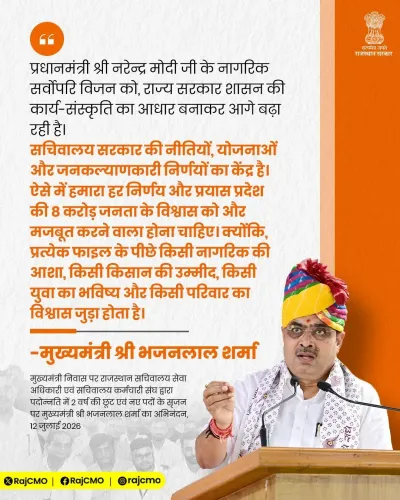
Jaipur, Dec 26 (NationPress) As 2025 comes to a conclusion, Rajasthan’s political narrative would be incomplete without acknowledging the significant upheaval in its bureaucracy. Under Chief Minister Bhajan Lal Sharma, the year has been marked as one of the most transformative and tumultuous phases for the state’s administrative framework, characterized by swift transfers, the emergence of new power dynamics, and a definitive assertion of control by the new administration.
From the Secretariat to the sub-divisional tiers, no position appeared stable. Between January 1 and December 19, 2025, the government released over 70 transfer notifications, relocating more than 1,100 officials across various departments. This reshuffle spanned across services — IAS, IPS, and RAS — indicating a systematic effort to align governance with the government’s vision of effective administration and zero tolerance. Shortly after taking office, the Bharatiya Janata Party-led Sharma government established its agenda.
Transfer notifications came in at an unprecedented rate within Rajasthan’s administrative history. Officials appointed during the previous Congress administration were ousted from significant roles, while fresh faces were integrated to realize the BJP government’s objectives. The churn was particularly pronounced in the IAS cadre, where 18 transfer notifications reassigned approximately 211 officials.
Significant reshuffles in January, June, and November reconfigured the roster of district collectors, departmental heads, and leaders of critical institutions, altering the administrative hierarchy. The Rajasthan Police also experienced sweeping changes. Through 16 IPS transfer notifications, 281 police officials — ranging from SPs to higher ranks like IGs and DIGs — were reassigned. These changes demonstrated the government's resolve to enhance law enforcement and position trusted officials in sensitive areas.
A pivotal moment occurred on July 3, 2025, with the appointment of Rajiv Kumar Sharma as Director General of Police (DGP). His appointment was framed as a step towards making policing more professional and bolstering internal security.
The cadre that truly bore the brunt in 2025 was the Rajasthan Administrative Service (RAS). Over 29 transfer notifications resulted in the relocation of more than 675 RAS officials, many at the SDM and ADM levels. Numerous officials were reassigned two to three times within a single year, marking 2025 as one of the most unstable years for mid-level administration. Extensive lists released in July, September, and October transformed districts into revolving doors, igniting discussions over efficiency versus experimentation.
The year also witnessed crucial leadership changes at the pinnacle of the administration. In November 2025, V. Srinivas took over as Chief Secretary after the Centre recalled Sudhansh Pant. Renowned for his digital reforms and innovative administrative practices, Srinivas's appointment was perceived as a move to align governance with technology-driven changes.
A significant political message of 2025 was the methodical removal of officials closely linked to the prior Ashok Gehlot-led Congress government. Long-standing officials in influential departments like Home and Finance were reassigned. Numerous district collectors, IGs, and senior IAS officials — including Jaipur Police Commissioner Biju George Joseph — were relocated, highlighting the BJP government’s intention to firmly establish its authority over the bureaucracy.
The Congress party, led by former CM Gehlot and state leaders Tika Ram Jully and Govind Singh Dotasra, accused the Bhajan Lal government of indecisiveness and reliance on “old officers.” They claimed that even policy-making and budget formulations remained influenced by the previous administration.
Jully remarked to IANS, "The bureaucratic lobby is noticeably divided. With the new chief secretary, this sentiment has become apparent. Now, let’s observe the outcomes he achieves. Previously, Pant was also brought to Rajasthan from Delhi with high expectations, but all fell flat."
The government’s reaction was not expressed through statements but rather through transfer notifications — swift, frequent, and extensive — conveying a clear message that the reins of administration were firmly in its control.
As Rajasthan enters 2026, the legacy of 2025 is unmistakable. It was a year that reset bureaucratic dynamics, tested administrative stability, and underscored the government’s determination to govern on its own terms. Whether this whirlwind of transfers will lead to improved governance remains to be seen.
Moreover, the year also witnessed significant shifts at the helm of the administration. Rajiv Kumar Sharma became the state police chief in July, while V. Srinivas took charge as Chief Secretary in November. With the BJP government consolidating its influence, numerous senior and pivotal officials were removed from key roles, indicating a clear reset in administrative priorities.
Officially, the reshuffle was attributed to good governance, efficiency, and reform. Unofficially, it sparked intense debate within bureaucratic circles. Advocates claim that the changes dismantled entrenched power structures and infused fresh energy into the system. Critics, however, question if frequent transfers hindered institutional memory and impeded decision-making.
As 2025 comes to a close, one thing is evident: Rajasthan’s bureaucracy was in constant motion throughout the year. The unmatched churn has left a lasting impact, reshaping power dynamics, redefining tenures, and establishing a new standard for administrative transformation.
Whether 2025 will be remembered as the year that improved governance or fatigued it is a question only time will answer. But for Rajasthan’s officers, it was undoubtedly the year when no position felt permanent.
Point of View
The events in Rajasthan underscore a significant shift in governance approaches. The reconfiguration of the bureaucracy reflects a broader strategy to align administrative practices with the ruling party's vision. While the changes may promote efficiency, the long-term implications for institutional stability must be closely monitored. NationPress will continue to provide insights on how these developments affect the governance landscape across India.
NationPress
23 Sept 2026
Frequently Asked Questions
What were the major changes in 2025 in Rajasthan's bureaucracy?
In 2025, Rajasthan saw extensive bureaucratic reshuffles under Chief Minister Bhajan Lal Sharma, with over 1,100 officials transferred across departments as part of a strategy to align governance with the ruling party's vision.
How did the Congress party respond to the reshuffles?
The Congress party criticized the Bhajan Lal government's approach, claiming it demonstrated indecisiveness and reliance on old officials, asserting that policy-making remained influenced by the prior administration.
What impact could these changes have on governance in Rajasthan?
While the reshuffles aim for greater efficiency and alignment with the government's priorities, there are concerns about the potential erosion of institutional memory and the stability of governance in the long run.
Who were some key figures involved in the bureaucratic changes?
Key figures include Chief Minister Bhajan Lal Sharma, Director General of Police Rajiv Kumar Sharma, and Chief Secretary V. Srinivas, who was appointed in November 2025.
What is the significance of the rapid transfers?
The rapid transfers signify a strategic effort by the BJP government to assert control over the bureaucracy and implement its governance agenda, reflecting a shift in power dynamics within the state's administrative framework.