Rajnath Singh: Bhagavad Gita Is a Mirror for All of Us
Synopsis
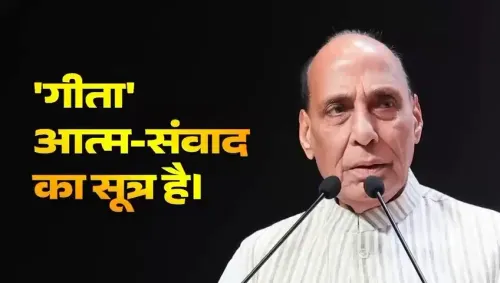
Union Defence Minister Rajnath Singh shared a philosophical reflection on the Bhagavad Gita on 27 September 2026, arguing that the scripture is a mirror for all human lives and that today's real Kurukshetra is an internal moral conflict rather than an external one.
Key Takeaways
Union Defence Minister Rajnath Singh posted a philosophical reflection on the Bhagavad Gita on 27 September 2026 .
He described the Gita as 'not merely counsel given to Arjuna' but as 'a mirror for all of our lives.' Singh argued that Kurukshetra , Arjuna, and Krishna are as present today as they were in the ancient past.
His key insight: today's Kurukshetra is 'less outside us and more within us' — a moral and psychological battleground.
The post carries no policy announcement; its register is contemplative and philosophical.
The statement fits a long tradition of Indian public figures drawing on the Gita to articulate values of duty, resilience, and ethical action.
The battlefield of Kurukshetra, Union Defence Minister Rajnath Singh wrote on Sunday, 27 September 2026, never really ended — it simply moved inward. In a reflective post on X, the senior BJP leader offered a philosophical reading of the Bhagavad Gita that reframes an ancient scripture as a living moral compass for every individual today.
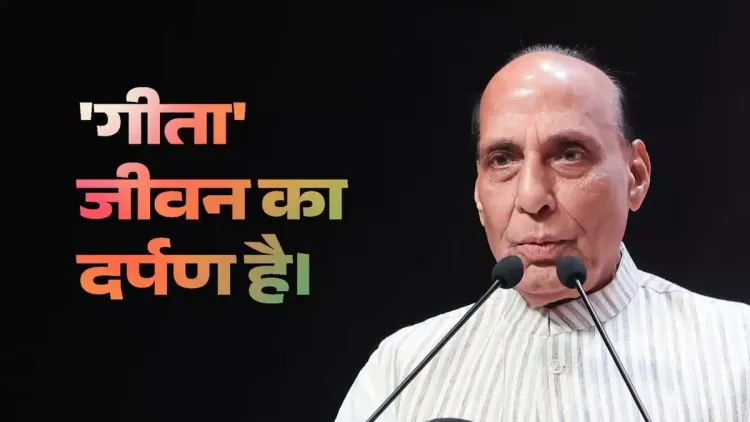
Singh wrote, in Hindi: 'गीता केवल अर्जुन को दिया गया उपदेश नहीं, बल्कि हम सभी के जीवन का दर्पण है।' — 'The Gita is not merely the counsel given to Arjuna; it is a mirror for all of our lives.' He continued: 'Kurukshetra, Arjuna, and Krishna existed then, and they exist today. The only difference is that today, Kurukshetra is less outside us and more within us.'
The Gita as an internal battlefield, not just a historical one
The distinction Singh draws is a well-worn thread in Indian philosophical tradition — but it carries weight when articulated by one of the country's most senior cabinet ministers. The classical reading of the Bhagavad Gita centres on Kurukshetra, the ancient battlefield in Haryana where, according to the Mahabharata, the god Krishna delivered his counsel to the warrior Arjuna on the eve of a devastating war. Singh's framing shifts the locus: the moral dilemma — duty versus doubt, action versus paralysis — is no longer a drama of chariots and arrows. It is the interior conflict every person navigates daily. This is not a new interpretation. Philosophers, saints, and statesmen from Adi Shankaracharya to Swami Vivekananda to Mahatma Gandhi have each argued that the Gita's deepest teaching is psychological and ethical rather than purely historical. What Singh adds is a pointed contemporaneity: the 'today' in his phrasing is deliberate, a signal that the scripture's relevance is not ceremonial but urgent.Indian political figures and the Gita: a recurring conversation
Indian public life has a long tradition of leaders invoking the Gita at moments of reflection. The gesture is rarely purely religious — it tends to signal a particular stance on duty, resilience, and ethical action without partisanship or policy prescription. Singh's post carries no announcement, no programme, and no adversarial edge. Its register is contemplative, not combative. That itself is the story: a defence minister, whose portfolio is defined by hard power and strategic decision-making, choosing a Sunday evening to speak about inner conflict rather than external threat. For millions of Indians who encounter the Gita as cultural inheritance as much as religious text, the message lands on familiar ground — but the voice giving it carries institutional weight that makes the reflection public and consequential in its own quiet way. The Kurukshetra within, Singh seems to suggest, demands just as much courage as the one without.Point of View
And Singh's Gita reflection fits a pattern of cementing ideological identity through classical Indian texts. The post is notable for its inward turn: a defence minister framing moral conflict as internal rather than external signals a contemplative register uncommon in security-focused portfolios. It reinforces the BJP's broader cultural-nationalist positioning without triggering any policy debate. The philosophical framing also gives the statement a wide, cross-partisan appeal — the Gita's moral universalism is hard to contest, making it effective soft communication.
NationPress
28 Sept 2026
Frequently Asked Questions
What did Rajnath Singh say about the Bhagavad Gita?
Rajnath Singh said the Bhagavad Gita is not merely advice given to Arjuna but a mirror for every person's life, and that today's real Kurukshetra exists within us rather than outside.
When did Rajnath Singh post his Bhagavad Gita reflection?
He posted the reflection on Sunday, 27 September 2026, in the evening on X (formerly Twitter).
What is the significance of Kurukshetra in the Bhagavad Gita?
Kurukshetra is the ancient battlefield in Haryana where, according to the Mahabharata, Krishna delivered his moral and philosophical counsel to the warrior Arjuna before a great war — the setting from which the Bhagavad Gita originates.
Is Rajnath Singh's Gita post linked to any government policy or event?
No. The post contains no policy announcement, official programme, or reference to a specific government initiative. It is a personal philosophical reflection.
Why do Indian political leaders often quote the Bhagavad Gita?
The Bhagavad Gita holds deep cultural, philosophical, and religious significance across India. Leaders quote it to signal values like duty, resilience, and ethical action, and it carries broad appeal that transcends narrow political lines.