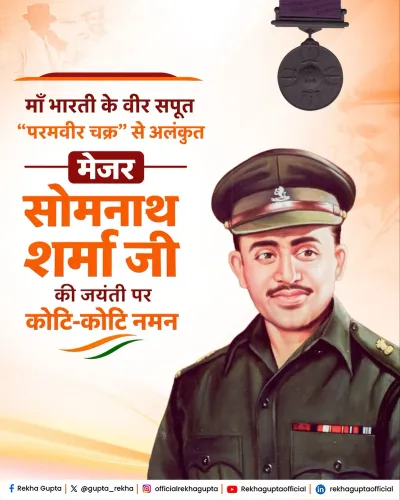
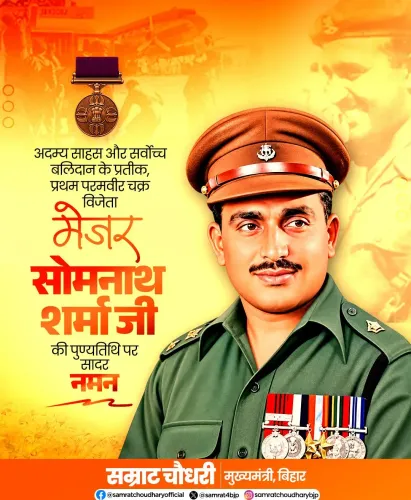
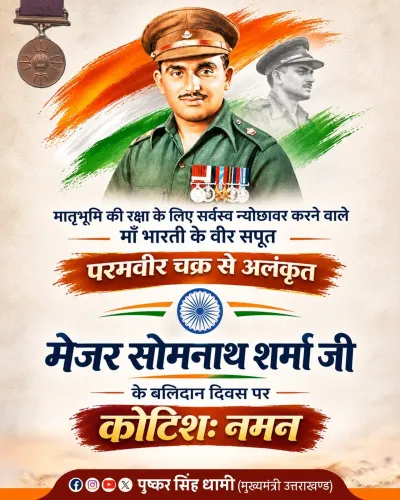
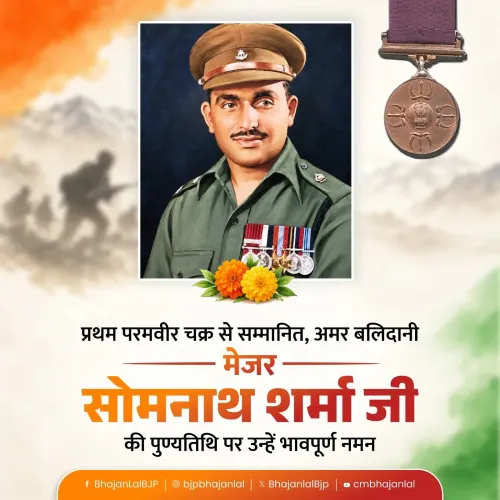
Rajnath Singh Pays Tribute to Maj Somnath Sharma on Balidan Diwas
Synopsis
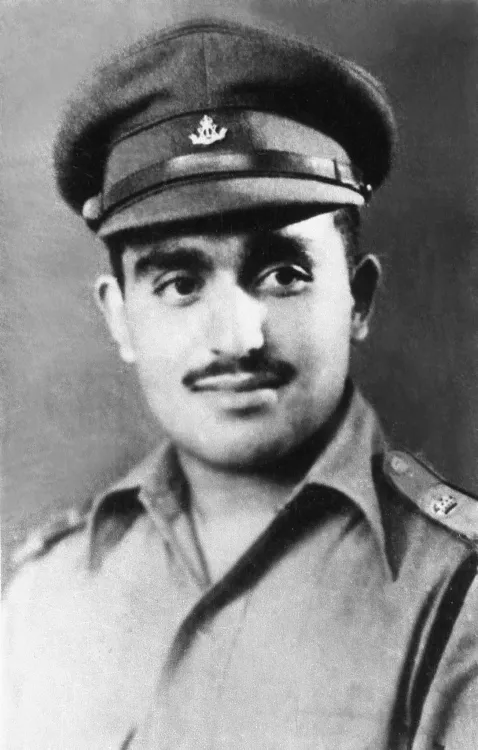
On the 79th martyrdom anniversary of Major Somnath Sharma, Defence Minister Rajnath Singh paid tribute to India's first Param Vir Chakra recipient, honouring his decisive stand at the Battle of Badgam on 3 November 1947 that helped secure Srinagar for India.
Key Takeaways
Union Defence Minister Rajnath Singh posted a solemn tribute on 3 November 2026 , marking the martyrdom anniversary of Major Somnath Sharma .
Major Sharma fell on 3 November 1947 at the Battle of Badgam , defending the approach to Srinagar against a tribal lashkar during the first India-Pakistan conflict.
He is India's first recipient of the Param Vir Chakra , the nation's highest wartime gallantry award, which he received posthumously.
The Param Vir Chakra was instituted on 26 January 1950 with retrospective effect covering the 1947–48 Kashmir operations.
Singh's tribute explicitly described Jammu and Kashmir as 'an integral part of India,' in keeping with established government formulations on annual war commemorations.
Major Sharma was 24 years old at the time of his death and served with the 4th Battalion, Kumaon Regiment .
Seventy-nine years after a young Army officer made the ultimate sacrifice in the snow-dusted fields outside Srinagar, Union Defence Minister Rajnath Singh paused on Tuesday, 3 November 2026 to honour the soldier whose name is inseparable from India's highest wartime gallantry — Major Somnath Sharma, the country's first Param Vir Chakra awardee.
Singh's post marked what he called the Balidan Diwas — the martyrdom day — of Major Sharma, invoking the exact date: 3 November 1947, when the Battle of Badgam was fought on the outskirts of Srinagar. That morning, a small Indian force held the line against a far larger tribal lashkar bearing down on the Kashmir Valley's gateway, buying critical time for reinforcements to reach the newly acceded state.
The Soldier Who Held Badgam
Major Sharma commanded a company of the 4th Battalion, Kumaon Regiment that day. Outnumbered and under ferocious assault, he continued directing his men even as his right arm was in a plaster cast from an earlier injury. He died when a grenade landed in an ammunition pile near him — his last act was reportedly to caution his men about the incoming fire. His defence of Badgam kept the road to Srinagar — and with it the airfield that allowed Indian troops to pour in — from falling into enemy hands.
The Param Vir Chakra was instituted by the Government of India on 26 January 1950 as the nation's highest wartime gallantry decoration, with retrospective effect covering the 1947–48 Kashmir operations. Major Sharma received it posthumously — first, numerically, among all holders of the award.
Territorial Assertion Woven Into the Tribute
Singh's tribute went beyond ceremonial remembrance. Describing Srinagar as part of 'Jammu and Kashmir, an integral part of India,' the Minister folded an explicit sovereignty affirmation into the elegiac prose — a formulation that successive defence ministers have employed in annual statements tied to the 1947–48 operations. Jammu and Kashmir acceded to India in October 1947, and its first military defence remains a touchstone of official narratives on the territory's status.
Traditions the Tribute Invokes
Singh quoted three maxims he attributed to the Indian Army — 'Service Before Self,' 'Courage in Adversity,' and 'Duty Above All' — framing Major Sharma's sacrifice as the founding expression of those values rather than a historical footnote. The language is deliberate: defence-establishment commemorations of early Kashmir operations consistently link individual acts of valour to the institutional character of the modern Army.
Major Somnath Sharma was 24 years old when he fell at Badgam. Nearly eight decades on, his name still opens the Param Vir Chakra roll — first in honour, first in sacrifice, first in the long line of soldiers that official India will spend generations remembering.
Point of View
Anchoring territorial claims in the memory of a 24-year-old officer who died defending Srinagar carries quiet but pointed diplomatic weight. The tribute also signals continuity in the BJP-led government's effort to keep the military's founding sacrifices central to national identity.
NationPress
3 Nov 2026
Frequently Asked Questions
Who was Major Somnath Sharma?
Major Somnath Sharma was an Indian Army officer of the 4th Battalion, Kumaon Regiment who died on 3 November 1947 at the Battle of Badgam near Srinagar. He was awarded the Param Vir Chakra posthumously — making him India's first recipient of the decoration.
What was the Battle of Badgam?
The Battle of Badgam was fought on 3 November 1947 as tribal lashkars, backed by Pakistan, advanced towards Srinagar. Indian troops, including Major Sharma's company, held the approach, protecting the airfield that allowed Indian reinforcements to land and secure the Kashmir Valley.
What is the Param Vir Chakra?
The Param Vir Chakra (PVC) is India's highest wartime gallantry award, instituted on 26 January 1950 with retrospective effect. Major Somnath Sharma is its first recipient, number one on the roll of all awardees.
Why does India observe Balidan Diwas for Major Somnath Sharma on 3 November?
3 November marks the day in 1947 when Major Sharma was killed in action at Badgam. The day is observed as his Balidan Diwas (martyrdom day) by defence establishments and political leaders to honour his sacrifice during the first military operation to defend Jammu and Kashmir after its accession to India.
Why did Rajnath Singh call J&K 'an integral part of India' in the tribute?
Describing Jammu and Kashmir as 'an integral part of India' is a standard government formulation that asserts India's sovereignty over the region, especially in the context of statements tied to the 1947–48 Kashmir conflict during which the state's accession was contested and fought over.