Rajya Sabha adjourned for 14th day as Opposition disrupts over Ram Temple, Delhi protest
Synopsis
For the 14th consecutive day, the Rajya Sabha could not function — adjourned till noon as Opposition members demanded answers on the Ram Temple donations controversy and police action against Delhi students. The repeated deadlock is eroding an entire session's legislative agenda, with neither side showing room to move.
Key Takeaways
The Rajya Sabha was adjourned till noon on 6 August , marking 14 consecutive days of disruptions.
Opposition demanded government accountability on alleged Ram Temple donation theft and police action against Delhi students .
Radhakrishnan declined fresh Rule 267 notices, triggering 'Grih Mantri Sadan Mein Aao' chants.
Raghav Chadha (BJP) flagged unethical referral commissions by diagnostic centres, citing NMC 2023 regulations banning the practice.
Sadanand Mhalu Shet Tanwade (BJP) demanded a one-time loan settlement for those affected by closure of 2,000 mines in Goa .
Multiple Standing Committee reports on trade, fertilisers, fake news, and rural development were tabled despite the disruptions.
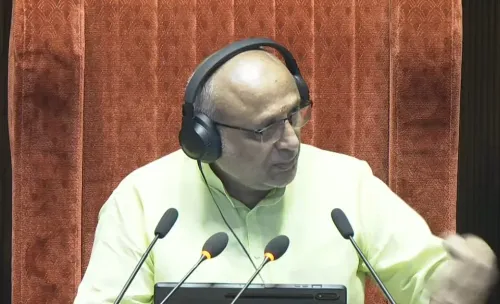
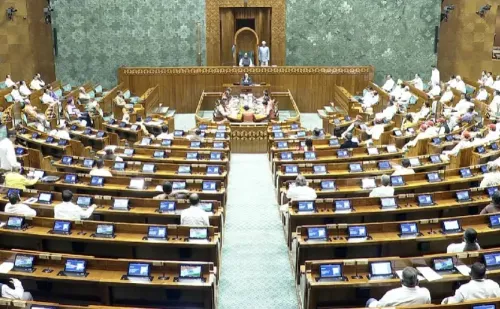
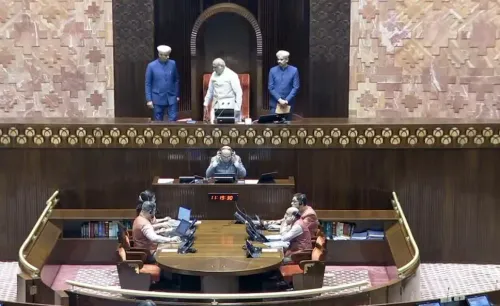
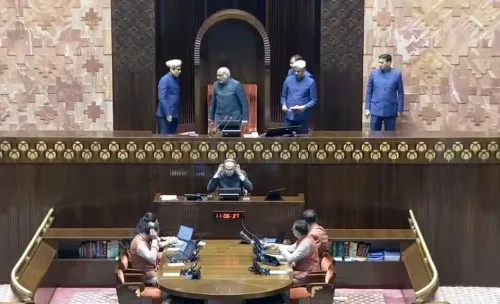
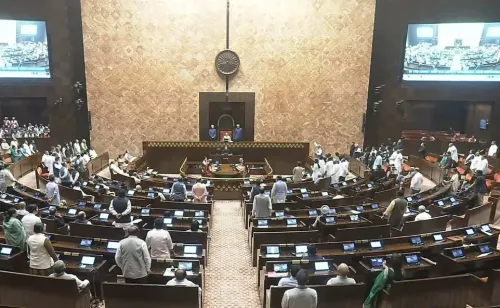
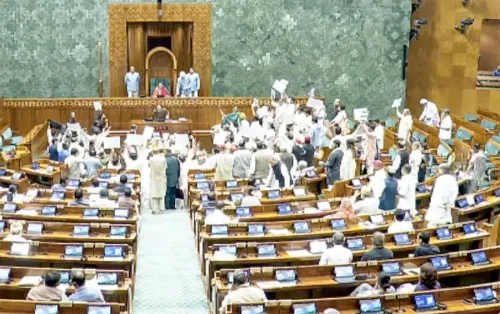
The Rajya Sabha was adjourned till noon on Thursday, 6 August — marking the 14th consecutive day of disruptions — as Opposition members staged protests demanding government accountability on the alleged theft of Ram Temple donations and police action against students during a demonstration in Delhi. Persistent sloganeering from the Opposition benches prevented orderly proceedings from the outset.
How the Disruptions Unfolded
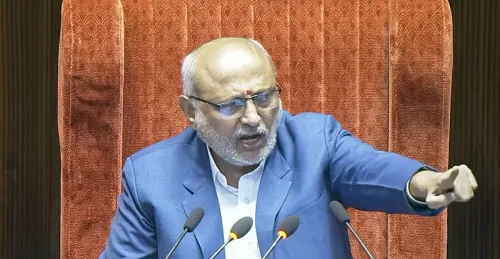
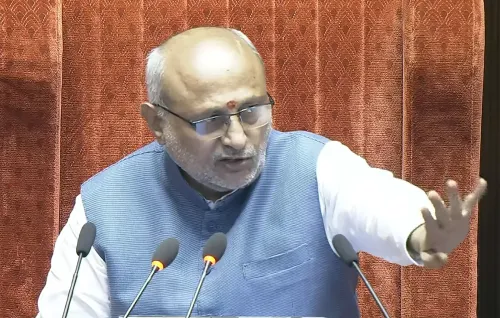
The session began at 11 am with papers and reports laid on the Table by ministers. Proceedings deteriorated quickly when Chairman C.P. Radhakrishnan declined to entertain any fresh notices under Rule 267, stating that rulings on such notices had already been issued multiple times. The refusal triggered loud chants of 'Grih Mantri Sadan Mein Aao' (Home Minister, come to the House) from Opposition benches.
The Chairman firmly told Opposition members he would not recognise any speaker as long as the shouting continued. Parliamentary Affairs Minister Kiren Rijiju cited rules against House disruption, while the Chair repeatedly urged members to return to their seats, assuring them they would be called once order was restored. The assurances went unheeded.
When Leader of the Opposition Mallikarjun Kharge rose to speak, treasury benches responded with their own ruckus. Finding no improvement, the Chairman adjourned the House till noon.
Substantive Issues Raised Amid the Din
Sadanand Mhalu Shet Tanwade of the Bharatiya Janata Party (BJP) from Goa demanded a one-time loan settlement scheme for residents financially impacted by the closure of 2,000 mines in the state.
Raghav Chadha of the BJP raised the issue of unethical referral commissions charged by diagnostic centres — sometimes involving foreign trips for doctors. He noted that the erstwhile Medical Council of India had banned 'fee-splitting' as far back as 2002, and the National Medical Commission in 2023 had specifically prohibited 'referral commission' under the Registered Medical Practitioner Regulations, with penalties including suspension for up to three months. Chadha added that gross violations could attract charges of cheating, conspiracy, and provisions of the Consumer Protection Act.
Tiruchi Siva of the Dravida Munnetra Kazhagam (DMK) sought to raise a matter under Rule 258, but the Chairman informed him that proper prior notice was required.
Papers Laid and Committee Reports Presented
Despite the disruptions, several ministers laid papers on the Table. These included Gajendra Singh Shekhawat for the Ministry of Culture; Jitendra Singh for Science and Technology and Personnel, Public Grievances and Pensions; Chandra Sekhar Pemmasani for Communications; Shobha Karandlaje for Labour and Employment; L. Murugan on behalf of Kirti Vardhan Singh for Environment, Forest and Climate Change; and Raksha Nikhil Khadse for Youth Affairs and Sports.
Members also presented a series of reports from Department-related Parliamentary Standing Committees. These covered India-US trade relations, fertiliser logistics and availability, mechanisms to curb fake news, performance of schemes under Digital Bharat Nidhi, functioning of public sector undertakings, and various rural development programmes. Minister Jitendra Singh made statements on implementation of Standing Committee recommendations relating to the Department of Biotechnology and the Department of Scientific and Industrial Research.
Context and Pattern
This is the 14th consecutive day of disruptions in the Rajya Sabha during the current session — an unusually prolonged standoff that has severely curtailed legislative business. The Opposition's twin demands — accountability over the Ram Temple donations controversy and answers on the police crackdown on student protesters in Delhi — have remained unaddressed on the floor, deepening the impasse. Notably, the repeated refusal to admit Rule 267 notices, which allow suspension of listed business for urgent matters, has become the principal flashpoint between the Chair and the Opposition.
With both sides showing no signs of yielding, the prospect of substantive legislative work resuming in the near term remains uncertain.
Point of View
And the treasury's apparent unwillingness to offer even a brief ministerial statement to defuse the standoff, are together hollowing out the session. What is being lost is not just time but the credibility of the Rajya Sabha as a deliberative chamber. The Ram Temple donations controversy and the Delhi student crackdown are legitimate public interest questions; burying them under sloganeering ensures they never get the serious scrutiny they deserve.
NationPress
20 Sept 2026
Frequently Asked Questions
Why was the Rajya Sabha adjourned on 6 August?
The Rajya Sabha was adjourned till noon on 6 August because Opposition members disrupted proceedings with persistent sloganeering, demanding government answers on the alleged theft of Ram Temple donations and police action against students protesting in Delhi. It was the 14th consecutive day of such disruptions.
What is Rule 267 and why did it become a flashpoint?
Rule 267 of the Rajya Sabha allows the suspension of listed business to take up an urgent matter of public importance. Chairman C.P. Radhakrishnan declined to admit any fresh Rule 267 notices on 6 August, stating rulings had already been issued multiple times, which triggered the Opposition's loud protests.
What did Raghav Chadha raise in the Rajya Sabha?
BJP member Raghav Chadha raised the issue of unethical referral commissions paid by diagnostic centres to doctors, sometimes involving foreign trips. He noted the practice was banned by the Medical Council of India in 2002 and explicitly prohibited by the National Medical Commission in 2023, with penalties including suspension for up to three months.
Who is demanding the Home Minister appear in the House?
Opposition members collectively demanded that the Home Minister come to the Rajya Sabha floor to address their concerns, chanting 'Grih Mantri Sadan Mein Aao'. The demand is linked to the government's silence on the Ram Temple donations controversy and the Delhi student protest crackdown.
What legislative work was completed despite the disruptions?
Despite the disruptions, several ministers laid papers on the Table and members presented Standing Committee reports covering India-US trade relations, fertiliser logistics, fake news mechanisms, Digital Bharat Nidhi schemes, and rural development programmes. Minister Jitendra Singh also made statements on biotechnology and scientific research recommendations.