Did Ram Sutar, the Sculptor Behind India's Tallest Tribute, Pass Away at 100?
Click to start listening
Synopsis
Renowned sculptor Ram Sutar, the visionary behind India's tallest statue, the Statue of Unity, has died at 100. His artistic legacy shaped India's identity, and his passing marks a significant loss for the nation's art heritage.
Key Takeaways
- Legacy: Ram Sutar's sculptures tell the story of India's unity and cultural identity.
- Recognition: His works received national accolades, showcasing his contribution to art.
- Influence: Sutar's art continues to inspire and shape India's artistic landscape.
- Realism in Art: He emphasized realism in his sculptures, conveying strength and leadership.
- Enduring Impact: The Statue of Unity symbolizes national pride and unity.
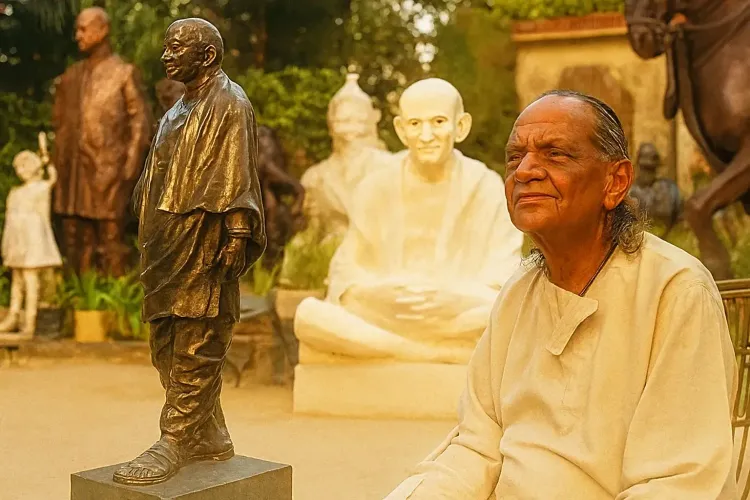
New Delhi, Dec 18 (NationPress) The esteemed sculptor Ram Vanji Sutar, known for his pivotal role in defining the visual landscape of modern India and for bringing to life the Statue of Unity in Gujarat, has passed away at his home in Noida.
His age was 100. Family officials indicated that he succumbed to ailments associated with aging. This loss signifies the conclusion of a remarkable era in Indian monumental artistry.
Following the announcement of his passing, tributes flooded in from all corners of the nation. President Droupadi Murmu and Prime Minister Narendra Modi honored him as a creator whose masterpieces immortalized the essence of India’s history and principles.
Political leaders and cultural entities expressed that his death is an irrevocable loss to the nation’s artistic legacy. He is survived by his family and a profound legacy that is etched into India’s environment.
His sculptures, prominently situated in urban centers, institutional areas, and public venues, continue to resonate with daily life, silently narrating the tale of a nation.
Born on February 19, 1925, in Gondur village of Dhule district in Maharashtra, Ram Sutar emerged from modest origins to become India’s most influential public sculptor.
Educated at the Sir J.J. School of Art in Mumbai, where he excelled as a gold medalist, he dedicated over seventy years to crafting figures that symbolize India’s political, cultural, and historical consciousness.
His most notable achievement is the Statue of Unity, a monumental tribute to Sardar Vallabhbhai Patel located in Kevadia, Gujarat.
At a towering height of 182 meters, it stands as the tallest statue globally and has transformed India’s stature in international monumental architecture.
Ram Sutar served as the chief sculptor and conceptual designer of the statue, tasked with encapsulating Patel’s role as the architect of India’s unity into a form that blended authority, realism, and composure.
In contrast to abstract monumental traditions, Sutar prioritized realism, ensuring that Patel's pose, facial expressions, and attire conveyed strength without aggression. The statue portrays Patel in a forward motion, signifying leadership and determination.
Despite the unprecedented scale of the project, Sutar meticulously oversaw the artistic details, collaborating closely with engineers and designers to maintain proportional accuracy and human expression. His involvement extended into his 90s, reflecting his unwavering commitment to artistry.
Since its inauguration in 2018, the Statue of Unity has become a symbol of national pride and has attracted significant tourism to Gujarat, representing the artistic pinnacle of Sutar’s career. Art historians have emphasized that the statue’s effectiveness lies not just in its engineering but in its sculptural integrity, a remarkable feat at such a scale.
Apart from the Statue of Unity, Ram Sutar’s creations are displayed in prominent public spaces throughout India and internationally. His works include the renowned Mahatma Gandhi statue outside the Indian Parliament, the equestrian statue of Chhatrapati Shivaji Maharaj at Parliament House, and statues honoring national figures like B.R. Ambedkar and V.D. Savarkar.
His sculptures are recognized for their dignity, balance, and emotional restraint, managing to command presence without exaggeration.
In recognition of his artistic contributions, Sutar received numerous prestigious awards, including the Padma Shri in 1999 and the Padma Bhushan in 2016. He was also honored with Maharashtra Bhushan, the state’s highest civilian award, acknowledging his lifetime commitment to public art.
As India grieves his loss, the Statue of Unity and his other masterpieces serve as enduring reminders of an artist who transformed metal and stone into symbols of collective memory.
Point of View
It is our solemn duty to acknowledge the profound impact that Ram Sutar has had on India's artistic landscape. His passing not only represents a personal loss for those who knew him but also leaves a significant void in the realm of public art. Sutar's ability to capture the essence of Indian culture through his sculptures will forever be remembered, as his works continue to inspire national pride and unity.
NationPress
21/12/2025
Frequently Asked Questions
What is Ram Sutar known for?
Ram Sutar is renowned for his monumental sculptures, including the Statue of Unity, which is the tallest statue in the world.
What awards did Ram Sutar receive?
He received several prestigious awards, including the Padma Shri in 1999, the Padma Bhushan in 2016, and Maharashtra's highest civilian award, the Maharashtra Bhushan.
Where was Ram Sutar born?
Ram Sutar was born on February 19, 1925, in Gondur village, located in the Dhule district of Maharashtra, India.
What legacy did Ram Sutar leave behind?
He left behind an extraordinary legacy of sculptures that symbolize India's political, cultural, and historical identity.
When was the Statue of Unity inaugurated?
The Statue of Unity was inaugurated in 2018 and has since become a symbol of national pride and a major tourist attraction.