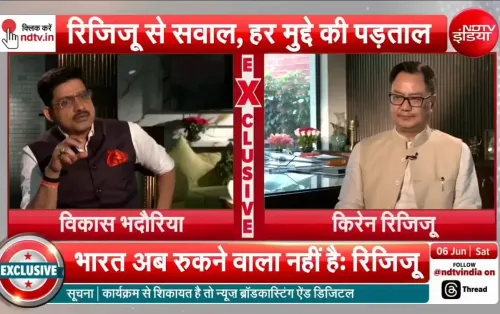
Rijiju backs Sanjay Singh's jab at Congress over poll losses
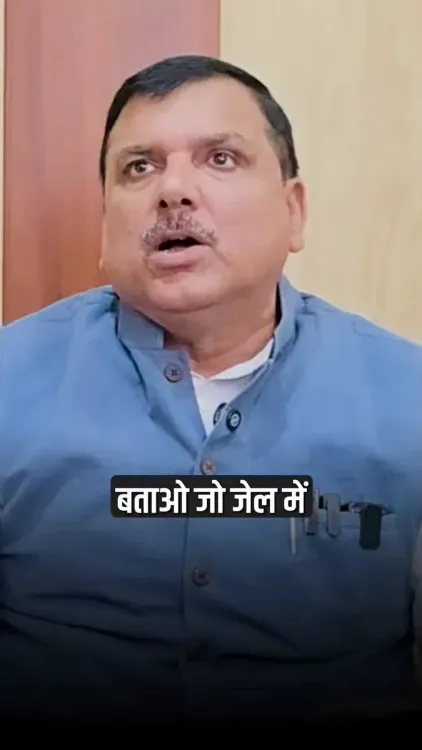
Synopsis
Union Parliamentary Affairs Minister Kiren Rijiju amplified AAP MP Sanjay Singh's argument that Congress, losing elections long before Gyanesh Kumar became CEC in 2025, is deflecting blame onto the Election Commission rather than examining its own performance.
Key Takeaways
Kiren Rijiju endorsed AAP MP Sanjay Singh 's public criticism of the Indian National Congress on November 8, 2026 .
The central argument: Congress's electoral losses predate Gyanesh Kumar 's appointment as Chief Election Commissioner in 2025 , making him an implausible scapegoat.
The CEC appointment process was overhauled by the 2023 Act , adding the PM and a Cabinet Minister to the selection panel — itself a source of opposition controversy.
Opposition parties questioning ECI neutrality after defeats is a recurring pattern since 2014 across multiple election cycles.
The BJP-AAP alignment here is tactical — both parties benefit from the critique but remain electoral rivals in key states.
A sharp burst of cross-party political fire lit up X on Sunday, November 8, 2026, as Union Parliamentary Affairs Minister Kiren Rijiju amplified an Aam Aadmi Party broadside against the Indian National Congress — a rare moment of BJP-AAP alignment aimed squarely at the grand old party.
Rijiju shared a pointed observation, writing: 'Shri Sanjay Singh ji of AAP exposed the Congress party completely!' He then quoted what he framed as Singh's argument: 'कांग्रेस पार्टी लगातार चुनाव हार रही है, लेकिन वे ज्ञानेश कुमार को दोष देंगे, जो 2025 में ही मुख्य चुनाव आयुक्त बने थे।' — 'The Congress party keeps losing elections, but they will blame Gyanesh Kumar, who only became Chief Election Commissioner in 2025.'
The logic is blunt: if Congress's electoral slide predates the current CEC's tenure by years, blaming the institution's new head for those defeats is, in Rijiju's framing, an exercise in deflection rather than self-reflection.
The Gyanesh Kumar appointment and its political backdrop
Gyanesh Kumar, a senior Indian Administrative Service officer, has been referenced as the Chief Election Commissioner appointed in 2025. His appointment came under the framework of the Chief Election Commissioner and Other Election Commissioners (Appointment, Conditions of Service and Term of Office) Act, 2023 — a legislation that itself became a flashpoint. The 2023 law restructured the CEC selection committee to include the Prime Minister and a Union Cabinet Minister alongside the Leader of the Opposition, drawing protests from opposition parties who argued it diluted institutional independence.A recurring pattern: opposition, losses, and ECI blame
The tendency to question the Election Commission of India's neutrality after electoral reverses is not new. Across multiple election cycles since 2014, Indian opposition formations have periodically raised concerns about the ECI's functioning — particularly around the timing of poll announcements and conduct during campaigns. What makes Rijiju's post notable is its source: he is not quoting a BJP colleague but an AAP Rajya Sabha MP, Sanjay Singh, who is himself frequently at odds with Congress on governance questions. When rivals converge on the same critique, the political optics for the targeted party sharpen considerably.BJP-AAP convergence — tactical, not structural
Rijiju's amplification of Singh's remarks should be read carefully. AAP and BJP remain fierce electoral competitors in Delhi and beyond. This is not an alliance — it is a moment of tactical agreement, the kind where two opponents briefly point in the same direction because it serves both their interests. For the BJP, it undercuts Congress credibility. For AAP, it positions Singh as a straight-talking critic unbothered by traditional opposition solidarity. Congress, meanwhile, faces the uncomfortable geometry of being criticised from both flanks simultaneously. The deeper question the post raises — whether repeated attribution of electoral losses to institutional actors damages public confidence in the Election Commission more broadly — is one that will likely echo into the next round of state elections.Point of View
He makes the critique of Congress appear broader and more credible than a standard ruling-party attack. It also signals that the BJP is content to let intra-opposition friction do some of the work for them heading into the next electoral cycle. The underlying tension around the Election Commission's independence — sharpened by the 2023 appointment law — means these exchanges are unlikely to stay on social media alone; they tend to migrate into parliamentary debates and court petitions. For Congress, being criticised simultaneously from the government benches and from a rival opposition party represents a difficult political geometry that demands a sharper institutional argument, not just a rebuttal.
NationPress
8 Nov 2026
Frequently Asked Questions
Why is Kiren Rijiju sharing an AAP MP's post against Congress?
Rijiju amplified Sanjay Singh's argument because it serves BJP's political interest in highlighting Congress's electoral decline, while also appearing as a cross-party consensus rather than a partisan attack.
Who is Gyanesh Kumar and when did he become Chief Election Commissioner?
Gyanesh Kumar is a senior IAS officer who is referenced as having been appointed Chief Election Commissioner in 2025, under the framework of the CEC appointment law passed in 2023.
What is the 2023 CEC appointment law?
The Chief Election Commissioner and Other Election Commissioners (Appointment, Conditions of Service and Term of Office) Act, 2023 changed the CEC selection panel to include the Prime Minister and a Union Cabinet Minister alongside the Leader of the Opposition, which opposition parties argued reduced institutional independence.
Has Congress blamed the Election Commission for its losses before?
Opposition parties, including Congress, have periodically questioned the Election Commission's neutrality following electoral defeats across multiple election cycles since 2014, citing concerns about timing and institutional conduct.
Are AAP and BJP allies because Rijiju praised Sanjay Singh?
No. This is a moment of tactical convergence, not a political alliance. AAP and BJP remain fierce electoral competitors; Rijiju's amplification reflects shared interest in a specific critique of Congress, nothing more.