Rijiju: Respect People's Mandate, Not Congress's Losses
Synopsis
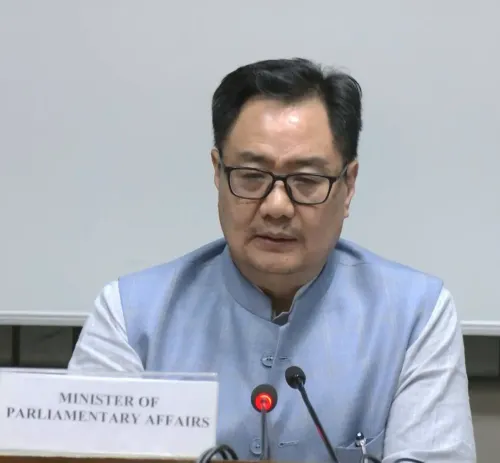
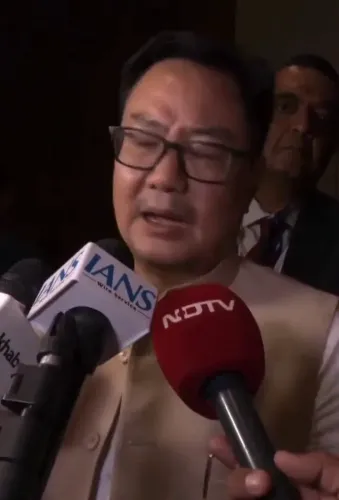
Union Parliamentary Affairs Minister Kiren Rijiju challenged the Congress-led opposition's claim that Indian democracy is under threat, asking pointedly how the party's repeated electoral losses translate into a democratic crisis and asserting that the people's mandate must be respected.
Key Takeaways
Union Parliamentary Affairs Minister Kiren Rijiju posted on June 6, 2026 , challenging the opposition's democratic-erosion narrative.
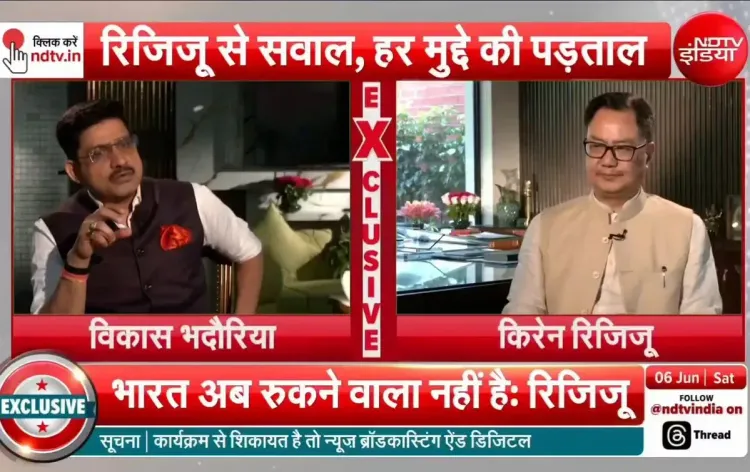
He posed the question: 'How does democracy come under threat because Congress keeps losing?' The post was linked to an #NDTVExclusive interview segment.
The BJP has held a Lok Sabha majority since 2014 , defeating the Congress -led UPA in two successive general elections.
Rijiju framed repeated electoral victories as affirmation of the people's mandate, not evidence of democratic erosion.
The debate is expected to resurface during the upcoming monsoon session of Parliament .
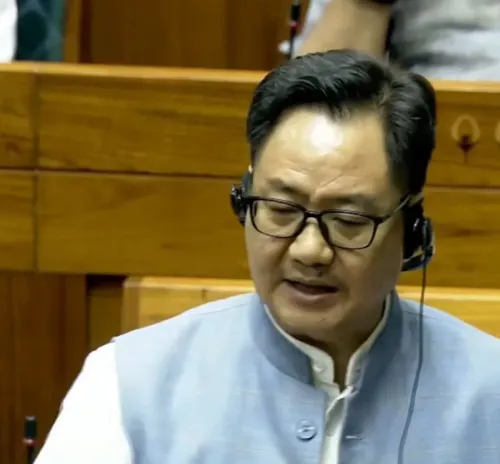
Union Parliamentary Affairs Minister Kiren Rijiju on Saturday, June 6, 2026, pushed back sharply against opposition claims that Indian democracy is under threat, arguing that the people's electoral verdict must be respected and questioning whether repeated Congress losses can themselves constitute a democratic crisis.
Context
Rijiju's remarks came in the form of a pointed bilingual post directed at a television channel interview, in which he posed the question: 'कांग्रेस के बार-बार हारने से लोकतंत्र कैसे खतरे में है?' ('How does democracy come under threat because Congress keeps losing?'). The post carried the hashtag #NDTVExclusive, indicating the remarks were tied to or responding to an interview segment on the channel. He paired the Hindi rhetorical question with a firm English assertion: 'Everyone must respect the mandate of the people in democracy.'
The framing was deliberate — casting the opposition's democratic-erosion narrative as a conflation of Congress's own electoral decline with a genuine institutional crisis. It is a line of argument the Bharatiya Janata Party (BJP) has deployed consistently since its first majority government in 2014.
Policy Backdrop
The BJP secured an outright Lok Sabha majority in 2014, ending a decade of Congress-led United Progressive Alliance (UPA) rule, and returned with an even larger mandate in 2019. In both cycles, and through several state election campaigns, the Indian National Congress — the principal national opposition party — suffered significant losses at the ballot box.
Opposition leaders and allied commentators have, since 2014, raised concerns about democratic safeguards, institutional autonomy, and the conduct of elections. The ruling party has consistently responded that these concerns amount to a refusal to accept legitimate popular verdicts. Rijiju's post fits squarely within that long-running exchange.
Stakeholders and Impact
The immediate stakeholders are the BJP and the Congress, but the argument resonates with a wider electorate that has returned the ruling party to power in successive national and state elections. For voters, the debate touches on a fundamental question: whether electoral outcomes are a sufficient measure of democratic health, or whether other institutional indicators matter equally.
Opposition parties are likely to interpret Rijiju's remarks as an attempt to delegitimise their criticism by reducing it to sour-grapes politics. The BJP's counter-argument — that winning majorities is itself the clearest democratic signal — has proved electorally effective in mobilising its base and framing the Congress as out of step with public opinion.
What's Next
The debate is likely to intensify in the run-up to the monsoon session of Parliament, where opposition parties have historically raised procedural and institutional questions on the floor of both Houses. Any scheduled state assembly elections will renew the same argument about mandate versus democratic safeguards. Rijiju, as Union Minister of Parliamentary Affairs, sits at the centre of that legislative battleground and is expected to continue making the case that the ballot box is the ultimate arbiter of democratic legitimacy.
Point of View
At their core, a failure to accept electoral defeat. By posing the question as a rhetorical challenge rather than a direct attack, he forces the Congress to either defend its record at the ballot box or clarify the distinction between losing elections and losing democratic norms — a distinction the party has struggled to communicate convincingly to swing voters. The timing, tied to a high-visibility television interview, suggests a coordinated effort to shape the pre-monsoon-session political discourse. Whether the gambit succeeds will depend on whether the opposition can reframe the debate around institutional specifics rather than electoral outcomes alone.
NationPress
23 Oct 2026
Frequently Asked Questions
What did Kiren Rijiju say about Congress and democracy?
Rijiju asked how Congress's repeated electoral losses amount to a threat to democracy, asserting that in a democracy everyone must respect the mandate of the people.
Why is Kiren Rijiju responding to Congress on democracy?
The BJP and Congress have been engaged in a long-running debate since 2014, with the opposition raising democratic-erosion concerns after successive election defeats and the ruling party arguing those concerns reflect a refusal to accept popular verdicts.
What is Kiren Rijiju's current role in the government?
Kiren Rijiju is the Union Minister of Parliamentary Affairs and Minister of Minority Affairs, and is a senior BJP leader from Arunachal Pradesh.
How many times has BJP won a Lok Sabha majority?
The BJP won outright Lok Sabha majorities in both 2014 and 2019, ending Congress-led UPA rule and returning with an even larger mandate in the second election.
What is the BJP's argument about electoral mandates and democracy?
The BJP argues that winning successive majorities at the national and state level is the clearest possible democratic signal and that framing these victories as democratic erosion amounts to delegitimising the will of the voters.