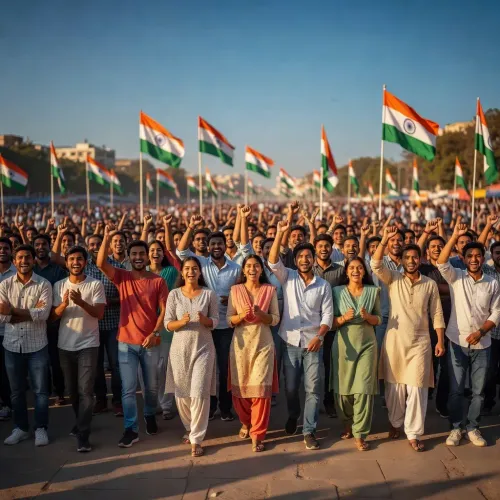
Rijiju: Indian Youth Resisting 'Anti-India Gangs' Is a Point of Pride
Synopsis
Union Parliamentary Affairs Minister Kiren Rijiju lauded Indian youth for not being misled by 'anarchists' and 'anti-India gangs,' accusing critics of using the Constitution and national flag as cover while targeting Indian democracy itself.
Key Takeaways
Kiren Rijiju posted on October 20, 2026 expressing pride in Indian youth for resisting what he called 'anarchists' and 'anti-India gangs.' He accused certain actors of weaponising symbols — the Constitution, the national flag — while working against Indian democratic institutions.
The statement fits a broader pattern of BJP ministers framing political opposition as a threat to constitutional order.
The Constitution of India , adopted 26 January 1950 , is a recurring symbolic battleground in Indian political discourse across all parties.
Rijiju's framing credits Indian youth with having already seen through anti-national narratives — a pointed rhetorical compliment with political intent.
Opposition reactions and any parliamentary follow-up will determine how far this framing travels beyond the ruling party's base.
Union Parliamentary Affairs Minister Kiren Rijiju on Tuesday, October 20, 2026 threw down a sharp political marker, declaring his pride in an Indian youth that — in his framing — refuses to be led astray by what he called 'anarchists' and 'anti-India gangs.'
The Core Charge: Symbols Used as Cover
Rijiju's post cuts to a specific accusation: that certain actors deploy the symbols of Indian democracy — the Constitution, the national flag — while working against the very institutions those symbols represent. 'They will display Constitution book but they are against Indian Constitution. They'll hold Indian flags but their target is India,' he wrote.
The framing is deliberate. By invoking constitutional veneration as a rhetorical pose rather than a genuine commitment, Rijiju is making an argument about bad faith — that the loudest invocations of democratic norms can mask anti-democratic intent. It is a line of attack that lands differently depending on which side of the aisle you sit on.
BJP's Running Argument About Democratic Legitimacy
This is not a standalone broadside. Senior BJP ministers, particularly those holding constitutional or parliamentary portfolios, have consistently framed political opposition as existing on a spectrum — from legitimate democratic contest at one end to what the ruling party describes as organised disruption at the other. Rijiju, as Parliamentary Affairs Minister, sits at the very junction where that argument is litigated: inside Parliament itself.
The Constitution of India, adopted on 26 January 1950, is frequently invoked by all sides in Indian politics. Its symbolic weight makes it a contested prop — opposition benches have held up printed copies during parliamentary sessions, while ministers like Rijiju have argued that performative constitutionalism papers over a deeper hostility to elected institutions.
Youth as the Audience and the Verdict
The pivot to Indian youth is politically significant. Rijiju is not just defending the government — he is crediting a generation with the discernment to see through what he calls anarchist narratives. It positions youth not as a constituency to be won but as one that has already delivered a judgment. That is a powerful rhetorical move, and one that opposition parties are unlikely to let stand without a counter-argument.
Reactions from opposition leaders and any follow-up during the next parliamentary session will be the real test of how much traction this framing gets beyond the ruling party's base.
Point of View
Not just in Parliament. What makes the framing politically durable is its structure — it is nearly impossible to rebut without appearing to confirm the charge. The opposition's challenge is to offer a counter-narrative that is equally visceral without ceding the constitutional high ground.
NationPress
20 Oct 2026
Frequently Asked Questions
What did Kiren Rijiju say about Indian youth and democracy?
Rijiju said he is proud of Indian youth for not being misled by 'anarchists,' accusing certain groups of displaying the Constitution and the national flag while actually working against Indian democracy and the Constitution itself.
Who are the 'anti-India gangs' Rijiju referred to?
Rijiju did not name specific individuals or organisations. The term is part of a broader BJP framing directed at domestic critics the party describes as working against Indian constitutional institutions.
What is Kiren Rijiju's role in the Indian government?
Kiren Rijiju is the Union Minister of Parliamentary Affairs and Minister of Minority Affairs, and a senior BJP leader representing Arunachal Pradesh.
Why is the Constitution of India significant in this debate?
The Constitution of India, adopted on 26 January 1950, is the supreme law of the land and a powerful symbol invoked by all political parties. Its display has become a recurring gesture of protest and counter-protest in Indian parliamentary and public discourse.
What is the political significance of Rijiju's statement about youth?
By crediting youth with resisting anti-national narratives, Rijiju positions the ruling party as aligned with the next generation's instincts — a political compliment that also signals the BJP is contesting the narrative battle beyond Parliament, on campuses and social media.