RSS Leader Mohan Bhagwat: India's Role in Ending Global Conflict
Synopsis
Mohan Bhagwat, the RSS chief, highlighted India's crucial role in resolving international conflicts, proclaiming that the nation can stop ongoing wars. His remarks during the VHP office inauguration in Nagpur emphasize the importance of Dharma in restoring global balance.
Key Takeaways
Mohan Bhagwat emphasizes India's potential to mediate in global conflicts.
He contrasts India's values with the prevailing “law of the jungle.” Bhagwat calls for the elimination of internal divisions for a united society.
He highlights the interconnectedness of various faiths in India.
True global happiness is linked to peace for all nations.
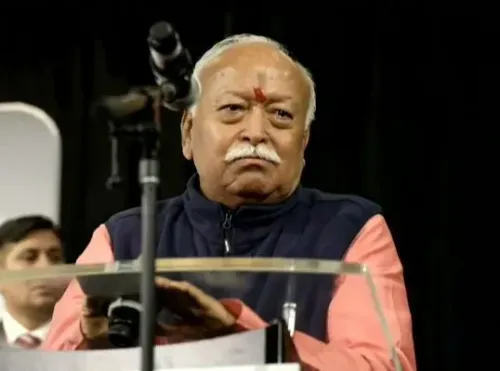
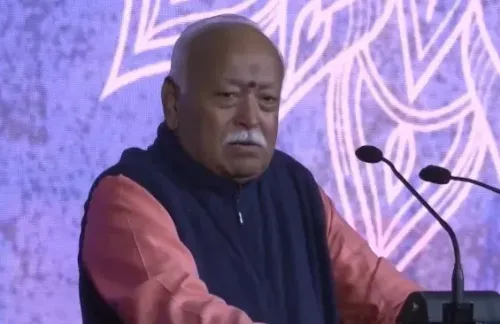
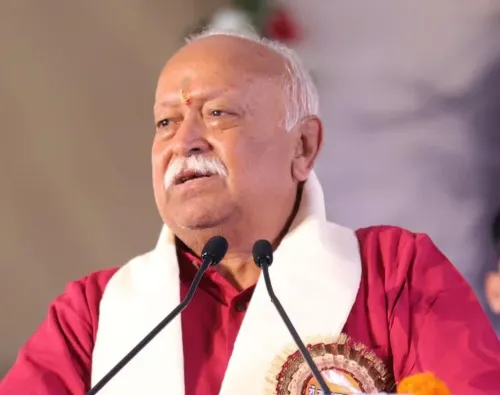
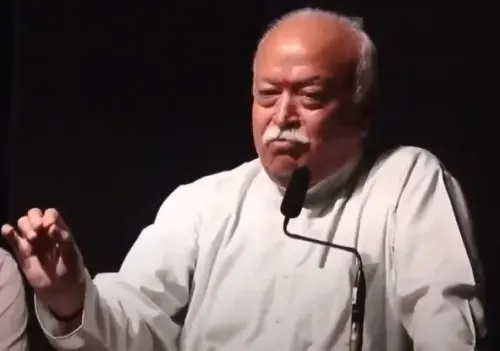
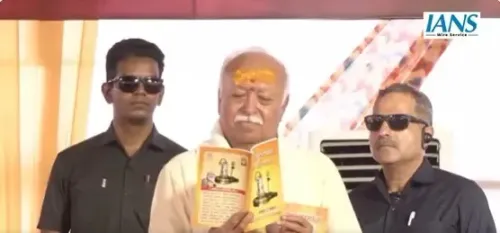
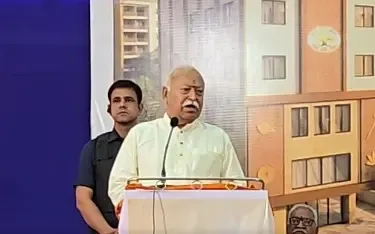
Nagpur, March 20 (NationPress) The chief of Rashtriya Swayamsevak Sangh (RSS), Mohan Bhagwat, emphasized India's essential position in mitigating global unrest, declaring that “India has the potential to cease the ongoing conflict” during the inauguration of the Vishwa Hindu Parishad (VHP) Vidarbha Prant office in Nagpur.
In his remarks on the rising global tensions, Bhagwat highlighted that nations are increasingly turning to India for restoring equilibrium through the principles of Dharma.
He pointed out that there is a growing consensus internationally that “only India” possesses the capacity to foster peace in the Middle East, owing to its intrinsic characteristics. He argued that it is India's duty to bring stability to a “wobbling world” by laying down a foundation based on Dharma.
Critiquing the current geopolitical scenario, the RSS chief contrasted India’s time-honored values, particularly the “law of humanity,” with the prevailing “law of the jungle,” where the survival of the fittest prevails in global matters.
Bhagwat utilized a traditional fable about a wolf and a lamb to demonstrate how power is often manipulated to endorse violence. He remarked that without a robust moral compass, the truth and innocence are often overshadowed by those wielding greater physical or military power.
In addressing the ongoing conflicts in the Middle East and Europe, he noted a mounting global expectation for India to step in as a mediator. He emphasized that over the past two millennia, various ideologies have failed to secure enduring peace as they missed the essence of interconnectedness and unity.
Bhagwat pinpointed self-serving interests and the quest for regional or global supremacy as the fundamental causes of contemporary disputes. He described this as an “interconnected duty” to provide a shaky world with a solid foundation.
He contended that genuine global happiness cannot be achieved until all parties achieve peace, a notion he identified as the essence of Sanatan Dharma and the preamble of the Indian Constitution.
Moving beyond international affairs, Bhagwat stressed the importance of internal strength and ethical behavior within Indian society.
He recognized that while India encompasses various faiths—including Jainism, Buddhism, and Sikhism—that may espouse different philosophies, they all align with a shared moral framework: truth, non-stealing, and service to others.
The RSS chief urged the removal of internal rifts, declaring that a robust, united society is essential since “the world does not respect the weak,” even if they possess the truth.
He concluded by stating that as India prepares to fulfill its global responsibility of spreading harmony, its material and economic advancements will naturally follow as a consequence of its spiritual and moral enlightenment.
Point of View
Mohan Bhagwat's assertion about India's potential to mediate in global conflicts underscores a growing recognition of the nation's role in international diplomacy. His emphasis on moral values and interconnectedness reflects a holistic approach to addressing global issues, appealing to a sense of national pride and responsibility.
NationPress
17 Sept 2026
Frequently Asked Questions
What did Mohan Bhagwat say about India's role in global conflicts?
Mohan Bhagwat stated that India can play a significant role in ending ongoing wars and restoring global balance through the principles of Dharma.
How does Bhagwat view modern conflicts?
He identifies selfish interests and the pursuit of dominance as primary drivers of contemporary conflicts and advocates for a foundation of unity.
What moral values did Bhagwat emphasize?
Bhagwat highlighted the importance of truth, non-stealing, and service to others, which align with the core teachings of various Indian faiths.
What was the context of Bhagwat's remarks?
His remarks were made during the inauguration of the Vishwa Hindu Parishad (VHP) Vidarbha Prant office in Nagpur.
What is Bhagwat's vision for India's future?
He believes that India's material and economic growth will follow as a result of its spiritual and moral awakening while fulfilling its duty to spread harmony.