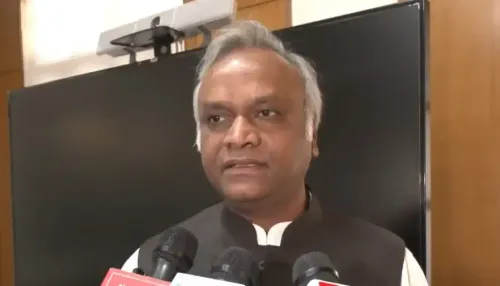
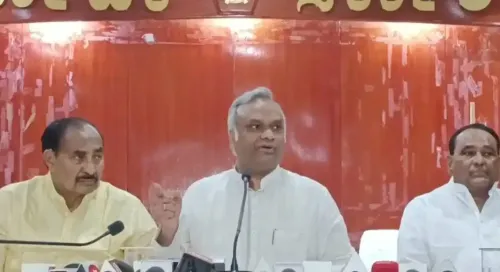
RSS must be registered, no body above law: Yathindra Siddaramaiah

Synopsis
Karnataka Urban Development Minister Yathindra Siddaramaiah has backed demands to register the RSS under Indian law, questioning its property holdings, funding sources, and political role. His remarks follow a letter by Congress leader Priyank Kharge to RSS chief Mohan Bhagwat — signalling that Karnataka’s Congress government is escalating pressure on an organisation that has operated outside standard registration frameworks since 1925.
Key Takeaways
Karnataka Urban Development Minister Yathindra Siddaramaiah on Tuesday backed the demand to register the RSS under Indian law.
He questioned the RSS’s properties worth crores across cities and towns, demanding public disclosure of funding sources.
Yathindra alleged the RSS has a direct political affiliation with the BJP , contradicting its self-description as a cultural body.
He endorsed Congress leader Priyank Kharge’s letter to RSS chief Mohan Bhagwat seeking registration and financial accountability.
He warned that granting the RSS exemptions based on Hindutva identity would open the door to similar claims by other religious organisations.
Karnataka Urban Development Minister Yathindra Siddaramaiah on Tuesday backed the demand to bring the Rashtriya Swayamsevak Sangh (RSS) under a mandatory legal registration framework, asserting that no organisation — cultural or otherwise — can claim exemption from the country's laws. Speaking to reporters in Bengaluru, the Minister said transparency and financial accountability must apply uniformly to all bodies, including the RSS.
What Yathindra Said
The Minister questioned why the RSS should be shielded from standard registration and disclosure requirements. “Why should the RSS not be registered? There cannot be one law for everyone and another for the RSS. How can any organisation be exempt from disclosure and accountability regarding its financial transactions?” he said.
Yathindra rejected the RSS’s self-description as a purely cultural body, alleging a direct political role. “The RSS describes itself as a cultural organisation, but it has a clear political affiliation. Everyone knows that it works for the Bharatiya Janata Party (BJP) during elections,” he added.
Questions Over Assets and Funding
The Minister raised pointed questions about the organisation’s property holdings and income sources. “The RSS has a large number of workers who need to be maintained. It owns properties worth crores of rupees in cities and towns across the country. Where did these properties come from? The public has a right to know,” he said.
He also endorsed a letter written by Congress leader Priyank Kharge to RSS chief Mohan Bhagwat, calling it “entirely appropriate.” The letter had sought registration and financial disclosure from the organisation.
On Equating RSS With Hinduism or the Nation
Responding to questions on whether the RSS could be equated with Hinduism or national identity, Yathindra drew a clear distinction. “Can an organisation be equated with a religion? Certainly not. The RSS is an organisation, and it cannot be equated with the nation or the country. It is a separate entity and must comply with the laws of the land,” he said.
He further argued that invoking Hindutva or Hindu religious identity to seek legal exemptions would set a dangerous precedent. “If such exemptions are granted to the RSS, what happens when other religious organisations seek similar privileges?” he asked.
The Broader Context
The demand for RSS registration is not new, but it has gained fresh political traction in recent weeks, particularly from Karnataka’s Congress-led government. The RSS, founded in 1925, has historically operated without formal registration under the Societies Registration Act or similar statutes, a status that critics argue places it outside standard financial scrutiny frameworks.
Yathindra’s remarks signal that the ruling Congress in Karnataka intends to keep the issue alive as a political and governance debate. Whether the Centre takes any legislative action on the matter remains to be seen.
Point of View
And the legal ambiguity has rarely been seriously tested. What is new is a state government actively using ministerial platforms to sustain the pressure. The BJP will frame this as an attack on Hindu culture; the Congress will frame it as rule of law. Neither framing is entirely wrong, which is precisely why this debate tends to generate heat without resolution. The real question — whether any government has the political will to actually legislate on this — is the one being carefully avoided.
NationPress
16 Sept 2026
Frequently Asked Questions
What is Yathindra Siddaramaiah’s demand regarding the RSS?
Karnataka Urban Development Minister Yathindra Siddaramaiah has demanded that the RSS be brought under a mandatory legal registration framework, arguing that no organisation can be exempt from financial disclosure and accountability laws. He made the remarks while speaking to reporters in Bengaluru on Tuesday.
Why does Yathindra say the RSS cannot claim to be only a cultural organisation?
He alleged that the RSS has a direct political affiliation with the BJP and actively works for the party during elections, which he argues disqualifies its claim to be solely a cultural body.
What did Yathindra say about RSS assets and funding?
He questioned how the RSS owns properties worth crores of rupees across cities and towns in India and said the public has a right to know where these assets came from, arguing that registration is a prerequisite for such disclosures.
What is the Priyank Kharge letter that Yathindra endorsed?
Congress leader Priyank Kharge had written to RSS chief Mohan Bhagwat seeking registration and financial transparency from the organisation. Yathindra described the letter as ‘entirely appropriate’ and consistent with the principle of equal application of the law.
Has the RSS ever been registered under Indian law?
The RSS, founded in 1925, has historically operated without formal registration under statutes such as the Societies Registration Act, a status that critics argue exempts it from standard financial scrutiny. No government has legislated to change this, and the current demand comes from Karnataka’s Congress-led state government.