CM Saini Backs Modi Govt on Paper Leak Bill, Fast-Track Courts
Synopsis
Haryana Chief Minister Nayab Singh Saini has praised Prime Minister Narendra Modi for taking a firm stance on paper leaks, backing a parliamentary bill that would establish fast-track courts and impose stringent penalties to restore transparency and credibility in India's public examination system.
Key Takeaways
CM Nayab Singh Saini publicly commended PM Narendra Modi for his government's firm stance on paper leaks in public examinations.
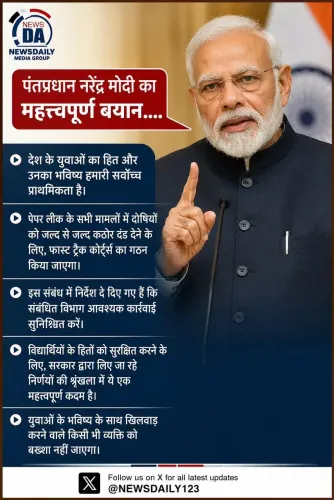
Saini backed a bill pending in Parliament that would create fast-track courts and enforce stringent punishments for paper leak offences.
The post follows the Public Examinations (Prevention of Unfair Means) Act, 2024 , already passed by Parliament to curb exam malpractice.
The reforms are aimed at protecting lakhs of students and parents who depend on fair competitive examinations for jobs and education.
Operationalisation of fast-track courts and state-level exam security protocols in Haryana and other BJP-ruled states are the next steps to watch.
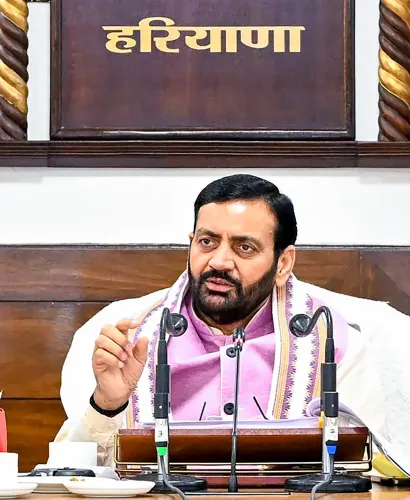
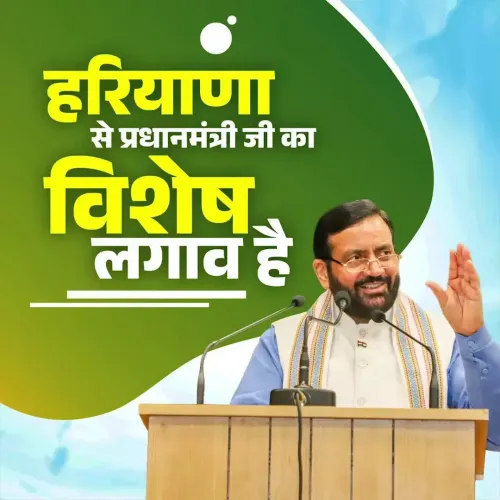
Haryana Chief Minister Nayab Singh Saini on Friday, 24 July 2026, publicly commended Prime Minister Narendra Modi for taking a firm and clear stance on the sensitive issue of paper leaks, stating that the government's commitment to protecting students' futures and maintaining trust in the examination system deserves recognition.
Context
In his post, CM Saini wrote — 'आदरणीय प्रधानमंत्री श्री नरेंद्र मोदी जी को हार्दिक साधुवाद' ['Heartfelt appreciation to the honourable Prime Minister Narendra Modi'] — for taking the concerns of 'lakhs of students and their parents seriously' on the issue of paper leaks. He noted that the PM's government had presented a 'clear and firm stance' on what he called a sensitive subject.
Saini further stated that a bill providing for fast-track courts and stringent punishment provisions in paper leak cases would become a strong law after being passed by Parliament. He added that strict action against the guilty, time-bound hearings, and severe penalties would further strengthen the transparency and credibility of the examination system.
Policy Backdrop
The legislative push referenced by CM Saini builds on the Public Examinations (Prevention of Unfair Means) Act, 2024, which Parliament passed to curb malpractices — including paper leaks — in public examinations. The law marked a significant shift toward deterrence, with harsher penalties aimed at those who compromise the integrity of competitive assessments.
India has seen recurring paper leak scandals at both national and state levels over successive years, affecting millions of aspirants in recruitment and academic examinations. Legislative focus has steadily moved from administrative fixes toward specialised judicial mechanisms designed to ensure faster accountability.
Stakeholders and Impact
The primary stakeholders are students and parents across India who depend on the fairness of public examinations for access to government jobs, higher education, and professional courses. Paper leak incidents have historically led to mass re-examinations, prolonged uncertainty, and loss of trust in regulatory bodies overseeing these tests.
The proposed fast-track court mechanism, if operationalised, would aim to reduce the time between detection of an offence and delivery of a verdict — a gap that critics have long argued allows culprits to evade meaningful consequences. CM Saini's endorsement signals alignment between the BJP-governed state of Haryana and the central government on this legislative agenda.
What's Next
Attention will now turn to the operationalisation of fast-track courts and the filing of first prosecutions under the strengthened legal framework. State governments, including Haryana, are also expected to adopt complementary exam security protocols to reinforce the central law at the ground level.
The credibility of the reforms will ultimately be tested by how swiftly cases are prosecuted and whether the deterrent effect translates into a measurable reduction in exam malpractice incidents across the country.
Point of View
Reinforcing the BJP's unified messaging on exam integrity ahead of potential state-level legislative action. By spotlighting fast-track courts and stringent penalties, the post signals that the party intends to make exam security a visible governance achievement rather than a bureaucratic fix. The timing also reflects a broader pattern in which state BJP leaders publicly amplify central government legislative moves to consolidate voter trust among aspirant communities — a demographic that has grown increasingly vocal after high-profile paper leak controversies. Whether the fast-track mechanism delivers visible prosecutions will determine if the political capital invested in this messaging translates into lasting credibility.
NationPress
22 Oct 2026
Frequently Asked Questions
What is the paper leak bill mentioned by Haryana CM Nayab Singh Saini?
CM Saini referred to a proposed bill in Parliament that would establish fast-track courts and impose stringent punishments for paper leak offences in public examinations, building on the Public Examinations (Prevention of Unfair Means) Act, 2024.
What is the Public Examinations (Prevention of Unfair Means) Act, 2024?
It is a central law passed by Parliament in 2024 to prevent malpractices including paper leaks in public examinations, with provisions for harsher penalties aimed at deterring those who compromise exam integrity.
Why did Haryana CM Saini praise PM Modi on paper leaks?
Saini praised PM Modi for taking a clear and firm stance on the issue and for his government's commitment to protecting students' futures and restoring trust in India's examination system.
How will fast-track courts help in paper leak cases?
Fast-track courts are designed to ensure time-bound hearings and swift delivery of verdicts, reducing the delay between detection of a paper leak offence and actual punishment of the guilty.
Which states are expected to adopt exam security measures under the new framework?
State governments, including BJP-governed Haryana, are expected to adopt complementary exam security protocols to reinforce the central legislation at the ground level, though specific state-level measures have not yet been announced.