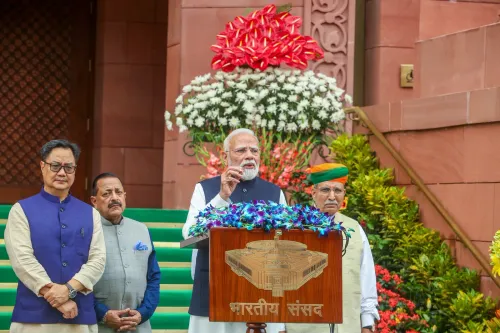
Jal Shakti Minister Paatil backs fast-track courts for paper leaks
Synopsis
Union Jal Shakti Minister C. R. Paatil on 23 July 2026 endorsed fast-track courts for paper-leak cases, saying the Modi government is firmly committed to protecting the dreams and hard work of India's youth. He warned that those who compromise examination integrity will not be spared.
Key Takeaways
Paatil , Union Jal Shakti Minister, publicly backed fast-track court formation for examination paper-leak offences on 23 July 2026 .
He stated the government's message is clear: those who harm the futures of India's youth 'will not be spared.' The Public Examinations (Prevention of Unfair Means) Act, 2024 already prescribes stringent penalties for paper leaks and unfair means in public exams.
Fast-track courts are intended to deliver swift convictions, closing the accountability gap that has historically benefited accused persons.
The move primarily impacts lakhs of job aspirants and students , especially first-generation and rural candidates most harmed by paper leaks.
Operationalisation requires state notifications and potential funding or procedural rules from the Ministry of Law and Justice .
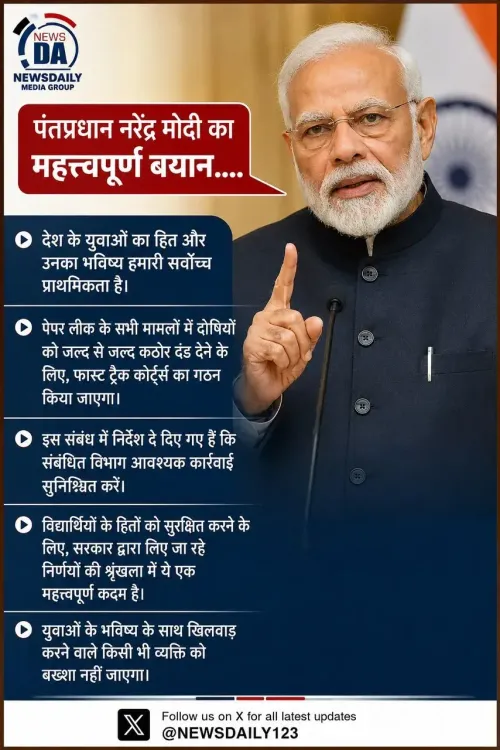
Union Jal Shakti Minister C. R. Paatil on Thursday, 23 July 2026, voiced strong support for the formation of fast-track courts to swiftly punish those responsible for examination paper leaks, framing the move as a firm commitment by the Modi government to protect the futures of India's youth.
Posting in Hindi on X, Paatil wrote: 'पेपर लीक जैसे गंभीर मामलों में दोषियों को जल्द से जल्द कठोर दंड दिलाने के लिए फास्ट ट्रैक कोर्ट के गठन की दिशा में कदम' — ('Steps toward the formation of fast-track courts to ensure the harshest punishment at the earliest for the guilty in serious matters like paper leaks'). He added that the message was unambiguous: 'Those who play with the dreams, hard work, and futures of the country's youth will not be spared.'
Context
The post comes against a backdrop of sustained public anger over examination irregularities that have roiled India's competitive recruitment landscape since 2022. High-stakes tests — including national medical entrance and state-level government job examinations — have been repeatedly hit by alleged paper leaks, triggering protests by lakhs of aspirants whose years of preparation were rendered uncertain.
C. R. Paatil, a senior BJP leader and former Gujarat BJP state president, has consistently positioned himself as a voice for youth welfare within the party. His intervention signals that the issue remains politically live at the highest levels of the ruling establishment.
Policy Backdrop
Parliament enacted the Public Examinations (Prevention of Unfair Means) Act, 2024, prescribing stringent penalties — including imprisonment and heavy fines — for those found guilty of leaking question papers or facilitating cheating in public recruitment examinations. The legislation was presented as a landmark deterrent against organised malpractice networks.
Fast-track courts are specialised judicial bodies designed to deliver time-bound verdicts in serious criminal cases. Their proposed deployment in paper-leak matters would add a procedural layer intended to close the gap between arrest and conviction — a gap critics say has historically allowed accused persons to escape meaningful accountability.
Stakeholders and Impact
The primary beneficiaries of any effective crackdown are job aspirants and students — particularly first-generation learners and candidates from rural and semi-urban backgrounds who invest years and significant household resources into competitive examination preparation. For them, a single paper leak can erase not just an attempt but an entire cycle of eligibility.
Coaching institutes, examination-conducting bodies such as the National Testing Agency (NTA), and state public service commissions are also directly affected, as their credibility hinges on the perceived integrity of the selection process. Organised criminal networks that profit from paper leaks stand to face accelerated legal jeopardy if the fast-track mechanism is operationalised.
What's Next
The critical next step is operationalisation — state governments will need to issue formal notifications designating specific courts as fast-track benches for paper-leak offences, while the Ministry of Law and Justice may announce supplementary funding or procedural rules to govern their functioning. Advocacy groups representing aspirants are likely to monitor whether the courts are constituted within a defined deadline.
With competitive examinations remaining a primary gateway to government employment for millions of young Indians, the speed and transparency with which these courts are set up will be a key indicator of whether the Modi government's stated commitment translates into institutional change on the ground.
Point of View
Reassuring a youth demographic that has grown visibly restive over repeated examination scandals. By invoking PM Modi's leadership and framing fast-track courts as an expression of 'firm commitment,' the BJP is attempting to convert a governance liability — repeated paper leaks — into a narrative of decisive executive action. The reference to the 2024 legislation anchors the message in existing law, lending it procedural credibility beyond mere rhetoric. Whether the courts are actually constituted and functional within a reasonable timeframe will determine if this signalling translates into lasting political capital with aspirants.
NationPress
21 Oct 2026
Frequently Asked Questions
What are fast-track courts for paper leaks in India?
Fast-track courts are specialised judicial benches designed to conduct time-bound trials in serious criminal cases. In the context of examination paper leaks, they are intended to ensure swift conviction and punishment for the accused under the Public Examinations (Prevention of Unfair Means) Act, 2024.
What is the Public Examinations Prevention of Unfair Means Act 2024?
The Public Examinations (Prevention of Unfair Means) Act, 2024 is a central law enacted by Parliament that prescribes stringent penalties — including imprisonment and heavy fines — for individuals found guilty of leaking question papers or facilitating cheating in government recruitment and entrance examinations.
Why did C. R. Paatil comment on paper leaks?
C. R. Paatil, Union Jal Shakti Minister and senior BJP leader, posted on X on 23 July 2026 to voice support for fast-track courts in paper-leak cases, framing it as part of PM Modi's government's commitment to protecting the futures of India's youth.
Which examinations have been affected by paper leaks in India?
Several high-stakes examinations have faced paper-leak allegations since 2022, including national medical entrance tests and various state-level government job recruitment examinations, prompting both legislative action and calls for judicial reform.
What happens next after the announcement of fast-track courts for paper leaks?
State governments must issue formal notifications designating specific courts as fast-track benches, and the Ministry of Law and Justice may announce funding or procedural rules. Advocacy groups representing aspirants are expected to monitor whether the courts are constituted within a clear deadline.