Shekhawat backs fast-track courts for paper leak cases

Synopsis
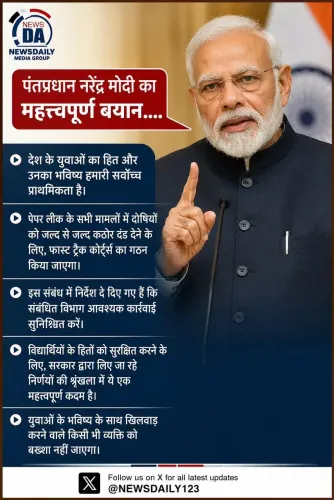
Union Culture and Tourism Minister Gajendra Singh Shekhawat on 23 July 2026 endorsed the government's decision to set up fast-track courts for paper leak cases, citing PM Modi's commitment to protecting student aspirations and restoring trust in India's competitive examination system.
Key Takeaways
Gajendra Singh Shekhawat publicly backed the establishment of fast-track courts specifically for paper leak cases on 23 July 2026 .
He described the future of India's youth as 'non-negotiable' and framed the decision as a direct message to those who compromise student aspirations.
The move builds on the Public Examinations (Prevention of Unfair Means) Act, 2024 , enacted after major scandals involving NEET-UG and UGC-NET .
Fast-track courts are intended to ensure swift prosecution and strengthen the deterrent effect of the 2024 legislation.
Implementation timelines, state-level notifications, and budgetary allocations for the courts remain to be watched.
The initiative is part of the Modi government's broader post-2024 focus on restoring credibility in merit-based examination and recruitment systems.
Union Culture and Tourism Minister Gajendra Singh Shekhawat on Thursday, 23 July 2026, voiced strong support for the government's decision to establish fast-track courts to adjudicate paper leak cases, calling the move a firm signal that those who undermine student aspirations will face swift and stringent justice.
Context
In his post, Shekhawat declared, 'The future of our youth is non-negotiable,' framing the fast-track court decision as a direct safeguard for millions of competitive exam aspirants across India. He credited the initiative to the leadership of Prime Minister Narendra Modi, stating that the government has 'consistently taken decisive steps to safeguard the interests of students and uphold the integrity of our examination system.'
The statement comes against the backdrop of sustained public concern over organised paper leaks that have repeatedly disrupted high-stakes national examinations, eroding trust among students and their families in the fairness of merit-based selection.
Policy Backdrop
The legislative foundation for stricter action on paper leaks was laid when Parliament enacted the Public Examinations (Prevention of Unfair Means) Act, 2024, following a wave of scandals involving exams such as NEET-UG and UGC-NET. The law introduced stringent penalties for individuals and organised networks found guilty of leaking question papers, impersonation, and other unfair practices in public recruitment and entrance examinations.
The proposed fast-track courts are positioned as the judicial complement to this legislative framework, designed to ensure that prosecutions under the Act are not mired in prolonged delays. Expedited adjudication is seen as critical to the law's deterrent effect, given that lengthy trials have historically blunted the impact of anti-malpractice measures.
Stakeholders and Impact
The primary beneficiaries of swift judicial action are the crores of students who invest years preparing for competitive examinations — from central recruitment boards to national medical and engineering entrance tests. Any compromise in examination integrity directly translates into lost opportunities for aspirants from economically weaker sections who cannot afford repeated preparation cycles.
Beyond students, the move signals accountability for examination-conducting bodies, coaching networks, and officials implicated in leak conspiracies. State governments will also be closely watched for how swiftly they notify and operationalise fast-track benches within their jurisdictions, since law and order and the judiciary are concurrent subjects.
What's Next
Attention will now turn to the implementation roadmap for these fast-track courts — specifically, the timelines for their constitution, the budgetary allocations required, and whether state governments align with the Centre's push through corresponding notifications. The credibility of the initiative will ultimately rest on the speed and consistency of its first prosecutions under the Public Examinations (Prevention of Unfair Means) Act, 2024.
As competitive examinations remain the primary gateway to government employment and higher education for millions of young Indians, the establishment of a robust and visible deterrence mechanism could prove to be a defining policy marker for the Modi government's third term on the education and youth agenda.
Point of View
Signalling that the BJP intends to own the narrative on examination integrity heading into future electoral cycles. The framing of 'non-negotiable' futures and 'swift justice' is calibrated to reassure a demographic — competitive exam aspirants — that has shown it can translate grievance into political pressure. The invocation of PM Modi's leadership ties the measure firmly to the party's centralised governance brand. The real test, however, will be whether fast-track courts are operationalised with the speed the rhetoric promises, or whether the initiative stalls at the implementation stage as similar measures have in the past.
NationPress
21 Oct 2026
Frequently Asked Questions
What are fast-track courts for paper leak cases in India?
Fast-track courts for paper leak cases are dedicated judicial benches designed to expedite trials under the Public Examinations (Prevention of Unfair Means) Act, 2024, ensuring swift convictions or acquittals rather than prolonged proceedings that blunt the law's deterrent effect.
What is the Public Examinations Prevention of Unfair Means Act 2024?
The Public Examinations (Prevention of Unfair Means) Act, 2024 is a central law passed by Parliament to deter paper leaks, impersonation, and other malpractices in public recruitment and entrance exams, following high-profile scandals involving NEET-UG and UGC-NET.
Why did Gajendra Singh Shekhawat comment on paper leak courts?
Shekhawat posted on 23 July 2026 endorsing the government's fast-track court decision, framing it as a decisive step under PM Modi's leadership to protect student aspirations and uphold the integrity of India's examination system.
Which exams were affected by paper leaks that led to new laws?
NEET-UG and UGC-NET were among the prominent national-level examinations affected by paper leak controversies that accelerated the passage of the Public Examinations (Prevention of Unfair Means) Act, 2024.
What happens next after the fast-track court decision for paper leaks?
The key steps to watch include the constitution of fast-track benches, budgetary allocations, and state government notifications to operationalise the courts, as well as the speed of first prosecutions under the 2024 Act.