Shekhawat backs 2026 Bill to crush paper leak mafia
Synopsis
Union Minister Gajendra Singh Shekhawat has backed the Public Examinations (Prevention of Unfair Means) (Amendment) Bill, 2026, which mandates fast-track trials, a special task force, and penalties of up to 7 years imprisonment and ₹10 crore fines for organised paper leak networks.
Key Takeaways
The Public Examinations (Prevention of Unfair Means) (Amendment) Bill, 2026 has been backed by Union Minister Gajendra Singh Shekhawat .
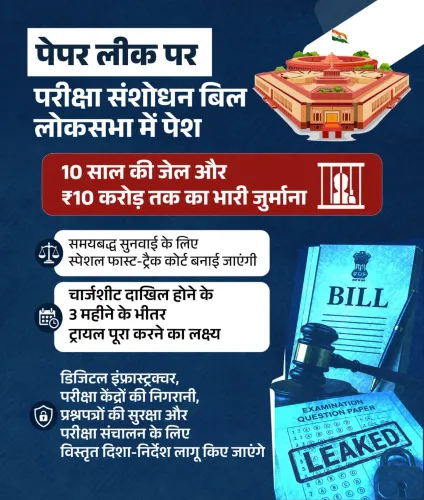
Organised paper leak gangs face a minimum 7-year prison sentence and fines up to ₹10 crore .
Use of unfair means in exams now carries up to 10 years in jail and a fine of up to ₹50 lakh .
Guilty examination institutions face fines of up to ₹5 crore .
Trials must be completed within 3 months , with dedicated fast-track courts and a special task force for serious cases.
The 2026 Bill builds on the original Public Examinations (Prevention of Unfair Means) Act, 2024 , which first criminalised exam fraud at the national level.
India's exam-fraud crisis just got a legislative answer with teeth. Union Culture and Tourism Minister Gajendra Singh Shekhawat on Wednesday, 29 July 2026, threw his weight behind the Public Examinations (Prevention of Unfair Means) (Amendment) Bill, 2026 — a sweeping crackdown that targets the organised networks that have repeatedly robbed lakhs of young Indians of their futures.
What the 2026 Amendment actually does to paper leak networks
The Bill's provisions are designed to hit hard and fast. Organised paper leak gangs now face a minimum seven-year prison sentence and fines of up to ₹10 crore. Individuals caught using unfair means during examinations face up to 10 years in jail and penalties reaching ₹50 lakh. Complicit examination institutions can be fined up to ₹5 crore.
Speed is built into the enforcement architecture. The legislation mandates trial completion within three months, backed by the creation of dedicated fast-track courts. A special task force will handle investigations in serious cases — stripping away the procedural delays that have historically allowed accused to walk free long before a verdict.
The crisis that made this Bill necessary
This amendment does not emerge in a vacuum. Since 2023–24, a cascade of high-profile leaks — most visibly in NEET-UG and UGC-NET, as well as multiple state-level recruitment examinations — exposed the vulnerability of India's public examination infrastructure. Millions of aspirants lost months, sometimes years, of preparation to fraud they had no hand in.
Parliament had already moved in 2024, passing the original Public Examinations (Prevention of Unfair Means) Act to criminalise such offences for the first time. The 2026 Amendment sharpens those provisions — escalating penalties, institutionalising fast-track justice, and creating a dedicated investigative mechanism that did not exist before.
Shekhawat framed the Bill as a direct message: 'पेपर लीक माफिया का खेल नहीं चलने वाला' — 'the paper leak mafia's game will not go on.' His post listed the six key provisions as a checklist, signalling that the government views this as a deliverable, not a declaration.
What now — courts, task forces, and first prosecutions
The real test begins in implementation. Three milestones will define whether the law delivers: the formal notification of rules under the amended Act, the actual constitution of the promised fast-track courts, and the first successful prosecution of an organised leak network under the new penalty structure. Each of these steps has, in past legislative cycles, been where momentum stalls.
For India's exam aspirants — the crore-strong cohort preparing for everything from UPSC to state PSC boards to central recruitment tests — the Bill represents a promise. Whether the machinery of special courts and task forces materialises on schedule will determine whether that promise holds.
A law with seven-year minimums and ten-crore fines is a credible deterrent on paper. The mafia's next move will test whether it is one in practice.
Point of View
The government is attempting to close the enforcement gap that has historically allowed accused to exploit procedural delays. For the BJP, this is also politically strategic: the NEET-UG crisis in 2024 generated rare cross-partisan outrage, and a visible legislative response ahead of state election cycles signals responsiveness to aspirant-class voters. The credibility of the entire exercise, however, now rests on implementation speed — a domain where India's legislative ambitions have often outpaced administrative delivery.
NationPress
28 Oct 2026
Frequently Asked Questions
What is the Public Examinations Amendment Bill 2026?
The Public Examinations (Prevention of Unfair Means) (Amendment) Bill, 2026 is a central government legislation that strengthens penalties against paper leaks and exam fraud, introducing fast-track courts, a special task force, and minimum 7-year prison terms for organised leak networks.
What is the punishment for paper leak under the new 2026 Bill?
Organised paper leak gangs face a minimum 7 years in prison and fines up to ₹10 crore. Individuals using unfair means during exams face up to 10 years in jail and fines up to ₹50 lakh.
What is the difference between the 2024 Act and the 2026 Amendment?
The original Public Examinations (Prevention of Unfair Means) Act, 2024 first criminalised exam fraud at the national level. The 2026 Amendment escalates penalties, mandates trial completion within 3 months, creates fast-track courts, and establishes a special task force for serious cases.
What happens to exam institutions found guilty under the 2026 Bill?
Examination institutions found complicit in fraud or malpractice can be fined up to ₹5 crore under the 2026 Amendment Bill.
Why did the Modi government introduce the paper leak Amendment Bill in 2026?
The Bill follows a series of high-profile exam leaks since 2023–24, including in NEET-UG and UGC-NET, which exposed systemic vulnerabilities and triggered nationwide protests by exam aspirants.