Yadav backs Modi's fast-track courts for exam paper leaks

Synopsis
Union Environment Minister Bhupender Yadav has endorsed PM Narendra Modi's decision to deploy fast-track courts for paper-leak offences, calling it a vital step toward transparent recruitment and swift justice for India's youth aspirants.
Key Takeaways
Union Environment Minister Bhupender Yadav publicly backed PM Narendra Modi 's decision on 23 July 2026 to establish fast-track courts for paper-leak cases.
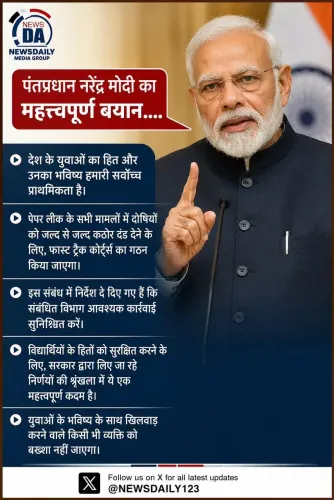
The fast-track courts are intended to ensure rapid case disposal and swift, stringent punishment for those guilty of examination fraud.
The move builds on the Public Examinations (Prevention of Unfair Means) Act, 2024 , which already prescribes heavy penalties for exam malpractice.
Yadav described the initiative as a 'clear message' to networks that exploit the hard work and future of young job aspirants.
The government's stated goal is a transparent and impartial public recruitment process, with faster judicial resolution as the key mechanism.
Operationalisation details — including court notifications and case-disposal timelines — are awaited.
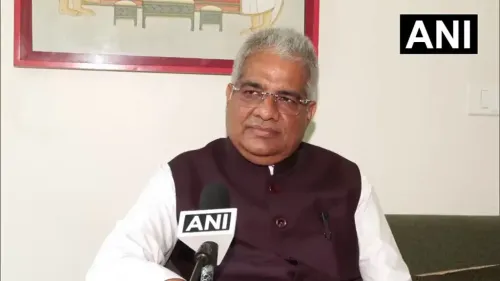
Union Environment Minister Bhupender Yadav on Thursday, 23 July 2026 backed Prime Minister Narendra Modi's decision to establish fast-track courts for the swift disposal of paper-leak cases, calling it a landmark step toward protecting the aspirations of India's youth and ensuring transparent public recruitment.
Context
Posting in Hindi on X, Yadav wrote: 'युवा शक्ति का विश्वास और उनके सपनों की सुरक्षा सरकार की सर्वोच्च जिम्मेदारी है' — 'Safeguarding the trust of youth power and their dreams is the government's foremost responsibility.' He stated that Prime Minister Modi has taken a significant decision to ensure rapid case disposal through fast-track courts and swift, stringent punishment for those found guilty of offences such as paper leaks.
Yadav described the initiative as a 'clear message' to those who 'play with the hard work and future of young people,' adding that the move would play an important role in securing the nation's bright future through a transparent and impartial recruitment process.
Policy Backdrop
The announcement builds on the Public Examinations (Prevention of Unfair Means) Act, 2024, a central legislation that introduced stringent penalties — including imprisonment and heavy fines — for paper leaks and other malpractices in competitive public examinations. The law was enacted following a series of high-profile leak incidents that disrupted national and state-level recruitment tests and drew widespread protests from job aspirants across the country.
The proposed fast-track court mechanism is intended to complement the 2024 Act by accelerating judicial proceedings in such cases, reducing the gap between the filing of charges and the delivery of verdicts. Fast-track courts have previously been deployed in India for offences such as sexual assault and crimes against children, and their extension to examination fraud signals the government's intent to treat such malpractice with comparable seriousness.
Stakeholders and Impact
The decision most directly affects millions of competitive examination aspirants — particularly those preparing for central and state government recruitment tests — who have repeatedly seen their efforts undermined by organised paper-leak networks. Student groups and civil society organisations had long demanded both tougher laws and faster justice in such cases.
State recruitment bodies and examination-conducting agencies are also key stakeholders, as the fast-track court framework is expected to create stronger institutional accountability. Legal experts have noted that deterrence in paper-leak cases depends heavily on the speed and certainty of punishment, making the judicial mechanism as important as the underlying legislation.
What's Next
Attention will now turn to the formal operationalisation of the designated fast-track courts, including any executive notifications specifying case-disposal timelines and the courts' jurisdictional scope. Observers will watch whether the initiative is accompanied by further legislative or administrative notifications that tighten examination security protocols at the source. The government's ability to deliver visible convictions under this framework will be the key measure of its effectiveness for the youth constituency it is targeting.
Point of View
The government is trying to close the credibility gap between legislation and enforcement — the weak link that critics have repeatedly highlighted. The move fits a broader pattern of the Modi administration using judicial-speed mechanisms to demonstrate muscular governance on emotive social issues. Whether the initiative translates into actual convictions at pace will determine how much political capital it ultimately yields.
NationPress
21 Oct 2026
Frequently Asked Questions
What is the fast-track court decision for paper leaks announced by PM Modi?
PM Narendra Modi has decided to establish fast-track courts specifically to handle paper-leak cases, ensuring swift disposal of cases and stringent punishment for the guilty, as endorsed by Union Minister Bhupender Yadav on 23 July 2026.
What is the Public Examinations (Prevention of Unfair Means) Act, 2024?
It is a central law enacted in 2024 that prescribes strict penalties — including imprisonment and heavy fines — for paper leaks and other malpractices in public competitive examinations in India.
How will fast-track courts help exam aspirants in India?
Fast-track courts are designed to reduce the time between the filing of charges and the delivery of verdicts in paper-leak cases, making punishment faster and more certain, which is expected to deter organised leak networks.
Who is Bhupender Yadav and why did he comment on paper leaks?
Bhupender Yadav is India's Union Minister of Environment, Forest and Climate Change and a senior BJP leader. As a party spokesperson on governance, he regularly amplifies key decisions by PM Modi, including those on youth welfare and recruitment integrity.
What happens next after the fast-track court announcement on paper leaks?
The government is expected to issue formal executive notifications specifying the jurisdiction and case-disposal timelines of the fast-track courts, with observers watching for the first visible convictions under the new framework.