CM Saini Pays Tribute to Vikram Sarabhai on Birth Anniversary
Synopsis
Haryana Chief Minister Nayab Singh Saini honoured Dr. Vikram Sarabhai on his birth anniversary, calling the Padma Vibhushan physicist the father of India's space programme whose visionary leadership through INCOSPAR and ISRO gave India enduring global recognition in space science.
Key Takeaways
Haryana CM Nayab Singh Saini paid tribute to Dr.
Vikram Sarabhai on his birth anniversary, August 12 .
Sarabhai is recognised as the founder of India's space programme and was awarded the Padma Vibhushan .
He established INCOSPAR in 1962 , which evolved into ISRO in 1969 .
CM Saini credited Sarabhai's 'unparalleled contribution and visionary leadership' with laying the foundation for India's global recognition in space.
Indian political leaders across parties routinely mark Sarabhai's birth anniversary, reflecting bipartisan reverence for the scientist's legacy.
The man who dreamed of India in space was born on August 12 — and Haryana Chief Minister Nayab Singh Saini marked the occasion with a heartfelt tribute to Dr. Vikram Sarabhai, the physicist who laid the foundation of India's space programme.
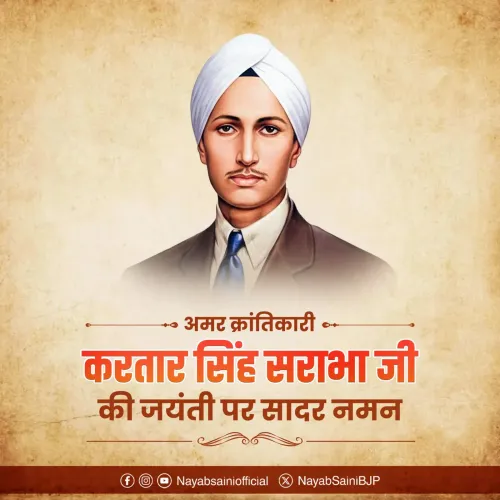
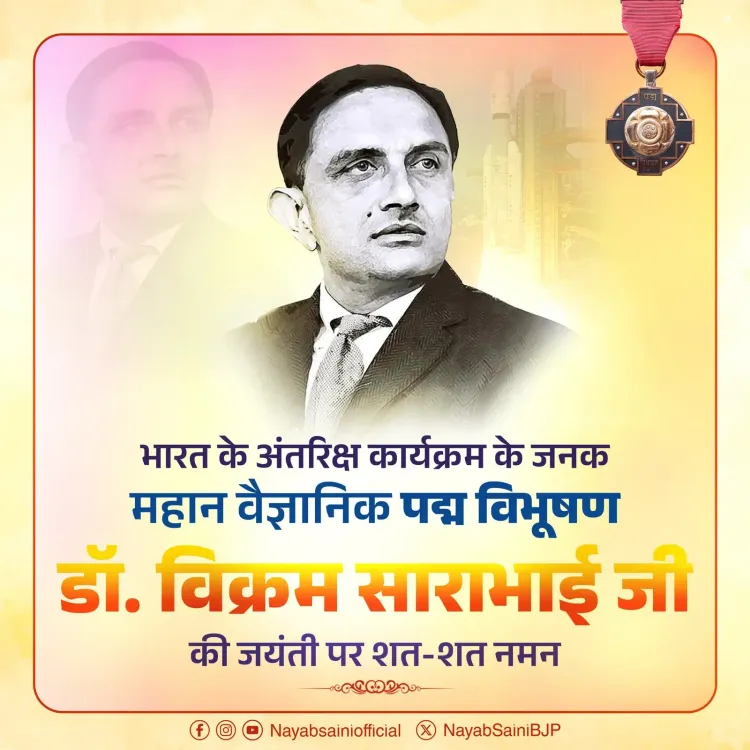
Posting on X, CM Saini offered his respects on Sarabhai's birth anniversary, writing: 'Bharatiya antariksh karyakram ke janak, mahan vaigyanik Padma Vibhushan Dr. Vikram Sarabhai ji ki jayanti par unhe kotishaha naman.' ('On the birth anniversary of the father of India's space programme, the great scientist Padma Vibhushan Dr. Vikram Sarabhai, I bow to him a million times.') He added that Sarabhai's unparalleled contribution to space research and visionary leadership laid a strong foundation for India's global recognition, and that the nation would always remain grateful for his priceless service.
The physicist who gave India its place among the stars
Dr. Vikram Sarabhai was a Padma Vibhushan-decorated physicist whose conviction that a developing nation had every right to pursue space science was, in the early 1960s, a genuinely radical idea. In 1962, he established INCOSPAR — the Indian National Committee for Space Research — under the Department of Atomic Energy, becoming its first chairman. That body evolved, under his stewardship, into what the world now knows as ISRO, formally constituted in 1969. Sarabhai did not live to see India's most celebrated missions — he passed away in 1971 — but every satellite placed in orbit, every rocket launched from Sriharikota, carries the imprint of the institutional architecture he built.A ritual of remembrance, rooted in genuine legacy
Across India's political spectrum, leaders mark August 12 with public tributes to Sarabhai — a pattern that reflects both the bipartisan reverence for foundational scientists and the growing national pride in ISRO's contemporary achievements. CM Saini's tribute follows that tradition, connecting Haryana's political leadership to a legacy that belongs to all of India. As ISRO continues to expand its ambitions in satellite services, lunar exploration, and launch capability, the anniversary of Sarabhai's birth serves as a reminder of how far — and from where — the journey began. Six decades after one scientist's vision became a government institution, India's space programme stands as one of the world's most cost-effective and prolific. That is the foundation Sarabhai poured.Point of View
But it also signals how deeply ISRO's contemporary successes have reinforced Sarabhai's canonical status. For BJP leaders, invoking scientific pioneers on their birth anniversaries serves a dual purpose: affirming national pride in indigenous capability and positioning the party within a continuum of nation-building. The tribute carries no partisan edge — Sarabhai's legacy is genuinely above political contestation — but the consistency of such gestures reflects a broader communications strategy of associating governance with India's civilisational and scientific achievements. As ISRO's global profile grows, Sarabhai's anniversary is likely to command even greater political attention.
NationPress
26 Sept 2026
Frequently Asked Questions
Who was Vikram Sarabhai and why is he called the father of India's space programme?
Dr. Vikram Sarabhai was a physicist and visionary who established INCOSPAR in 1962, the body that became ISRO in 1969. His conviction that India must pursue space science for national development earned him the title of father of India's space programme, and he was posthumously honoured with the Padma Vibhushan.
When is Vikram Sarabhai's birth anniversary?
Vikram Sarabhai's birth anniversary falls on August 12 . Indian leaders and the scientific community mark the day with tributes honouring his role in founding India's space institutions.
What did Haryana CM Nayab Singh Saini say about Vikram Sarabhai?
CM Saini paid tribute on X, calling Sarabhai the 'father of India's space programme' and a 'great scientist.' He said Sarabhai's unparalleled contribution to space research and visionary leadership laid a strong foundation for India's global recognition, and that the nation would always remain grateful.
What is INCOSPAR and how is it related to ISRO?
INCOSPAR — the Indian National Committee for Space Research — was established in 1962 under Vikram Sarabhai's leadership. It was the institutional precursor to ISRO, which was formally constituted in 1969 and continues to lead India's space missions today.
Why do Indian politicians tribute Vikram Sarabhai every year?
Leaders across India's political spectrum mark Sarabhai's birth anniversary because his work underpins every major achievement of ISRO — from satellite launches to lunar missions. The tributes reflect bipartisan recognition of his foundational role and connect current space successes to his original vision.