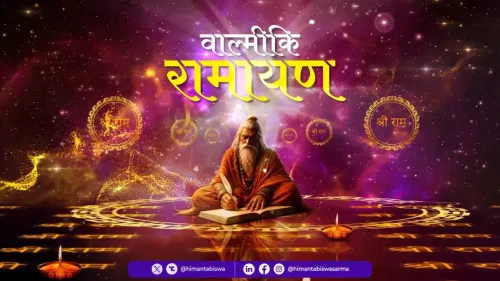
Assam CM Himanta Sarma Cites Valmiki Ramayana Bal Kanda Verse

Synopsis
Assam Chief Minister Himanta Biswa Sarma cited Valmiki Ramayana's Bal Kanda, Sarga 32, Shloka 1, in a brief X post in Assamese and Devanagari, accompanied by a video and no caption, continuing a pattern of scriptural references in BJP leaders' social-media communication.
Key Takeaways
Assam CM Himanta Biswa Sarma posted on 3 June 2026 citing Valmiki Ramayana, Bal Kanda, Sarga 32, Shloka 1 .
The reference was shared in both Assamese and Devanagari script.
The post carried a video and no accompanying text or interpretation.
The Bal Kanda is the opening book of the Valmiki Ramayana, covering Rama's birth and early life.
The post fits a broader pattern of BJP leaders citing classical Sanskrit texts on social media.
Assam Chief Minister Himanta Biswa Sarma on Wednesday, 3 June 2026, posted a citation from the Valmiki Ramayana on X, pointing readers to Bal Kanda, Sarga 32, Shloka 1. The post, shared in both Assamese and Devanagari script, was accompanied by a video and carried no additional commentary from the chief minister.
The tweet reads simply 'বাল্মীকি ৰামায়ণ, বালকাণ্ড, সৰ্গ ৩২, শ্লোক ১' and 'वाल्मीकि रामायण, बालकाण्ड, सर्ग ३२, श्लोक १' ('Valmiki Ramayana, Bal Kanda, Sarga 32, Shloka 1'). By offering only the scriptural reference and a video, Sarma has invited followers to look up the verse themselves rather than framing its meaning in his own words.
Context
Sarma, who has led the Assam government since 2021 and serves as convenor of the North-East Democratic Alliance (NEDA), is among the more prolific users of X in Indian political circles. He routinely mixes administrative announcements with cultural and devotional content, and his handle frequently switches between Assamese, Hindi and English to reach distinct audience segments within and beyond the state.
The Bal Kanda is the opening book of the Valmiki Ramayana, traditionally regarded as the Adi Kavya or first poem of Sanskrit literature. It narrates the lineage of the Ikshvaku dynasty, the birth of Rama at Ayodhya, and his early exploits, and is widely read during religious discourses and household recitations across India.
Policy backdrop
Citations from classical Sanskrit texts have become a recurring feature of public communication by leaders of the Bharatiya Janata Party, particularly in states where the party is in office. Such posts are typically read as part of a broader effort to weave scriptural references into mainstream political discourse and to project continuity between governance and cultural heritage.
In Assam, the Sarma government has placed cultural identity at the centre of several recent initiatives, including renovation of temples, promotion of pilgrimage circuits and amplified observance of festivals tied to the state's Vaishnavite traditions. A verse citation from the chief minister's verified handle therefore sits within a familiar template of cultural signalling, even when no explicit policy is announced.
Stakeholders and impact
The immediate audience for the post includes Hindu devotees, students of Sanskrit and cultural organisations that engage with the Ramayana tradition. By writing the reference in both Assamese and Devanagari, Sarma has addressed his domestic constituency in Assam alongside the broader Hindi-reading audience across northern and central India.
For political observers, even a brief scriptural post from a sitting chief minister tends to be parsed for thematic cues, especially when it is paired with video content. The absence of any caption leaves room for multiple interpretations, ranging from a personal devotional note to a hint at an upcoming cultural programme or speech.
What's next
Attention will turn to whether Sarma follows up with an interpretation of the verse, a related event in Assam, or a speech that draws on the Bal Kanda theme. State-sponsored cultural calendars and assembly proceedings in the coming weeks may indicate whether the citation was a stand-alone devotional message or a precursor to a larger announcement.
Either way, the post reinforces a pattern in which scriptural references are mainstreamed into the daily social-media output of senior Indian politicians, shaping how classical texts circulate in contemporary political conversation.
Point of View
In two scripts and with a video, leaves interpretation open while reinforcing a cultural register that has become routine in BJP communication. The move sits within a wider arc in which classical Hindu texts are mainstreamed into daily political messaging, blurring the line between devotional expression and governance signalling. Whether a follow-up policy or event materialises will determine if this was personal or programmatic.
NationPress
21 Oct 2026
Frequently Asked Questions
What did Himanta Biswa Sarma post on X on 3 June 2026?
He posted a citation of Valmiki Ramayana, Bal Kanda, Sarga 32, Shloka 1, written in Assamese and Devanagari, along with a video and no caption.
What is the Bal Kanda in the Valmiki Ramayana?
The Bal Kanda is the first of the seven books of the Valmiki Ramayana. It narrates the lineage of the Ikshvaku dynasty, the birth of Rama at Ayodhya and his early exploits.
Why do BJP leaders often cite Sanskrit verses on social media?
It is part of a wider pattern of weaving Hindu scriptural heritage into political communication. Such posts engage devotees and cultural organisations while linking governance with traditional texts.
Did Himanta Biswa Sarma explain the meaning of the shloka?
No. The post contains only the reference to the verse and a video, with no interpretation or commentary from the chief minister.
What role does Himanta Biswa Sarma hold apart from being Assam CM?
He has been Chief Minister of Assam since 2021 and serves as the convenor of the North-East Democratic Alliance (NEDA), a BJP-led grouping of regional parties in the North-East.