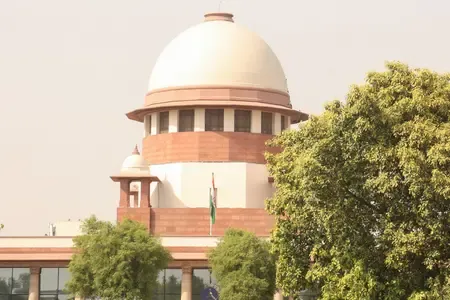
Why Did the Supreme Court Reject PIL Against Bottled Water Standards?

Synopsis
The Supreme Court's refusal to entertain a PIL challenging India's bottled water standards highlights a disconnect from the nation's realities. The court emphasized the need for practical solutions over luxury litigation. This case opens a discussion on health standards and access to clean drinking water in India.
Key Takeaways
The Supreme Court rejected a PIL challenging bottled water standards.
Emphasis placed on addressing practical issues over luxury litigation.
India's situation calls for context-appropriate standards.
Petitioner can submit a representation to authorities.
Health risks associated with antimony and DEHP remain a concern.
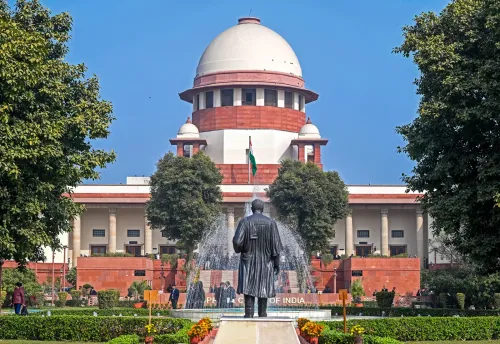
New Delhi, Dec 18 (NationPress) The Supreme Court on Thursday declined to entertain a public interest litigation (PIL) that challenged the current quality standards for bottled drinking water and plastic packaging in India.
A bench led by Chief Justice of India (CJI) Surya Kant and Justice Joymalya Bagchi highlighted that the plea exhibited a detachment from the ground realities of the nation.
The PIL questioned the permissible limits of antimony and DEHP (Di(2-ethylhexyl) phthalate) in packaged drinking water, as set by the Food Safety and Standards Authority of India (FSSAI) and the Bureau of Indian Standards (BIS).
During the proceedings, CJI Surya Kant remarked on the petitioner's reliance on foreign standards and guidelines.
"Given the challenges we face, do you (the petitioner) think we can apply US guidelines, etc.? Be aware of ground realities. You are referencing Australian and Saudi Arabian guidelines. This is all just theoretical discussion," the apex court stated, emphasizing that adopting benchmarks from developed countries is premature for India.
"If the petitioner had advocated for drinking water accessibility in villages that lack it, we could appreciate that. However, determining the labeling of water bottles is merely luxury litigation," the bench noted.
The Supreme Court chose not to entertain the petition but permitted the petitioner to present a representation to government authorities.
"Present a representation to the authorities. We are confident it will be taken into account," the bench advised.
The petition, filed under Article 32 of the Constitution by advocate Shrishti Agnihotri, sought the annulment of FSSAI and BIS notifications setting permissible limits for antimony and DEHP, claiming these standards were ultra vires Article 14 of the Constitution and against the Food Safety and Standards Act, 2006.
According to the PIL, India, as a signatory to the Universal Declaration of Human Rights and the International Covenant on Economic, Social and Cultural Rights, is required to ensure that international health and safe drinking water norms are integrated into domestic law.
The petitioner contended that Indian standards "permit a higher concentration of antimony and DEHP in drinking water compared to the safe limits established by the World Health Organization and other nations".
Additionally, the plea claimed that FSSAI failed to fulfill its statutory responsibilities under Section 18 of the FSSAI Act, 2006, which mandates consideration of international standards while developing regulations and conducting an "open and transparent public consultation" during the formulation or revision of standards.
Arguing that increased exposure to antimony and DEHP poses significant health risks, including cardiovascular, respiratory, and organ-related issues, the petitioner asserted that the current standards infringe upon the right to health and the right to clean drinking water under Article 21 of the Constitution.
Point of View
The emphasis must remain on addressing pressing issues like access to clean drinking water in underserved areas. This decision reflects a balanced approach, prioritizing the needs of the population over theoretical frameworks.
NationPress
3 Oct 2026
Frequently Asked Questions
What was the main issue in the PIL?
The PIL challenged the existing quality standards for bottled drinking water and plastic packaging set by the FSSAI and BIS, claiming they allowed higher levels of antimony and DEHP than international norms.
What did the Supreme Court say about foreign standards?
The Supreme Court highlighted that it is impractical to implement foreign standards in India without considering the country's unique challenges and circumstances.
What is the significance of the court's ruling?
The court's ruling emphasizes the need to focus on practical issues, such as access to clean drinking water in rural areas, rather than luxury litigation over labeling and standards.
Can the petitioner take further action?
Yes, the Supreme Court allowed the petitioner to submit a representation to the relevant government authorities for consideration.
How does this ruling impact public health?
This ruling directs attention toward ensuring safe drinking water access and addressing health risks associated with contaminants like antimony and DEHP.