What is the SHANTI Bill 2025 and How Does it Impact India's Nuclear Sector?
Synopsis
Uncover the key aspects of the SHANTI Bill 2025, which aims to revolutionize India's nuclear sector by allowing private participation while ensuring strategic control remains with the government. This legislation is pivotal for achieving the nation’s clean energy goals and securing a sustainable future.
Key Takeaways
SHANTI Bill 2025 modernizes India's nuclear legal framework.
It allows private participation in the nuclear sector.
Safety protocols require prior authorization for radiation exposure activities.
It establishes a graded liability framework for nuclear operators.
A regulatory framework is created for peaceful applications of nuclear technology.
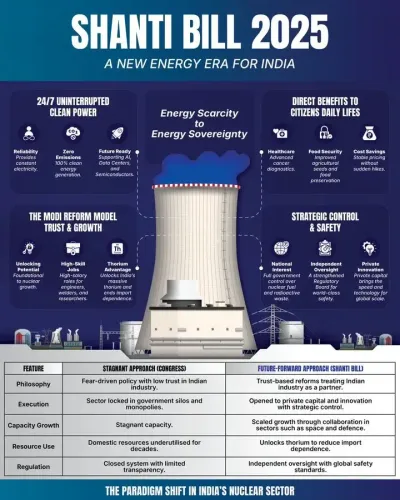
New Delhi, Dec 19 (NationPress) The Sustainable Harnessing and Advancement of Nuclear Energy for Transforming India (SHANTI) Bill, 2025, which was recently ratified by the Parliament, aims to streamline and update the legal framework governing India’s nuclear industry. This initiative is designed to facilitate the nation's transition towards clean energy, with a target of achieving a remarkable 100 GW of nuclear energy capacity by 2047.
This legislation opens the door for private enterprises to engage in India's nuclear sector, allowing them to manage operations, produce power, manufacture equipment, and conduct specific tasks such as the fabrication of nuclear fuel. This includes the processes of conversion, refining, and enrichment of Uranium-235, as well as the production, handling, processing, or disposal of other designated materials.
Furthermore, all operations involving radiation exposure must receive prior safety authorization from the regulatory authority.
At the heart of this legislation is a robust commitment to retaining India's strategic oversight of its nuclear framework. While the sector becomes more accessible to private investment, the Bill ensures that pivotal functions remain under government control.
The central government retains sole authority over the nuclear fuel cycle, waste management, and security-related operations.
The reforms enhance safety protocols and strengthen India's nuclear governance structure in anticipation of future growth.
The Bill reserves certain sensitive nuclear fuel-cycle functions exclusively for the Central government or its fully owned entities, which include activities such as enrichment or isotopic separation of designated or radioactive materials (unless otherwise specified), management of spent fuel like reprocessing, recycling, radionuclide separation, and high-level waste management, as well as the production and improvement of heavy water, alongside any other operations explicitly stated by the Union government.
It creates a systematic process for the granting, suspending, or revoking of licenses and safety authorizations related to nuclear energy production and use.
Unlike existing regulations that enforce a uniform statutory cap on operator liability, the SHANTI Bill introduces a graded liability framework. This structure specifies liability limits detailed in the Bill's Second Schedule, adjusted according to the type and characteristics of the nuclear facility.
The legislation establishes a regulatory framework for the utilization of nuclear and radiation technologies across healthcare, agriculture, industry, research, and other peaceful applications.
It also permits exemptions from licensing for limited activities such as research, development, and innovation.
Moreover, the Bill presents a practical civil liability framework to address nuclear damage and establishes a dedicated Commission to manage cases involving significant nuclear incidents, ensuring prompt adjudication.
The Atomic Energy Regulatory Board (AERB) is granted formal statutory recognition, bolstering regulatory autonomy and authority while enhancing systems for security, safeguards, quality assurance, and coordinated emergency response.
Additionally, the Bill confers exclusive acquisition rights to the Central government in specific nuclear-related scenarios and establishes an Atomic Energy Redressal Advisory Council to facilitate dispute resolution.
Point of View
I firmly believe that the SHANTI Bill represents a significant leap forward for India's nuclear capabilities. By balancing private sector involvement with stringent government oversight, this legislation not only furthers our clean energy ambitions but also ensures the safety and security of our nuclear framework. The nation's commitment to achieving sustainable growth through nuclear energy is commendable and vital for our future.
NationPress
20 Sept 2026
Frequently Asked Questions
What is the SHANTI Bill 2025?
The SHANTI Bill 2025 is a legislative framework approved by the Indian Parliament that aims to modernize and consolidate India's nuclear legal structure to support a clean energy transition.
How does the SHANTI Bill impact private companies?
The Bill allows private companies to engage in various aspects of the nuclear sector, including operations, power generation, and the manufacturing of nuclear equipment.
What are the key safety measures in the SHANTI Bill?
The Bill mandates prior safety authorization from regulatory authorities for any activities involving radiation exposure, reinforcing safety protocols.
What is the significance of the graded liability framework?
The graded liability framework introduced by the SHANTI Bill varies liability limits based on the characteristics of nuclear installations, moving away from a one-size-fits-all approach.
How does the SHANTI Bill affect nuclear governance?
The Bill strengthens India's nuclear governance framework by enhancing regulatory independence and establishing clear processes for licensing and safety authorizations.