Shekhawat hails Gavit's historic CWG 2026 para-sprint gold
Synopsis
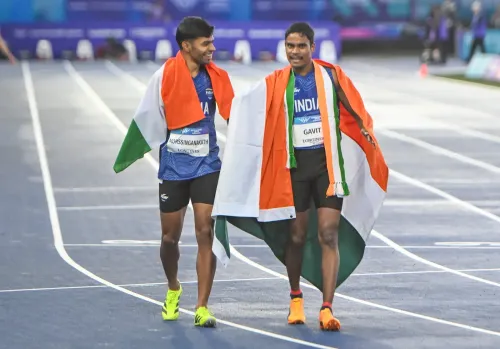
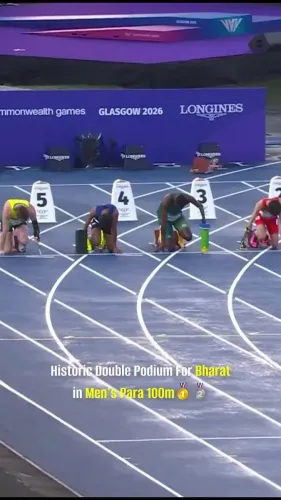
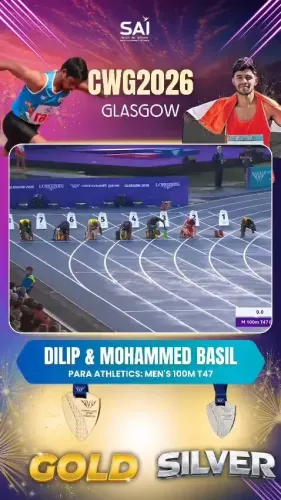
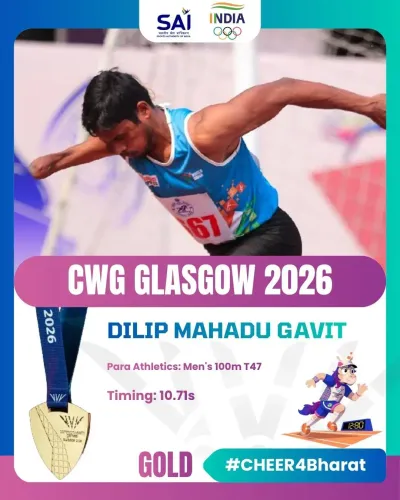
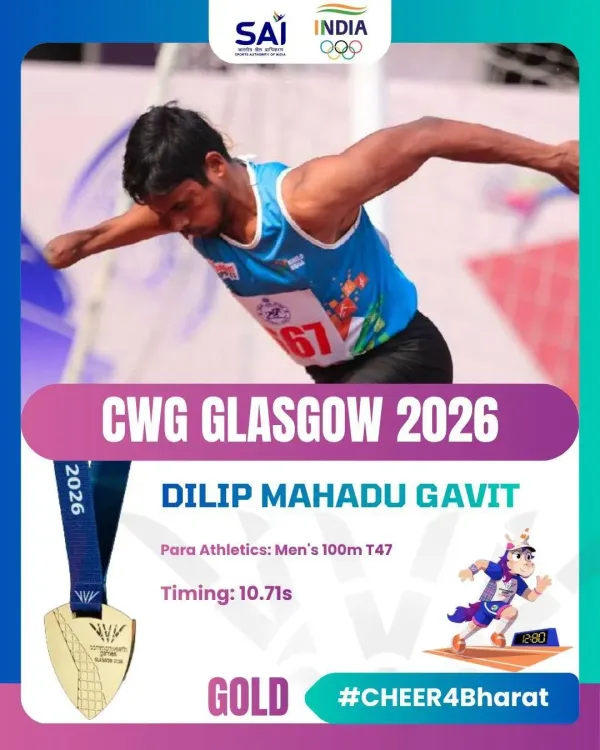
TOPS-supported Dilip Mahadu Gavit clocked a Games-record 10.71 sec to win para-sprint gold at CWG 2026 in Glasgow — the first Indian male to do so — while NCoE Thiruvananthapuram's Mohammad Basil Morsingankath took silver. Union Minister Gajendra Singh Shekhawat celebrated the historic Indian one-two on X.
Key Takeaways
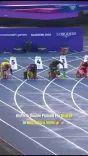
Dilip Mahadu Gavit won para-sprint gold in 10.71 seconds — a Commonwealth Games record and his season-best — at Glasgow 2026 .
Gavit is the first Indian male para-athlete to win gold in para-athletics at the Commonwealth Games and only the second Indian para-athlete overall to achieve this.
Mohammad Basil Morsingankath (NCoE Thiruvananthapuram) took silver in 10.83 seconds , also a season-best, completing an Indian one-two finish.
Gavit is supported by the Target Olympic Podium Scheme (TOPS) , launched in 2014 to provide targeted support to elite medal prospects.
Basil trains at the National Centre of Excellence, Thiruvananthapuram , part of the SAI NCoE network expanded from 2019 onward.
Union Culture and Tourism Minister Gajendra Singh Shekhawat hailed both athletes on X, calling their achievement an inspiration for millions of young and differently-abled Indians.
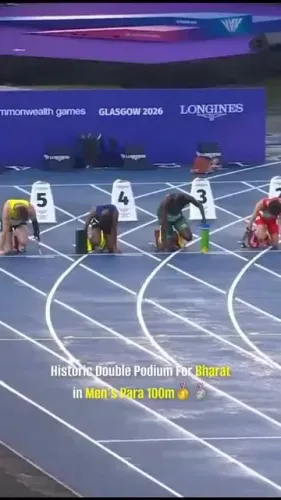
History was made on the Glasgow track on Thursday, 30 July 2026, when Dilip Mahadu Gavit — a Target Olympic Podium Scheme (TOPS)-supported para-sprinter — crossed the line in 10.71 seconds, a Games record and his own season-best, to become the first Indian male para-athlete to win gold in para-athletics at the Commonwealth Games. Union Culture and Tourism Minister Gajendra Singh Shekhawat was among the first to mark the moment, posting a heartfelt tribute on X that also celebrated a stunning silver by Mohammad Basil Morsingankath.
Gavit's 10.71 — a Games record that rewrites Indian para-sprint history
Gavit's winning time of 10.71 seconds did not just earn him gold; it set a new Commonwealth Games record and made him only the second Indian para-athlete ever to win gold in para-athletics at the Games. The milestone underlines how far India's para-sport programme has come since the days of ad-hoc support — Gavit trains under the TOPS framework, which was launched in 2014 to channel targeted coaching, funding, and logistical backing toward athletes with genuine medal prospects at major multi-sport events.
Minister Shekhawat's post noted that the achievement is 'prerna ka srot' (a source of inspiration) for millions of young and differently-abled athletes across India — a sentiment that captures the symbolic weight of a gold that goes beyond the stopwatch.
Basil's silver from Thiruvananthapuram's NCoE track
The Indian celebration doubled when Mohammad Basil Morsingankath — training out of the National Centre of Excellence (NCoE), Thiruvananthapuram — clocked 10.83 seconds, also a personal season-best, to take silver. An Indian one-two finish in a para-sprint final at the Commonwealth Games is unprecedented, and it reflects the quiet infrastructure revolution that the Sports Authority of India has been building since it began expanding the NCoE network from 2019 onward to serve both Olympic and para-athletes under the same high-performance roof.
TOPS, NCoE and the systematic rise of Indian para-sport
The back-stories of both medallists illustrate a deliberate policy shift: India no longer treats para-sport as an afterthought. TOPS — under the Ministry of Youth Affairs and Sports — has progressively included para-athletes alongside their able-bodied counterparts, while the NCoE network provides dedicated coaching environments that were simply unavailable a decade ago. India had already sent its largest-ever para-athletics contingent to the 2022 Birmingham Commonwealth Games; Glasgow 2026 is now delivering on that investment with podium results.
Minister Shekhawat, whose portfolio covers Culture and Tourism rather than Sports, nonetheless amplified the achievement under the #Cheer4Bharat and #CWG2026 banners — a cross-ministerial show of solidarity that has become a visible feature of how the current government communicates major sports wins to a national audience.
Two athletes, two government schemes, one golden morning in Glasgow — and a benchmark for every para-sprinter who lines up next.
Point of View
Scheme-backed excellence — a policy arc running from TOPS (2014) through the NCoE expansion (2019) to the record books in Glasgow. The Indian one-two in a single para-sprint final is precisely the kind of podium cluster the government has been engineering, and it arrives ahead of what will be a politically sensitive Union Budget cycle where sports funding allocations will face scrutiny. Minister Shekhawat's cross-portfolio amplification signals that para-sport wins are now treated as whole-of-government achievements, not just the Sports Ministry's brief. The next test is whether this momentum translates into expanded TOPS slots and NCoE capacity before the 2028 Los Angeles Paralympic cycle.
NationPress
30 Jul 2026
Frequently Asked Questions
Who is Dilip Mahadu Gavit and what did he win at CWG 2026?
Dilip Mahadu Gavit is an Indian para-sprinter supported under the Target Olympic Podium Scheme (TOPS). At the 2026 Commonwealth Games in Glasgow, he won gold in para-athletics with a Games-record time of 10.71 seconds, becoming the first Indian male para-athlete to win gold in para-athletics at the Commonwealth Games.
What is the Target Olympic Podium Scheme (TOPS)?
TOPS is a central government scheme launched in 2014 under the Ministry of Youth Affairs and Sports. It provides financial support, elite coaching, and logistical assistance to Indian athletes who are strong medal prospects at the Olympics and major multi-sport events, including para-athletes.
Who is Mohammad Basil Morsingankath?
Mohammad Basil Morsingankath is an Indian para-sprinter who trains at the National Centre of Excellence (NCoE) in Thiruvananthapuram. He won silver at CWG 2026 Glasgow with a season-best time of 10.83 seconds, completing a historic Indian one-two in the para-sprint final.
What is the National Centre of Excellence (NCoE) in Thiruvananthapuram?
The NCoE Thiruvananthapuram is a high-performance training hub under the Sports Authority of India, part of a network expanded from 2019 onward. It provides dedicated coaching and facilities for both Olympic and para-athletes in athletics and other disciplines.
Why is Gajendra Singh Shekhawat commenting on a sports achievement?
Gajendra Singh Shekhawat is Union Minister of Culture and Tourism, not Sports, but senior ministers across portfolios routinely amplify major Indian sporting achievements on social media as part of cross-ministerial government communication under campaigns like #Cheer4Bharat.