Shekhawat Slams Opposition Over Payment Gateway 'Twist'
Synopsis
Union Culture and Tourism Minister Gajendra Singh Shekhawat used X to accuse opposition parties of deliberately conflating payment gateways with bank accounts, mocking their 'well-educated' self-image. The post adds to a recurring partisan tussle over how India's layered digital-finance architecture is explained and critiqued in public debate.
Key Takeaways
Union Minister Gajendra Singh Shekhawat posted the rebuttal on X on 4 June 2026 .
He accused opposition parties of deliberately conflating payment gateways with bank accounts .
The post mocked the opposition's 'well-educated' self-description without naming a specific party.
Payment gateways are licensed by the RBI under a separate 2020 framework, distinct from bank-account regulation.
No regulatory clarification has been announced in response to the underlying dispute.
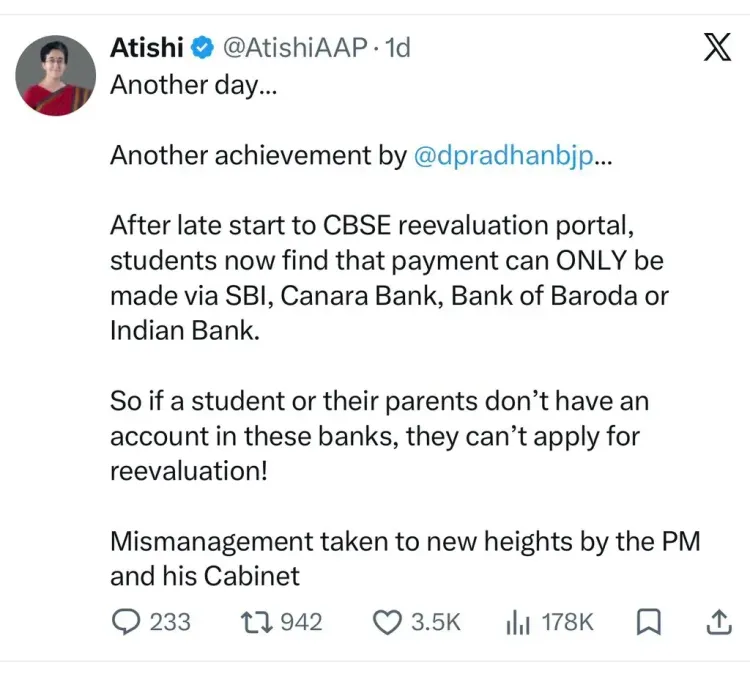
Union Culture and Tourism Minister Gajendra Singh Shekhawat on Thursday, 4 June 2026, took to X to sharply rebuke opposition parties, accusing them of deliberately conflating payment gateways with bank accounts to manufacture a political controversy. The BJP leader and Lok Sabha MP from Jodhpur framed the rebuttal as a swipe at rivals who project themselves as policy-literate.
In his post, Shekhawat wrote: 'So much for the well-educated party. They deliberately twisted payment gateways with bank accounts and called it an issue.' The minister did not name a specific party or spokesperson, but the phrasing echoes a familiar line of BJP attack against opposition figures who position themselves as technocratic critics of government policy.
Context
The post lands amid a recurring partisan tussle over how India's digital-finance architecture is explained in public debate. Payment gateways — the technical intermediaries that route card and UPI transactions between merchants, acquiring banks and customer accounts — are regulated separately from the underlying bank accounts they connect.
Shekhawat's framing suggests that opposition critics blurred this distinction, treating a gateway-level issue as if it were a bank-account-level failure. He offered no technical detail in the post itself, leaving the specific trigger for the rebuttal unspecified.
Policy backdrop
India's payments stack is overseen primarily by the Reserve Bank of India, with the National Payments Corporation of India running rails such as UPI, RuPay and IMPS. Payment aggregators and gateways operate under a separate RBI licensing regime introduced in 2020, which sets capital, governance and settlement-account requirements distinct from those applied to scheduled commercial banks.
That structural separation — gateway as conduit, bank as custodian of funds — is the technical point Shekhawat appears to be defending. Government communicators have, on previous occasions, pushed back against opposition critiques of fintech regulation by arguing that critics elide the layered nature of the system.
Stakeholders and impact
The immediate audience is the opposition bench, whose spokespersons routinely critique the government on regulatory and financial-technology matters. Industry players — payment aggregators, banks and merchant platforms — also track such ministerial statements closely, given how public framing can shape subsequent regulatory clarifications.
For the BJP, the post fits a broader rhetorical pattern of contesting the opposition's claim to technocratic authority. By invoking the 'well-educated' label in scare quotes, Shekhawat is signalling that the government intends to litigate not just the substance of the dispute but the credibility of its critics.
What's next
Opposition spokespersons are likely to respond, either by restating the original critique or by demanding specifics from the minister. A clarification from the RBI or the Finance Ministry on the underlying gateway-versus-account question would settle the technical dispute, though no such statement has been announced.
The exchange underscores how India's digital-finance debate has moved from a narrow regulatory conversation into mainstream political contestation — a shift that will keep ministers, opposition leaders and regulators in a continuous loop of public rebuttal as the payments ecosystem expands.
Point of View
The minister is asserting that critics misread India's layered fintech stack. The exchange reflects how digital-finance regulation has become a live front in partisan combat, with ministers willing to engage in granular rebuttals on X rather than route responses through formal channels. Watch for whether the RBI or Finance Ministry issues any clarifying note.
NationPress
18 Oct 2026
Frequently Asked Questions
What did Gajendra Singh Shekhawat say about payment gateways?
Shekhawat accused opposition parties of deliberately conflating payment gateways with bank accounts and presenting the conflation as a genuine issue. He made the remark in a post on X on 4 June 2026, without naming a specific party.
What is the difference between a payment gateway and a bank account?
A payment gateway is a technical intermediary that routes transaction data between merchants, banks and customers, while a bank account is the actual repository of funds. Gateways are regulated by the RBI under a separate payment-aggregator framework introduced in 2020.
Who regulates payment gateways in India?
The Reserve Bank of India regulates payment gateways and payment aggregators under guidelines first issued in 2020. These rules cover capital requirements, governance and settlement-account norms distinct from those applied to banks.
Which constituency does Gajendra Singh Shekhawat represent?
Gajendra Singh Shekhawat is the Lok Sabha MP from Jodhpur, Rajasthan. He currently serves as the Union Minister of Culture and Tourism.
Has the opposition responded to Shekhawat's post?
No formal response from opposition spokespersons has been recorded at the time of the post. Such exchanges typically draw counter-statements within hours on social media.