Shekhawat meets Punjab Governor Kataria in New Delhi
Synopsis
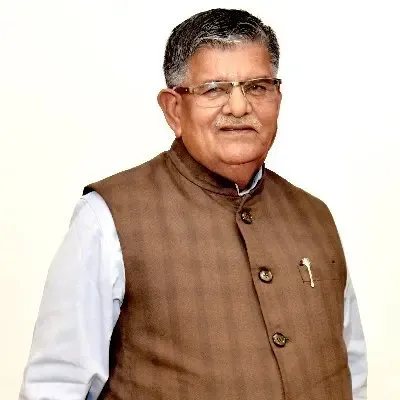
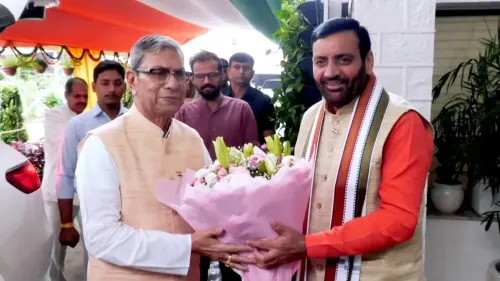
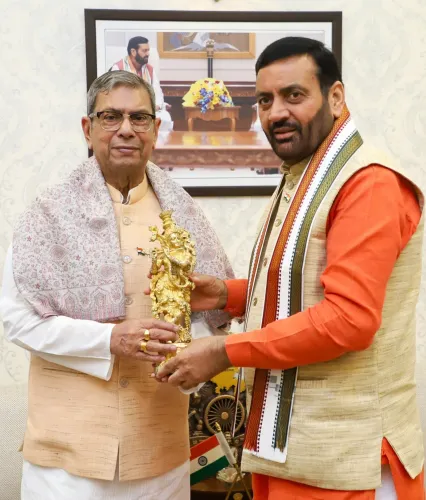
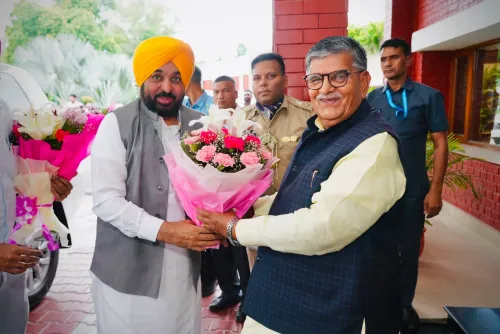
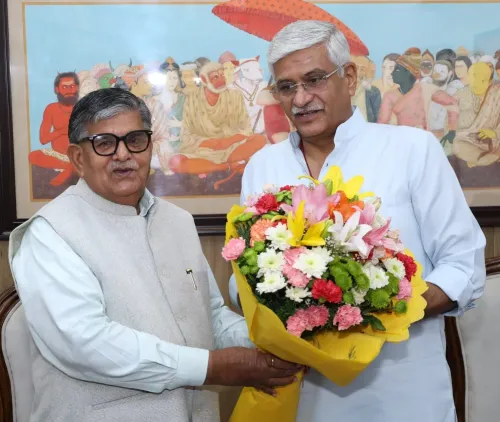
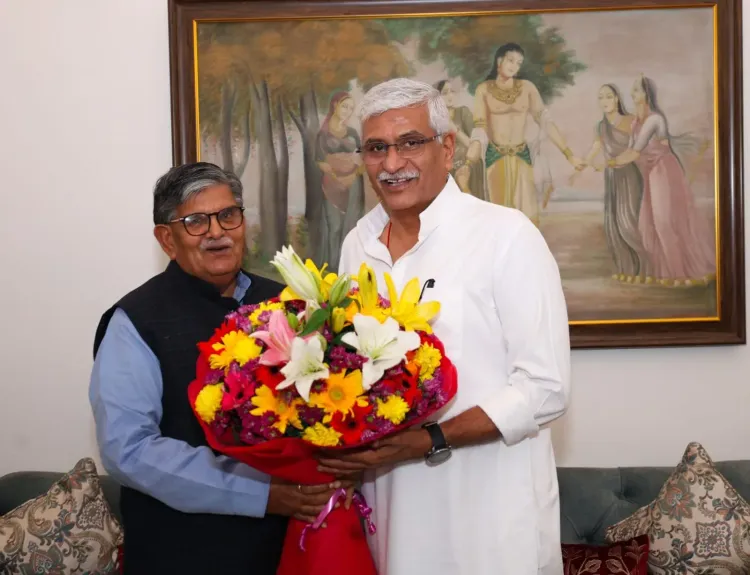
Union Culture and Tourism Minister Gajendra Singh Shekhawat received Punjab Governor and Chandigarh Administrator Gulab Chand Kataria at his New Delhi camp office on 29 September 2026. The two leaders held discussions on 'various subjects,' reflecting routine but substantive federal coordination between a Union minister and a dual-charge constitutional head.
Key Takeaways
Gajendra Singh Shekhawat , Union Minister of Culture and Tourism, hosted Punjab Governor Gulab Chand Kataria at his New Delhi camp office on 29 September 2026 .
Kataria holds a dual charge as Governor of Punjab and Administrator of the Union Territory of Chandigarh , giving the meeting added federal significance.
Both leaders share roots in Rajasthan and the BJP , providing an established political rapport alongside their institutional roles.
The meeting was described as a 'courtesy call' with 'productive discussion on various subjects'; no specific outcomes were disclosed.
Shekhawat's Ministry of Culture and Tourism has potential policy overlap with Punjab and Chandigarh on heritage conservation and tourism circuit development.
A courtesy call in the capital quietly underscored the working rhythms of India's federal machinery. Union Culture and Tourism Minister Gajendra Singh Shekhawat received Punjab Governor and Chandigarh Administrator Gulab Chand Kataria at his New Delhi camp office on Tuesday, 29 September 2026, for a round of discussions spanning 'various subjects.'
Shekhawat shared the news on X, writing in Hindi: 'Aaj Nayi Dilli, camp karyalay mein Punjab ke maanniya Rajyapal evam Chandigarh ke Prashashak Shri Gulab Chand Kataria ji ka shishthachaar bhent ke liye aagaman hua. Unse vibhinn vishyon par saarthak charcha hui.' — 'Today, the honourable Governor of Punjab and Administrator of Chandigarh, Shri Gulab Chand Kataria, visited my New Delhi camp office for a courtesy meeting. We had a productive discussion on various subjects.'
Kataria's dual charge and its federal weight
Gulab Chand Kataria carries a distinctive dual responsibility: he is simultaneously the constitutional head of Punjab — a state with a directly elected government — and the administrator of Chandigarh, the Union Territory that serves as the shared capital of Punjab and Haryana. That combination places him at a unique intersection of state and central authority, making coordination with Union ministers a practical necessity rather than mere protocol.
Kataria is himself a veteran BJP leader, having served in senior capacities in Rajasthan before his gubernatorial appointment — a background he shares with Shekhawat, also a Rajasthan-rooted BJP heavyweight and Lok Sabha MP from Jodhpur. The shared political geography likely adds a layer of ease to their institutional engagement.
Where culture, tourism, and Punjab's heritage connect
Shekhawat's portfolio offers a natural policy bridge to Punjab and Chandigarh. The region is home to UNESCO-listed and centrally protected heritage assets, and the Ministry of Culture and Tourism has been active in pushing state-partnership models for heritage conservation and tourism circuit development. Any follow-up programming between the ministry and the Chandigarh administration — or Punjab's government — on these fronts would flow directly from the kind of groundwork a meeting like this lays.
The specifics of what was discussed remain undisclosed. But in India's administrative calendar, courtesy calls of this nature are rarely purely ceremonial — they tend to surface priorities, clear bottlenecks, and set the agenda for formal follow-through. Watch this space for any joint heritage or tourism announcements tied to Punjab or Chandigarh in the weeks ahead.
Point of View
A state governed by a rival party, where heritage and tourism projects can build goodwill independent of electoral politics. If a joint heritage or tourism initiative follows, this meeting will be seen as the quiet starting pistol.
NationPress
29 Sept 2026
Frequently Asked Questions
Why did Punjab Governor Gulab Chand Kataria meet Gajendra Singh Shekhawat?
Kataria paid a courtesy call on Union Culture and Tourism Minister Shekhawat at his New Delhi camp office on 29 September 2026 to hold discussions on 'various subjects.' Specific topics were not disclosed publicly.
Who is Gulab Chand Kataria?
Gulab Chand Kataria is the Governor of Punjab and Administrator of Chandigarh. A veteran BJP leader, he previously held senior positions in Rajasthan before his gubernatorial appointment.
What is Gajendra Singh Shekhawat's role?
Gajendra Singh Shekhawat is India's Union Minister of Culture and Tourism, a senior BJP leader, and the Lok Sabha MP representing Jodhpur in Rajasthan.
Why does the Punjab Governor also administer Chandigarh?
Chandigarh is a Union Territory that serves as the shared capital of Punjab and Haryana. By convention, the Governor of Punjab is also appointed as the Administrator of Chandigarh, giving the position a dual constitutional role.
Could this meeting lead to any tourism or heritage projects in Punjab or Chandigarh?
Shekhawat's Ministry of Culture and Tourism actively partners with state and UT administrations on heritage conservation and tourism circuits. Analysts note that such courtesy calls often precede formal joint programming, making follow-up announcements possible.